Algeria
 Egypt
 Libya
 Sudan
 Tunisia
 Benin
 Burkina Faso
 Cabo Verde
 Côte d'Ivoire
 Ghana
 Guinea
 Guinea-Bissau
 Liberia
 Mali
 Mauritania
 Niger
 Nigeria
 Senegal
 Sierra Leone
 The Gambia
 Togo
 Cameroon
 Central African Republic
 Chad
 DR Congo
 Equatorial Guinea
 Gabon
 Republic of the Congo
 São Tomé and Príncipe
 Burundi
 Comoros
 Djibouti
 Eritrea
 Ethiopia
 Kenya
 Madagascar
 Malawi
 Mauritius
 Mozambique
 Rwanda
 Seychelles
 Somalia
 South Sudan
 Tanzania
 Uganda
 Angola
 Botswana
 Eswatini
 Lesotho
 Namibia
 South Africa
 Zambia
 Zimbabwe
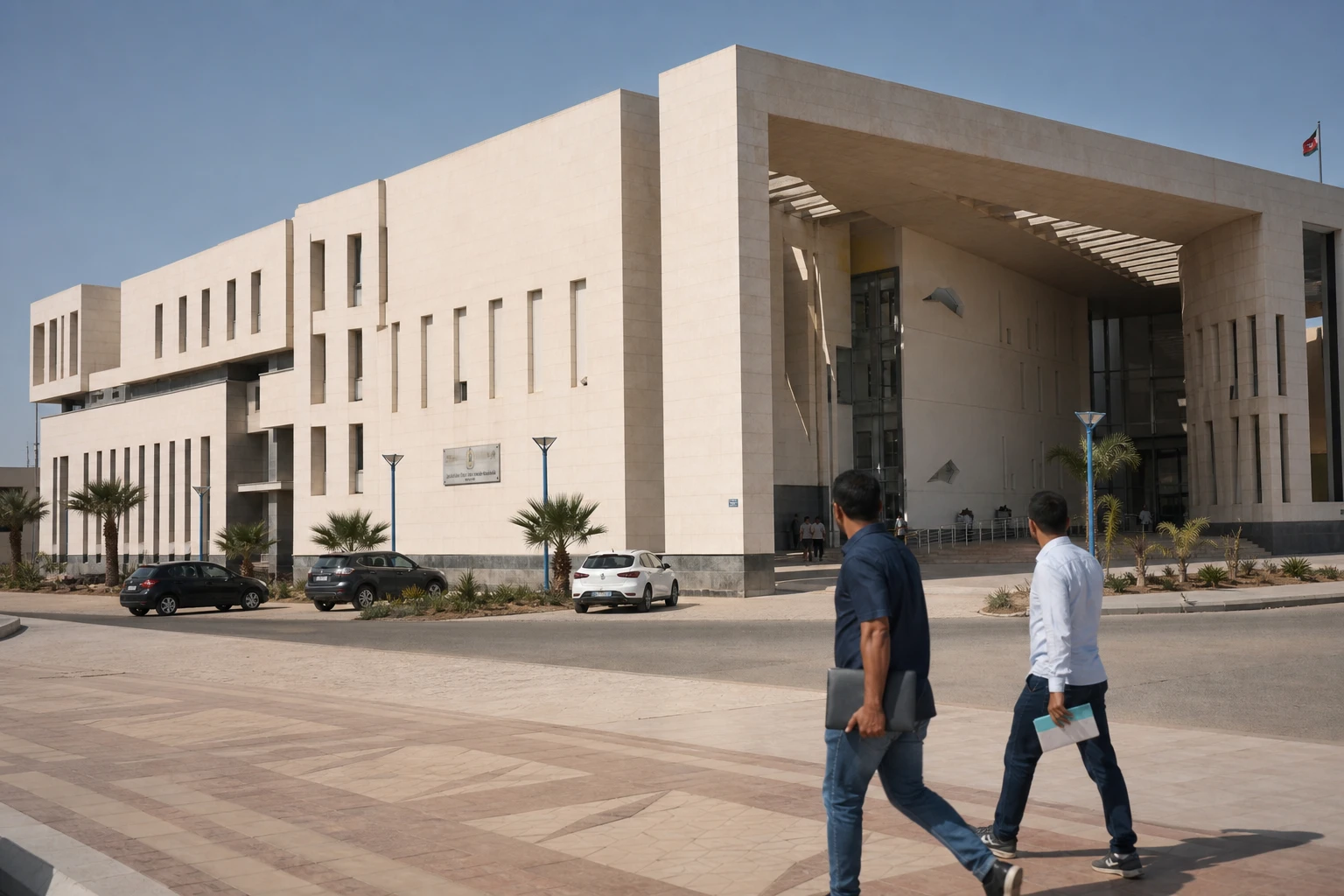
European aircraft land regularly in Dakhla, even as the legal framework for their routes remains contested. Morocco presents the city as a fast-growing tourist and economic destination. The European Union, meanwhile, continues to distinguish Western Sahara from the Kingdom of Morocco in its own law.
A territory with a separate status
Western Sahara has been on the United Nations’ list of Non-Self-Governing Territories since 1963. The UN therefore regards it as a territory whose final status has not been settled. MINURSO, established in 1991, was meant to support a process of self-determination that has never been completed. The United Nations recalls the international status of Western Sahara.
Morocco administers most of the territory de facto and advocates its autonomy plan under Moroccan sovereignty. The Polisario Front, for its part, claims independence for Western Sahara. Since hostilities resumed in November 2020, the issue has also remained a low-intensity armed conflict, despite the absence of a continuous front comparable to those in other wars on the continent.
This situation creates a gap between administrative reality and international legal positions. Rabat manages infrastructure, airports and economic activity in the cities of Dakhla and Laayoune. Yet several international institutions refuse to automatically treat these territories as part of Morocco.
What the EU-Morocco air transport agreement says
The Euro-Mediterranean Aviation Agreement was signed in 2006 between the European Union and the Kingdom of Morocco. It substantially opens up air transport markets between the two sides and sets common rules on traffic rights, competition, safety and passenger rights. The European Commission sets out the terms of the air transport agreement with Morocco.
But the agreement concerns relations between the Union and Morocco. It contains no clause clearly extending its scope to Western Sahara. The European Commission reiterated this in 2026 in response to a parliamentary question about routes between several European cities, Dakhla and Laayoune.
The EU’s reply therefore establishes a limit. It confirms that the EU-Morocco agreement does not cover flights linking a member state with Western Sahara. However, it does not specify what other legal basis allows European airlines to operate these routes.
This point matters. An airline does not simply obtain a landing slot. It also needs traffic rights, national authorisations, a safety framework and insurance cover. When a territory’s status is contested, the legal chain becomes less clear.
Commercial routes are expanding
In practice, traffic is growing. Transavia, part of the Air France-KLM group, has expanded its service to Dakhla from Paris-Orly. For the 2026 summer season, the route is set to operate three times a week, under a partnership with Morocco’s National Tourism Office. Moroccan business media reported the increase in Transavia’s flight frequencies.
Ryanair also serves Dakhla from Spain and the Canary Islands. Binter connects the city with Las Palmas. Royal Air Maroc also operates flights to the destination. These new services support Morocco’s tourism strategy, which aims to make Dakhla a showcase for the “southern provinces”.
For Rabat, the stakes are twofold. The first is to support a destination geared towards water sports, hotels and coastal activities. The second is to strengthen Morocco’s economic and administrative presence in a territory whose sovereignty remains disputed.
The benefits are not evenly distributed. Airlines seek international customers and profitable routes. Hotels, agencies and local tourism operators may benefit from the arrival of visitors. Sahrawi people, however, remain at the centre of a political question that trade or tourism agreements cannot resolve on their own.
European case law complicates the issue
The Court of Justice of the European Union has repeatedly recalled that Western Sahara has a status “separate and distinct” from that of Morocco under EU law. In October 2024, it also ruled that the application of EU agreements to the territory must respect the right to self-determination and obtain the consent of the people of Western Sahara under the conditions set out in international law. The Court of Justice set out its ruling of 4 October 2024.
The case law concerned agricultural and fisheries agreements. It does not automatically amount to a ruling on every commercial flight. It does, however, establish a general principle: an agreement concluded with Morocco cannot be extended to Western Sahara as if the territory’s status raised no questions.
The European Commission refers in part to bilateral agreements concluded between certain member states and Morocco. This shifts the issue to national capitals. It does not, however, resolve the fundamental question: can a bilateral agreement signed with Rabat cover Western Sahara if the EU agreement concluded with the same partner does not clearly cover it?
For now, no European authority has ordered the suspension of the routes concerned. The immediate risk for airlines therefore remains limited. It is not, however, zero. A challenge could target authorisations, public partnerships, compliance with agreements or the way passengers are informed about the destination and its status.
Airspace shared between several authorities
The issue is not limited to landing rights. A significant part of the airspace above Western Sahara falls within the Canary Islands Flight Information Region, known as FIR Canarias. Spanish aeronautical information refers, in particular, to routes and navigation points associated with Dakhla under the coordination of the Canary Islands control centre. ENAIRE’s aeronautical documents describe routes linked to Dakhla.
Operational traffic management does not determine sovereignty over the territory. It does, however, show that several actors are involved: Moroccan authorities for the airport, Spain for part of air traffic control, European airlines for commercial operations and international organisations for navigation standards.
In the event of an incident, this overlap could become sensitive. An accident investigation would depend on the location of the event, the operator’s state, the control authority and the applicable rules. For passengers on a European airline, the usual liability mechanisms would in principle remain available. However, co-ordination between authorities could become more complex if an accident occurred in an area where responsibilities are contested.
A test of EU consistency
The expansion of flights to Dakhla highlights a practical contradiction. The European Union legally distinguishes Western Sahara from Morocco, yet its airlines and national institutions are involved in routes that help integrate Dakhla into Morocco’s tourism network.
For Morocco, each new route strengthens the city’s links with Europe and supports a development strategy for the southern territories. For European institutions, the challenge is to ensure consistency between commercial decisions, neighbourhood policy and the case law of the Court of Justice.
The next step will be as much legal as political. As long as no specific framework sets out the conditions for operating these routes, flights can continue. But every increase in flight frequency will also bring greater visibility to a question Brussels has not yet fully resolved: on what precise legal basis do European aircraft serve a territory that EU law treats separately from Morocco?