
 Algeria
 Egypt
 Libya
 Morocco
 Sudan
 Tunisia
 Benin
 Burkina Faso
 Cabo Verde
 Côte d'Ivoire
 Ghana
 Guinea
 Guinea-Bissau
 Liberia
 Mali
 Mauritania
 Niger
 Nigeria
 Senegal
 Sierra Leone
 The Gambia
 Togo
 Cameroon
 Central African Republic
 Chad
 Equatorial Guinea
 Gabon
 Republic of the Congo
 São Tomé and Príncipe
 Burundi
 Comoros
 Djibouti
 Eritrea
 Ethiopia
 Kenya
 Madagascar
 Malawi
 Mauritius
 Mozambique
 Rwanda
 Seychelles
 Somalia
 South Sudan
 Tanzania
 Uganda
 Angola
 Botswana
 Eswatini
 Lesotho
 Namibia
 South Africa
 Zambia
 Zimbabwe
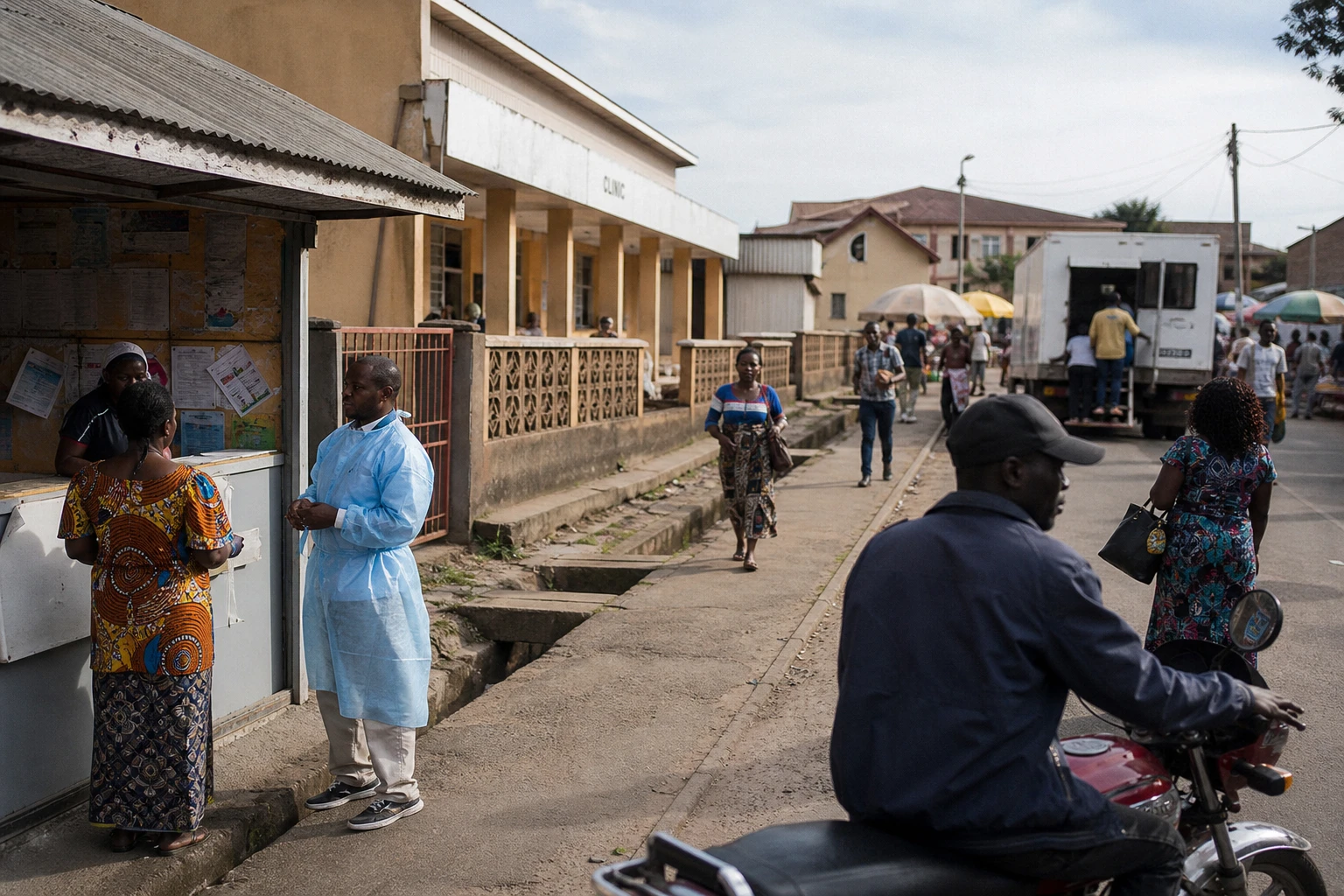
An outbreak disrupting eastern DR Congo
In eastern Democratic Republic of the Congo, a health emergency almost never remains confined to hospitals. It intersects with blocked roads, cross-border markets, families on the move and mistrust that takes hold quickly when information travels more slowly than the virus.
This combination explains why the resurgence of Ebola is once again attracting attention. In early August, data published by the World Health Organization showed an outbreak already described as the largest ever recorded for the Bundibugyo strain, and the second-largest Ebola outbreak in history after the West African outbreak of 2013-2016.
What the available figures show
The figures changed very quickly over the weeks. On 8 June 2026, the WHO reported 550 confirmed cases in the Democratic Republic of the Congo and 101 confirmed deaths. By 15 July, the total had risen to 2,124 confirmed cases and 828 deaths in the country. On 2 August, the outbreak was still expanding, with sustained transmission and a persistently high death toll. The WHO has not yet provided a consolidated total as of 7 August in the information consulted, but it confirms that the outbreak continues to spread.
At the same time, surveillance has shifted towards several eastern provinces. June updates had already shown outbreaks in Ituri, North Kivu and South Kivu, in locations around Bunia, Mongbwalu, Beni, Nyankunde and Miti-Murhesa. This geographical spread makes the response more complex, as teams have to work in different areas with varying levels of access and security risk.
The Bundibugyo strain remains at the centre of concerns. The WHO points out that it is an Ebola virus distinct from the Zaire strain, with its own dynamics. Experts mobilised by the global agency also warn that the response is more difficult when new cases emerge outside already identified chains of contact. This suggests silent transmission in some communities.
Why eastern DR Congo remains vulnerable
The Democratic Republic of the Congo is not just fighting a virus. It has to respond in an environment where insecurity, population displacement and a breakdown in trust hinder contact tracing, patient monitoring and safe burials. In this context, every logistical delay can give the virus a head start.
Yet the response relies on very practical tools. In Kasenyi, on the western shore of Lake Albert in Ituri, a mobile laboratory has been deployed to bring diagnosis closer to border communities. The WHO says results can now be obtained in about an hour, whereas samples previously had to be transported to Bunia, extending confirmation to several hours. This time saving is crucial to isolate a case, protect a family and break a chain of transmission.
The public health challenge is therefore clear. The Congolese authorities have to hold their ground on several fronts at once: healthcare, surveillance, community communication, team safety and cooperation with neighbouring provinces. For residents, the stakes are even more immediate: being tested quickly, receiving prompt care and avoiding the risk of the disease being confused with other common illnesses in the region.
Uganda’s case shows the impact of cross-border movement
Neighbouring Uganda illustrates the same reality, but from a different angle. On 16 July, the WHO said Uganda was entering a 42-day countdown without a new case before it could declare its outbreak over. As of 17 July, the country had recorded 20 confirmed cases and two deaths, including 15 cases imported from the Democratic Republic of the Congo. No new cases had been detected since 21 June.
This improvement does not mean the risk has disappeared. Rather, it shows that in border areas, containing an outbreak depends as much on the speed of diagnosis as on the smooth exchange of information between health services. Movement between Ituri and western Uganda remains frequent for trade, healthcare and family ties. In such an area, the virus can cross a political border without encountering any real epidemiological barrier.
A warning that extends beyond DR Congo
Central and East Africa see this outbreak as a test of regional preparedness. Africa CDC classified the episode as a public health emergency of continental security concern on 18 May 2026, while the WHO also declared it a public health emergency of international concern. These decisions are not symbolic. They pave the way for greater coordination, funding and technical support between neighbouring countries.
The continental message is simple: borders alone do not provide protection, especially in areas where markets, roads and families connect the two shores of the same shared basin every day. A lasting response therefore depends not only on treatment centres. It also relies on surveillance at points of entry, local trust, nearby laboratories and the rapid flow of information between Kinshasa, the eastern provinces and neighbouring capitals.
At this stage, the main question is no longer whether the outbreak deserves attention. It is whether the region’s health systems can turn the technical progress already under way into a lasting barrier against further spread of the virus. The next milestones will be the consolidation of August data, monitoring cross-border cases and the ability to maintain surveillance where fighting and population movements complicate everything.



