Algeria
 Egypt
 Libya
 Morocco
 Sudan
 Tunisia
 Benin
 Burkina Faso
 Cabo Verde
 Côte d'Ivoire
 Ghana
 Guinea
 Guinea-Bissau
 Liberia
 Mali
 Mauritania
 Niger
 Nigeria
 Senegal
 Sierra Leone
 The Gambia
 Togo
 Cameroon
 Central African Republic
 Chad
 Equatorial Guinea
 Gabon
 Republic of the Congo
 São Tomé and Príncipe
 Burundi
 Comoros
 Djibouti
 Eritrea
 Ethiopia
 Kenya
 Madagascar
 Malawi
 Mauritius
 Mozambique
 Rwanda
 Seychelles
 Somalia
 South Sudan
 Tanzania
 Uganda
 Angola
 Botswana
 Eswatini
 Lesotho
 Namibia
 South Africa
 Zambia
 Zimbabwe
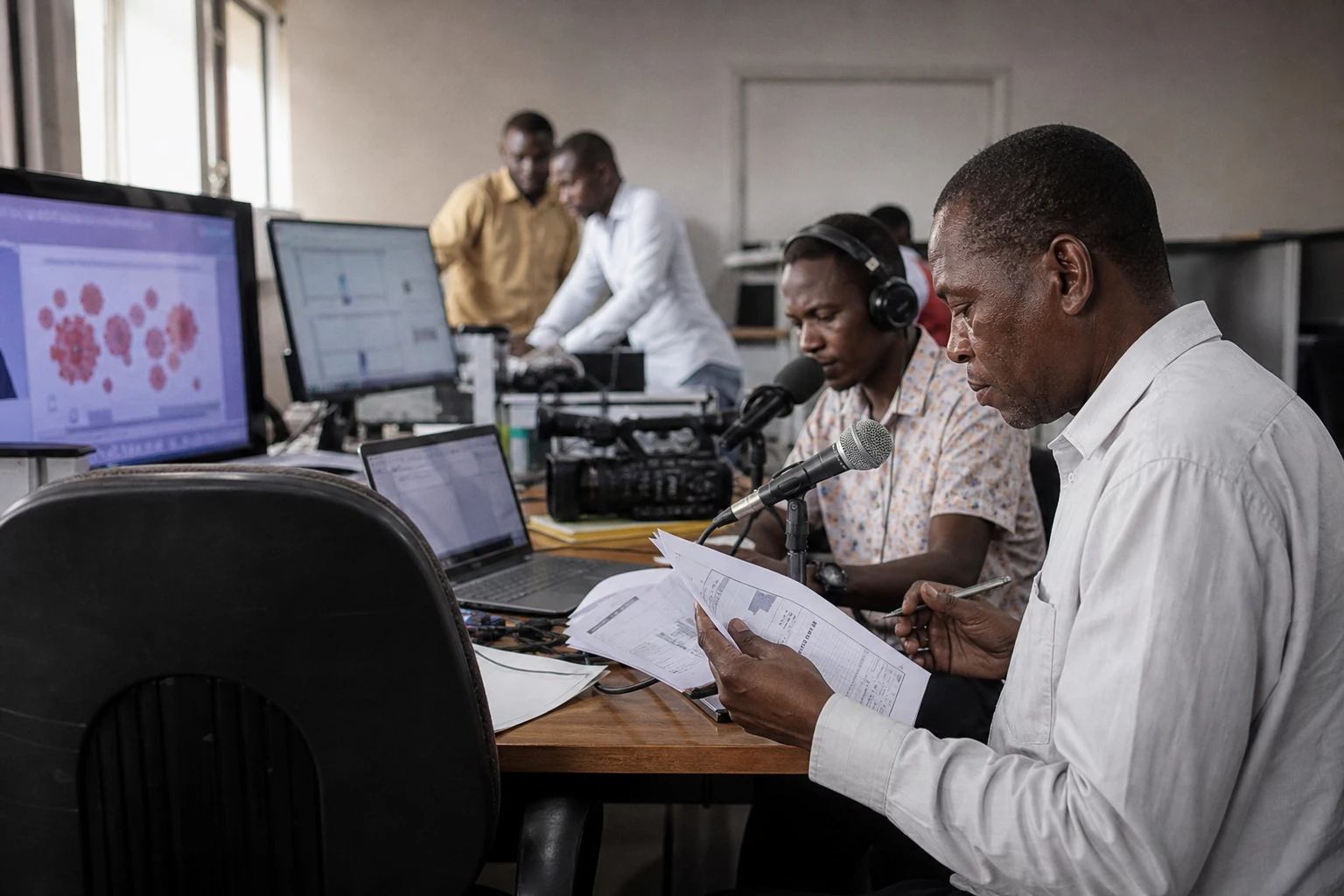
An outbreak spreading beyond Ituri
In Bunia, the question is no longer just how to treat Ebola cases. The challenge is also to hold a public health front line in an area where movement, insecurity and pressure on healthcare facilities complicate every step. In the Democratic Republic of the Congo, the outbreak linked to the Bundibugyo virus has not remained confined to a local hotspot; it has spread to several provinces and already crossed borders, with imported cases reported in Uganda and then Europe.
The picture is stark. According to the WHO’s rapid assessment published on 20 August 2026, the outbreak had reached 4,566 confirmed cases and 2,128 deaths in the DRC by 13 August 2026, with a heavy concentration in Ituri, which has become the epicentre of the crisis. The WHO also says the risk remains “very high” for the DRC and high for neighbouring countries.
What Kinshasa, the WHO and the African Union say
On 15 May 2026, the Congolese Ministry of Health declared the 17th Ebola outbreak in the health zones of Rwampara, Mongbwalu and Bunia, in Ituri. On the same day, Uganda reported an imported case. The WHO later confirmed that the outbreak in the DRC involved the Bundibugyo strain, for which there is no licensed vaccine or specific treatment.
Africa CDC, for its part, declared the outbreak a public health emergency of continental security on 18 May 2026. This is not a symbolic decision. It is a reminder that a health crisis in eastern DRC can quickly become regional, then continental, when trade routes, population movements and vulnerable borders accelerate the spread of the virus.
Congolese authorities and their partners have set up rapid response teams, treatment centres, contact tracing and public awareness activities. But the response remains under pressure, as the affected area combines difficult access, community mistrust and a lack of operational resources. The WHO also stresses community engagement as a prerequisite for controlling the outbreak.
A health response weakened by a lack of tools
The most sensitive issue lies in the nature of the virus. The Ervebo vaccine, used against the Zaire strain, is not licensed for Bundibugyo. The WHO has nevertheless said that members of its technical group recommended prioritising it for a clinical trial in the context of the current outbreak, in order to generate data useful to the response.
At the same time, authorities and partners have had to contend with wider-than-expected transmission. The WHO notes that the outbreak has spread to several provinces, while the case fatality rate observed in its recent assessments remains high. In this type of outbreak, the first victims are often families far from urban centres, followed by frontline health workers exposed through a lack of protection, early diagnosis or passable roads.
Funding matters as much as medical care. When financing is delayed, treatment centres, sample transport logistics and contact tracing become less effective. Africa CDC has also highlighted transport, public gatherings and border crossings as three factors that can turn a local crisis into a regional one.
What this outbreak says about the DRC and Central Africa
This outbreak is a reminder of a familiar reality in Central Africa: public health is shaped not only in laboratories, but also in neighbourhoods, markets, border posts and humanitarian corridors. In the DRC, the east of the country faces both major health needs and enduring security constraints. This helps explain why an Ebola alert can escalate quickly, even when it is issued early.
For Kinshasa, the challenge is twofold. It must protect the affected provinces without creating the impression that the response is being managed solely from the capital. For people in Ituri, the Kivu area and transit zones, the expectation is simple: available care, clear information and a response that treats communities as partners, not as a backdrop to an emergency. Recent experience has shown that mistrust can slow the rise in cases as much as a lack of equipment.
At continental level, the outbreak also raises a broader question about African health sovereignty. The response now involves institutions on the continent, foremost among them Africa CDC, as well as national ministries, regional laboratories and border networks. The next step to watch will be whether the authorities can stabilise Ituri, break the remaining chains of transmission and generate useful clinical data on countermeasures against Bundibugyo.