
 Algeria
 Egypt
 Libya
 Morocco
 Sudan
 Tunisia
 Benin
 Burkina Faso
 Cabo Verde
 Côte d'Ivoire
 Ghana
 Guinea
 Guinea-Bissau
 Liberia
 Mali
 Mauritania
 Niger
 Nigeria
 Senegal
 Sierra Leone
 The Gambia
 Togo
 Cameroon
 Central African Republic
 Chad
 Equatorial Guinea
 Gabon
 Republic of the Congo
 São Tomé and Príncipe
 Burundi
 Comoros
 Djibouti
 Eritrea
 Ethiopia
 Kenya
 Madagascar
 Malawi
 Mauritius
 Mozambique
 Rwanda
 Seychelles
 Somalia
 South Sudan
 Tanzania
 Uganda
 Angola
 Botswana
 Eswatini
 Lesotho
 Namibia
 South Africa
 Zambia
 Zimbabwe
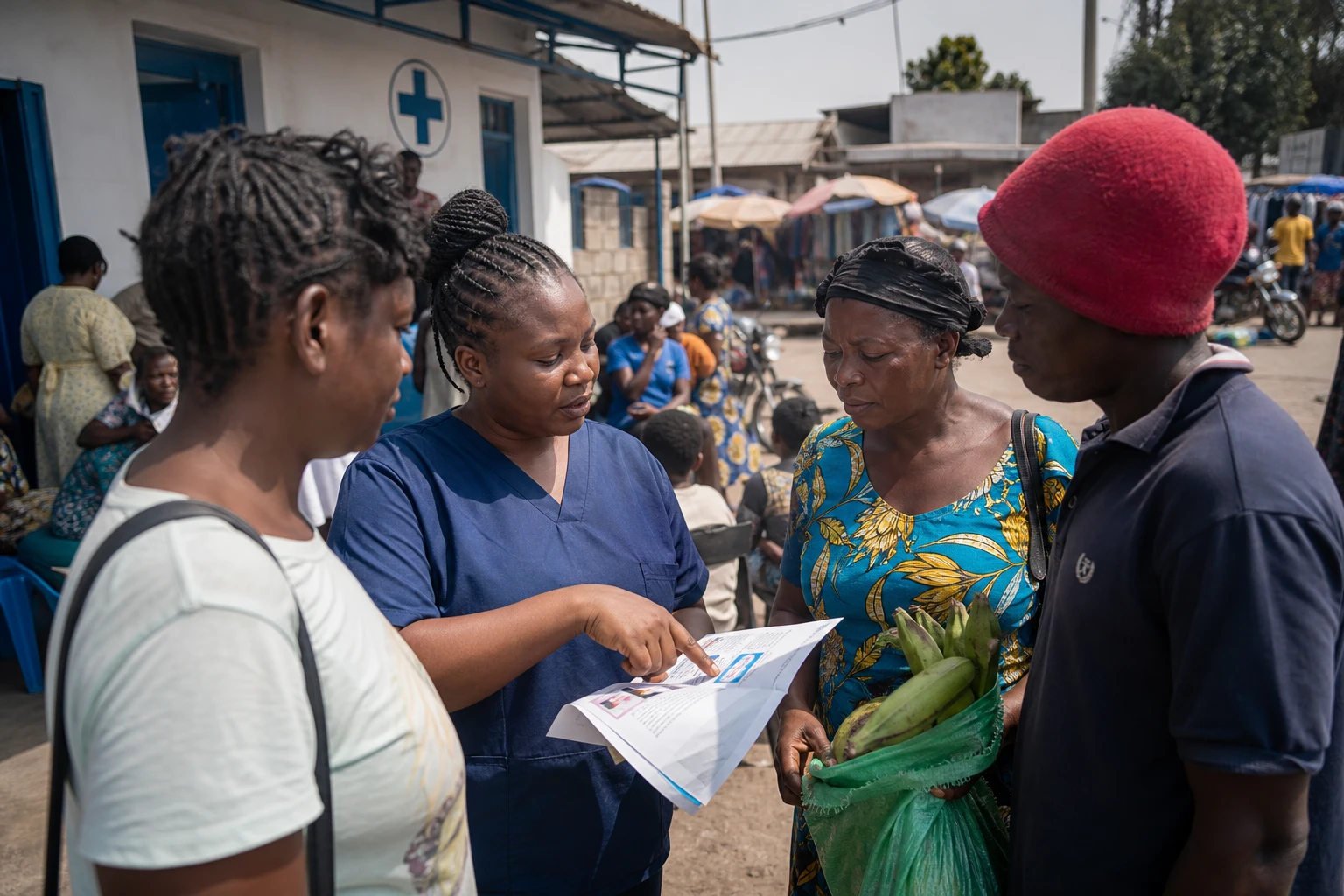
In Ituri, the response to Ebola begins in villages, markets and health centres
In the east of the Democratic Republic of the Congo, the battle against Ebola is not just about numbers. It is also about trust. When health teams arrive too late, or without local partners, the virus gains ground. This is where the fragility of a response is measured: not only in the number of beds available in Bunia, but in communities’ ability to recognise a warning, accept isolation and protect loved ones.
This new outbreak follows a trajectory familiar to Congolese people and health actors in the Great Lakes region. DR Congo has faced several Ebola epidemics since 1976, and the current outbreak, caused by the Bundibugyo virus, was declared on 15 May 2026 in Ituri province, before crossing provincial borders and, at least once, an international border, with a case exported to Uganda. On 17 May 2026, the WHO classified the event as a public health emergency of international concern, underscoring its regional as well as national significance.
A wider outbreak than initially reported, but with a clearly identified driver of transmission
Figures circulating in some raw press reports, including several thousand cases and deaths, do not match the verified data available. As of 15 July 2026, the WHO reported 2,124 confirmed cases in DR Congo, including 828 deaths, with 390 recoveries. Cases were spread across 46 health zones in five provinces: Ituri, North Kivu, South Kivu, Haut-Uele and Tshopo. Ituri remained the epicentre, but the outbreak was no longer confined to one province.
The starting point remains Ituri province in the country’s north-east, where the first signals were detected in Mongbwalu and Rwampara. The INRB in Kinshasa confirmed the Bundibugyo strain, which is distinct from the Zaire strain more often associated with major Ebola outbreaks in DR Congo. This distinction matters. It informs surveillance, vaccination strategy and clinical preparedness, at a time when the WHO says there is still no vaccine or treatment specifically approved for Bundibugyo ebolavirus.
The core response remains a familiar one: contact tracing, early isolation, supportive care, protection for health workers, safe and dignified burials, and local communication. This is precisely where Jean Kaseya, director-general of Africa CDC, has stressed in recent weeks the need to change approach. His assessment echoes lessons already drawn from previous responses in DR Congo: without the involvement of community leaders, survivors, religious figures, women and young people, health messages remain fragile.
The visit to Kinshasa is a reminder of an obvious truth: public health is also decided at the political level
Jean Kaseya’s visit to Ituri, followed by his meeting with President Félix-Antoine Tshisekedi Tshilombo in Kinshasa, is part of this effort to reassert political control. The Congolese presidency has convened a national Ebola task force several times during 2026, evidence that the response has become an issue of health sovereignty as much as a medical matter. In a vast country with fragile transport routes and hard-to-reach health zones, the central government cannot do everything alone. But it remains essential for coordinating, funding and making decisions.
Africa CDC’s role is central here. On 5 June 2026, the continental institution and the WHO launched a joint continental preparedness and response plan for Ebola Bundibugyo, accompanied by a funding appeal for $518 million. This figure says something about the nature of the problem: the response cannot remain confined to Ituri. It must also protect Uganda, South Sudan and, more broadly, the entire Great Lakes region, where trade, humanitarian and family movements remain constant.
The Congolese authorities and their partners have also had to face a more uncomfortable reality: cases may have been underestimated in several areas. As surveillance has been stepped up, the figures have risen rapidly. The WHO noted that the increase observed was partly due to expanded testing and contact tracing. This change does not only mean that the outbreak is worsening. It also means that the system is beginning to see the situation more clearly, which is the minimum requirement for containing a viral outbreak.
Beyond Ituri, a test of African coordination
For DR Congo, this period is a test on several levels. On the health front, it assesses the country’s ability to hold the epidemic line in the east while managing recurring emergencies elsewhere. Politically, it measures Kinshasa’s credibility in leading a unified response between the capital and the provinces. Regionally, it tests whether African health security mechanisms can act quickly, together and with the resources promised.
The continental significance is clear. In recent years, major health emergencies in Africa have stopped at neither administrative nor national borders. They travel along trade routes, with people moving for work, cross-border families and humanitarian corridors. Ebola in DR Congo is therefore a reminder of a simple lesson: African public health is not protected through isolation, but through cooperation, speed and community roots. It is on this front that the Congolese response will now be judged in the coming weeks, in Bunia as well as in Kinshasa.



