
 Algeria
 Egypt
 Libya
 Morocco
 Sudan
 Tunisia
 Benin
 Burkina Faso
 Cabo Verde
 Côte d'Ivoire
 Ghana
 Guinea
 Guinea-Bissau
 Liberia
 Mali
 Mauritania
 Niger
 Nigeria
 Senegal
 Sierra Leone
 The Gambia
 Togo
 Cameroon
 Central African Republic
 Chad
 Equatorial Guinea
 Gabon
 Republic of the Congo
 São Tomé and Príncipe
 Burundi
 Comoros
 Djibouti
 Eritrea
 Ethiopia
 Kenya
 Madagascar
 Malawi
 Mauritius
 Mozambique
 Rwanda
 Seychelles
 Somalia
 South Sudan
 Tanzania
 Uganda
 Angola
 Botswana
 Eswatini
 Lesotho
 Namibia
 South Africa
 Zambia
 Zimbabwe
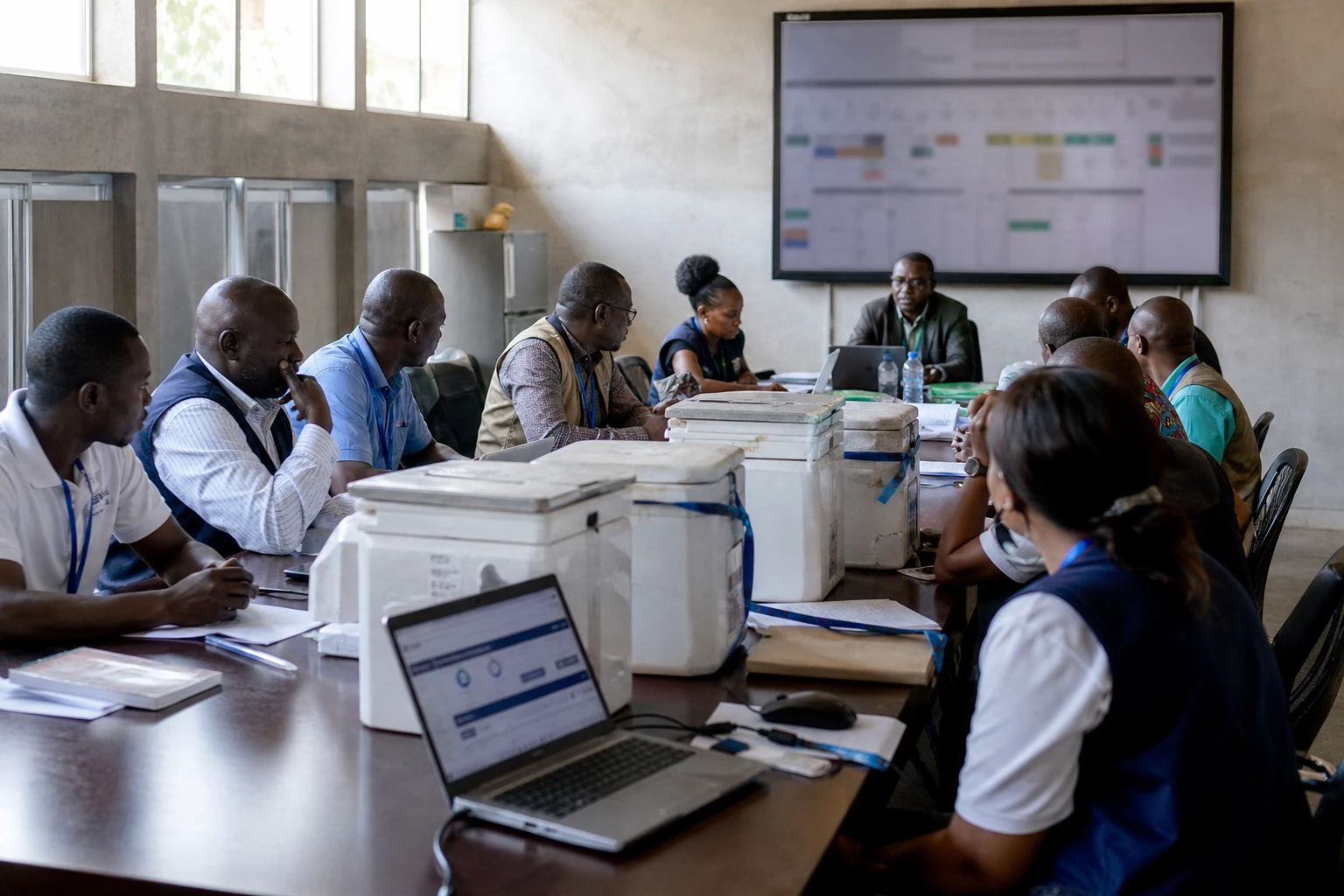
In Bunia, the fight against Ebola is taking place both in health centres and on the hard-to-reach roads of Ituri. Transmission is declining, but has not been halted. In this context, France wants to increase its support for the response led by the authorities of the Democratic Republic of the Congo.
A Congolese response under severe pressure
France’s Minister for Europe and Foreign Affairs, Jean-Noël Barrot, visited Bunia on 3 October 2026. The city, the capital of Ituri, is home to the coordination centre for the response to the epidemic.
On that occasion, he announced his intention to propose new humanitarian funding during upcoming French budget discussions. The announcement supplements commitments Paris has already made to humanitarian aid, medical research and strengthening local capacity.
In an official statement, the minister stressed the need to support the Congolese authorities, healthcare workers, researchers and humanitarian organisations mobilised in the east of the country. He also recalled that surveillance must begin where the virus is circulating, before a chain of transmission reaches more densely populated areas.
Jean-Noël Barrot’s statement in Bunia places the announcement within broader French-Congolese health cooperation. It refers in particular to the PRISME programme, which focuses on epidemic preparedness and response.
Managing the crisis remains, however, first and foremost a Congolese responsibility. National teams are responsible for surveillance, patient care, contact tracing and dialogue with communities. External support can strengthen these efforts, but cannot replace public institutions or local networks.
High figures, transmission still active
According to data released at the end of September 2026, the epidemic had passed the threshold of 8,000 confirmed cases. The death toll was nearing 4,000. About a quarter of the victims are believed to be children, according to figures presented during the French visit.
These figures make this outbreak the deadliest ever recorded in the Democratic Republic of the Congo. They also place it among the most severe Ebola epidemics ever documented worldwide.
Transmission is not concentrated in a single city. It affects several provinces and several dozen health zones. Ituri remains the main reported hotspot. North Kivu is also exposed, owing to population movements and its proximity to major trade routes.
The World Health Organization says delays in identifying cases, deaths in communities and difficulties accessing some areas can prolong chains of transmission. WHO epidemiological bulletins on DR Congo also show the role of isolated health zones and cross-border movements in the dynamics of the disease.
The identified strain, Bundibugyo, adds a scientific challenge. It has been studied less than the Zaire strain, which caused previous major outbreaks in the region. Prevention and treatment tools must therefore be assessed with caution. The authorities and their partners are continuing trials and adapting medical protocols.
The cost of the response plan has risen sharply
The first national response plan was estimated at about $240 million. A revision presented on 4 September 2026 raised requirements to $1.3 billion for a period of 180 days.
This increase does not reflect only the rise in the number of patients. It also reflects the expansion of operations. Surveillance must cover more areas. Teams must arrange the transport of samples, support families, disinfect, provide medical care and communicate with communities.
Security also weighs on the budget. In some areas of the east, health workers cannot move freely. Operations are sometimes suspended or reorganised. Populations living in areas affected by violence, forced displacement or mining activity are particularly difficult to reach.
Needs therefore extend beyond hospitals. They also affect rural health centres, laboratories, transport networks and community health workers. In cities, pressure is being felt by healthcare facilities and markets. In rural areas, it is expressed above all in the distance from services and the difficulty of referring patients.
Several international partners have announced new funding. The United States, World Bank, United Kingdom, Germany, South Korea, Italy, the United Arab Emirates, Japan and Australia are among the contributors cited. France had already allocated €13.4 million to the fight against Ebola between January and July 2026. An additional commitment of $16 million was also announced.
An alert that extends beyond DR Congo’s borders
Ituri shares borders with Uganda and South Sudan. North Kivu borders Rwanda and Uganda. Trade, family visits and the movement of displaced people make a strictly national response impossible.
Uganda has already faced an outbreak linked to the Bundibugyo virus. Even after an epidemic officially ends, reintroduction remains possible as long as the virus is circulating in a neighbouring country. Coordination between health services, points of entry and laboratories is therefore essential.
The Democratic Republic of the Congo is a member of both the East African Community and the Southern African Development Community. These two regional bodies can facilitate information-sharing, the movement of samples and preparedness in neighbouring countries. The African Union and the Africa Centres for Disease Control and Prevention also have a role to play in harmonising alerts.
The next stage will be financial, but above all operational. The authorities will have to turn announcements into rapid disbursements, keep teams in remote areas and preserve the trust of communities. The ability to detect every chain of transmission will determine the epidemic’s actual duration.
In Bunia, the challenge is therefore not simply to contain a virus. It is also to strengthen a health system capable of responding to successive outbreaks, despite insecurity and the vast scale of Congolese territory. A lasting exit from the crisis will depend on this local capacity, supported but not replaced by foreign partners.



