Algeria
 Egypt
 Libya
 Morocco
 Sudan
 Tunisia
 Benin
 Burkina Faso
 Cabo Verde
 Côte d'Ivoire
 Ghana
 Guinea
 Guinea-Bissau
 Liberia
 Mali
 Mauritania
 Niger
 Nigeria
 Senegal
 Sierra Leone
 The Gambia
 Togo
 Cameroon
 Central African Republic
 Chad
 Equatorial Guinea
 Gabon
 Republic of the Congo
 São Tomé and Príncipe
 Burundi
 Comoros
 Djibouti
 Eritrea
 Ethiopia
 Kenya
 Madagascar
 Malawi
 Mauritius
 Mozambique
 Rwanda
 Seychelles
 Somalia
 South Sudan
 Tanzania
 Uganda
 Angola
 Botswana
 Eswatini
 Lesotho
 Namibia
 South Africa
 Zambia
 Zimbabwe
Another warning sign for a closely watched mining sector
In the Democratic Republic of the Congo, cobalt is no longer just an export mineral. It has become a test of sovereignty, traceability and industrial security. When an investigation raises the possibility that uranium was present in shipments bound for China, the entire chain of controls comes under scrutiny, from extraction to the port of departure. The question goes beyond mining technology. It also concerns Kinshasa’s ability to track its strategic minerals all the way to the end customer.
The context helps explain the scale of the issue. DR Congo is at the heart of the global cobalt market, while China dominates much of the refining of metals used in the energy transition. In Kinshasa, the state has already taken a tougher line on the resource, announcing a suspension of exports in February 2025 before moving to quotas and tighter oversight in 2026. The Authority for the Regulation and Control of Strategic Mineral Substances Markets, ARECOMS, and the state-owned General Cobalt Company, EGC, have been placed at the forefront of the system.
What the investigation alleges
On 30 July 2026, a press investigation reignited the debate, alleging that some of the uranium naturally present in minerals from south-eastern Congo may have left the country mixed in with cobalt products bound for China. The issue is sensitive because uranium is an element with significant nuclear value and is subject to far stricter controls than cobalt. According to the information available, the investigation draws on internal documents, testimony and a scientific study published the same day in Nature Communications, which estimates that 2,000 to 5,000 tonnes of uranium may have been exported between 2000 and 2024 in shipments of cobalt hydroxide.
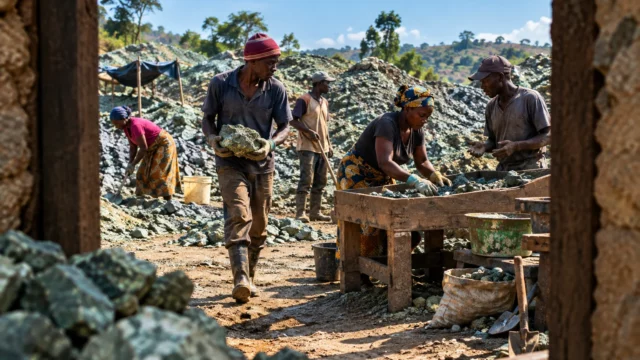
This estimate remains a working hypothesis, not legal proof. The authors themselves say they cannot determine how the uranium was subsequently used. Their approach does, however, recall a long-established geological fact: in the Copperbelt of Greater Katanga, copper, cobalt and uranium are often found in the same formations. DR Congo’s General Atomic Energy Commission also acknowledges that the country has uranium resources and radiological-protection expertise, notably through its facilities in Kinshasa and the former province of Katanga.
The Tenke Fungurume complex, often cited in discussions of Congolese cobalt, remains at the centre of concern because it symbolises the growing influence of Chinese capital in the sector. At the same time, DR Congo is seeking tighter control over its mineral exports. In the summer of 2026, the authorities withdrew unused quotas and tightened customs rules, signalling that the government wants to regain control of a sector long considered too porous.
Traceability, security and local value addition
For Kinshasa, the stakes are not merely radiological. They are economic. If sensitive by-products leave the country without being clearly identified, DR Congo loses some of the value created on its soil and exposes its operators to greater regulatory risk. If, on the other hand, uranium is confirmed in certain flows, that would make the case for tighter controls at export points, radiation detectors and better separation of mineral flows before shipment. The Congolese authorities have already discussed this kind of equipment as part of efforts to control strategic substances and tackle abuses in the sector.
The response from industrial companies also matters. CMOC, a major shareholder in Tenke Fungurume Mining, denies any involvement in uranium extraction or separation and maintains that its products comply with applicable standards. In a case of this kind, a company’s categorical denial is not enough to close the debate; rather, it calls for an independent audit, laboratory data and a documented chain of responsibility. This is precisely where DR Congo’s credibility is at stake, as it seeks to move from being a mere supplier of raw materials to an industrial player capable of controlling its supply chains.
The issue also affects communities in Lualaba and Haut-Katanga, where people live with the tangible consequences of the rush for copper and cobalt. Export revenues primarily benefit the state, major operators and overseas refining chains. Local residents, meanwhile, want credible controls, stable jobs and reduced health risks. The uranium question is therefore no laboratory detail. It adds to a broader set of longstanding concerns: transparency, pollution, mining taxation and the real place of local content in an industry dominated by large international groups.
A Congolese case, but a continental warning
Ultimately, this affair says something broader about Central Africa and the continent as a whole. Africa supplies a decisive share of critical minerals, yet too often remains at the end of the value chain, far from refining, certification and the highest margins. DR Congo is at the forefront of this equation, caught between pressure from China, growing US interest and efforts to capture more value. In this context, the question is not merely whether a shipment was misidentified. It is who really controls Africa’s strategic raw materials, and with what tools.
What happens next will depend on technical verification, but also on the ability of Congolese institutions to enforce robust controls. The quota timetable, forthcoming reports on the cobalt sector and any radiological inspections will show whether this warning leads to lasting reform or becomes another episode of suspicion without follow-up. In any event, Kinshasa now knows that a shipment of cobalt carries more than a metal used in batteries. It may also quietly carry far weightier questions of security and sovereignty.