Algeria
 Egypt
 Libya
 Morocco
 Sudan
 Tunisia
 Benin
 Burkina Faso
 Cabo Verde
 Côte d'Ivoire
 Ghana
 Guinea
 Guinea-Bissau
 Liberia
 Mali
 Mauritania
 Niger
 Nigeria
 Senegal
 Sierra Leone
 The Gambia
 Togo
 Cameroon
 Central African Republic
 Chad
 Equatorial Guinea
 Gabon
 Republic of the Congo
 São Tomé and Príncipe
 Burundi
 Comoros
 Djibouti
 Eritrea
 Ethiopia
 Kenya
 Madagascar
 Malawi
 Mauritius
 Mozambique
 Rwanda
 Seychelles
 Somalia
 South Sudan
 Tanzania
 Uganda
 Angola
 Botswana
 Eswatini
 Lesotho
 Namibia
 South Africa
 Zambia
 Zimbabwe

Between promises of disarmament and a battle of narratives
In Kigali and Kinshasa, the FDLR issue remains a test of credibility. Behind the word “disarmament” lie years of mistrust, armed groups still active in the east of the Democratic Republic of the Congo and a border that continues to weigh on regional security. President Paul Kagame has therefore brought the issue back to the centre of the debate, as the DRC says it is making progress on a protocol relating to the armed group.
The issue goes well beyond an exchange of statements. It touches on Congolese sovereignty, Rwanda’s security and the role of regional mechanisms established in recent months, notably the Washington Agreement and its operational plan, CONOPS, which governs the withdrawal of foreign forces and the neutralisation of the FDLR.
What Kigali and Kinshasa are saying
On Monday 24 August 2026, in Kigali, Paul Kagame said he had heard of no initiative that genuinely addressed the “root causes” of the problem, describing current efforts as superficial, according to a press account made public that day. The Rwandan head of state also said that Rwanda would remain concerned until the issue was resolved. He further judged that sanctions against Kigali were creating new difficulties instead of providing a solution. ([]())
His foreign minister, Olivier Nduhungirehe, had already criticised the protocol announced by Kinshasa on social media, describing it as a political manoeuvre and a delaying tactic. For its part, the Congolese foreign ministry points to the Washington Agreement of 27 June 2025, which Kinshasa presents as a legal basis for the withdrawal of Rwandan forces and the neutralisation of the FDLR. The official Congolese text recalls that CONOPS, endorsed on 31 October 2024 in Luanda, provides the technical framework for the process.
Rwanda sees the matter differently. Kigali has long stressed its security dimension. The Rwandan Demobilisation and Reintegration Commission says it works with former FDLR combatants at centres such as Mutobo, in Musanze, and says it carries out rigorous checks before any reintegration. The same commission also reported on 29 July 2026 that it had sent back to the DRC 32 Congolese who had falsely presented themselves as former FDLR combatants.
Why the issue remains explosive
The FDLR, or Democratic Forces for the Liberation of Rwanda, is an armed group that emerged in the aftermath of the 1994 genocide against the Tutsi. Kigali considers it a direct threat, while Kinshasa regularly accuses Rwanda of fuelling instability in the east of the DRC, notably through its alleged support for the M23, a claim Kigali denies. This mutual suspicion sustains a cycle in which each side demands a prior gesture from the other.
The problem is not confined to diplomacy. In eastern Congo, the presence of armed groups, population displacement and community tensions complicate civilians’ lives, undermine trade and weigh on rural areas as well as urban centres. In several recent communications, the Congolese authorities have presented peace in the east as a project linked to sovereignty, the restoration of state authority and the stabilisation of the country.
Western sanctions add another layer of pressure. On 2 March 2026, the US Treasury sanctioned the Rwanda Defence Force and four senior officials, accusing them of supporting the M23, while the State Department subsequently announced visa restrictions against several Rwandan officials. Washington linked these measures to the implementation of peace commitments in the Great Lakes region. Kigali, for its part, describes them as counterproductive.
The real challenge: making the regional mechanism work
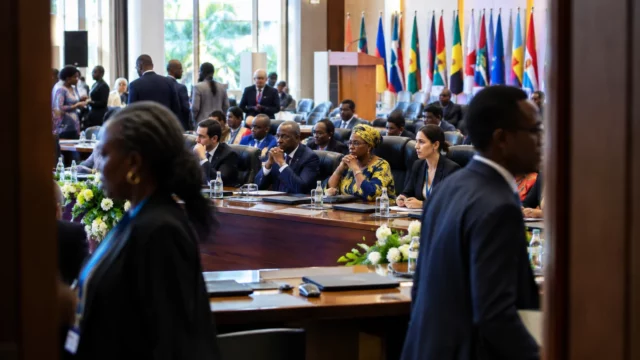
The focus is now on implementation. The Washington Agreement provides for a joint security coordination mechanism, with the United States and Qatar participating as observers, as well as an oversight committee that also includes the African Union. On paper, the mechanism is intended to verify withdrawals, document armed group presence and resolve disagreements. In practice, everything will depend on trust between the parties and their willingness to accept cross-checks.
For the DRC, the challenge is twofold. It must show that a disarmament process can move forward without leaving the ground to groups that continue to operate in North Kivu, South Kivu and neighbouring areas. It must also ensure that a partial protocol is not seen as a way of bypassing the wider agreement. For Rwanda, the challenge is to turn a historical threat into a security issue addressed in concrete terms, rather than through successive announcements.
This phase matters to the entire Great Lakes region. It affects the DRC and Rwanda, as well as the balance with Burundi, Uganda and stabilisation mechanisms backed by international partners. Above all, it shows one simple thing: without a clear timetable, independent verification and credible arrangements for disarmed combatants, peace protocols remain vulnerable to accusations of being a façade. The next test will therefore be less about words than implementation, starting with follow-up meetings and the first verifiable steps under CONOPS.