Algeria
 Egypt
 Libya
 Morocco
 Sudan
 Tunisia
 Benin
 Burkina Faso
 Cabo Verde
 Côte d'Ivoire
 Ghana
 Guinea
 Guinea-Bissau
 Liberia
 Mali
 Mauritania
 Niger
 Nigeria
 Senegal
 Sierra Leone
 The Gambia
 Togo
 Cameroon
 Central African Republic
 Chad
 Equatorial Guinea
 Gabon
 Republic of the Congo
 São Tomé and Príncipe
 Burundi
 Comoros
 Djibouti
 Eritrea
 Ethiopia
 Kenya
 Madagascar
 Malawi
 Mauritius
 Mozambique
 Rwanda
 Seychelles
 Somalia
 South Sudan
 Tanzania
 Uganda
 Angola
 Botswana
 Eswatini
 Lesotho
 Namibia
 South Africa
 Zambia
 Zimbabwe
When the law exists, but land still calls the shots
In the east and south-east of the Democratic Republic of the Congo, Indigenous issues are not limited to a commemorative day. They play out in access to forests, land, education, healthcare and decision-making forums. International Day of the World’s Indigenous Peoples on 9 August is above all a reminder of a simple reality: a law changes nothing if it does not reach chiefdoms, villages, and mining or environmental projects.
In DR Congo, Law No. 22/030 of 15 July 2022 sets out a clear framework for protecting and promoting the rights of Indigenous Pygmy peoples. It recognises, among other things, access to public services, representation in decision-making bodies, free, prior and informed consent, and rights over the land and natural resources they traditionally occupy or use. The law was promulgated in 2022 and published in the Official Gazette on 14 November that year.
A clearer legal framework, but uneven implementation
The core problem lies in the gap between written law and lived reality. Congolese law provides for a special fund, socio-economic development plans, appropriate education and meaningful community participation in any project that affects them directly or indirectly. It also requires particular attention to the political representation of Indigenous Pygmy peoples. But several Congolese organisations and media outlets report that public awareness of the law, its funding and its implementing decrees are progressing slowly.
This is where the issue becomes tangible. In Kalemie, in Tanganyika province, the Kabobo-Luama protected landscape occupies a sensitive area at the intersection of conservation, pastoralism, traditional hunting and forest use. In May 2023, DR Congo’s environment ministry launched a management project for the protected area in Kalemie, in the presence of provincial authorities, confirming the site’s strategic importance. Other sources already describe Kabobo as a wildlife reserve of about 1,500 sq km, established to conserve an ecological complex that also affects local communities.
For Indigenous peoples who depend on the forest, conservation can be a benefit or a constraint, depending on how it is carried out. Congolese law prohibits relocations without free, prior and informed consent, and requires fair and equitable compensation. It also calls for communities to be involved in drawing up and implementing projects. In theory, this safeguard addresses precisely the kind of tension raised around Kabobo-Luama. In practice, local people say they still lack alternative activities, farming or livestock-rearing opportunities when access to certain resources is restricted.
Representation, land and young people: the heart of the issue
The demand is not only about land. It is also political. Article 14 of the law guarantees access to public services and the exercise of political power within decision-making bodies. Article 30 calls for specific measures to promote the representation of Indigenous Pygmy peoples in institutions at every level. This is particularly important in provinces where decisions on land, mines, forests and concessions are made far from the villages affected.
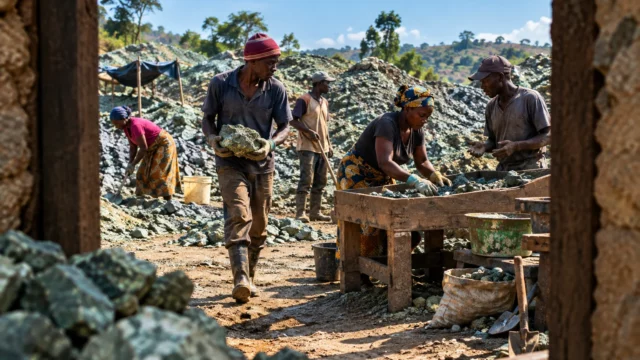
In Tanganyika, this demand carries particular resonance. The province has already been affected by community tensions, notably over land use and the distribution of local power. Civil society groups and Indigenous representatives stress that a merely symbolic presence is not enough. They are calling for lasting integration into the administration, local governance and extractive projects. In Manono, for example, the growth of lithium and mining activity reinforces the idea that a resource can generate wealth without automatically giving neighbouring communities a place at the table.
On the ground, the issue also affects women and children. Congolese law provides for specific policies to strengthen their rights, as well as compulsory, free access to primary and secondary education and vocational training in public institutions. It also provides for action against prejudice and positive communication about Indigenous Pygmy peoples. This is essential in a country where social exclusion is often passed on through absent schools, unsuitable languages and fear of discrimination in dealings with the authorities.
What Central Africa sees in the Congolese case
The issue in DR Congo extends beyond the country. In the Congo Basin, Indigenous peoples are at the centre of a continent-wide debate about forests, climate and development models. UN instruments stress that implementing Indigenous rights is not an optional moral extra, but a condition for sustainability. In this part of Central Africa, conservation, the mining transition and the fight against deforestation cannot make lasting progress without credible consultation and redress mechanisms.
DR Congo is also part of a regional environment in which resource governance weighs on social stability. Between SADC, of which the country is a member, cooperation around Lake Tanganyika and the climate dynamics of the Congo Basin, the way Kinshasa applies its law on Indigenous peoples will be watched far beyond its borders. The next milestones are not only legal. They are administrative, budgetary and local: implementing decrees, a special fund, representation in institutions and regulation of projects affecting Indigenous lands.
In the Democratic Republic of the Congo, the Indigenous issue is therefore no longer about the absence of a framework. It is about the credibility of the state in honouring its own commitments. The law exists. So do expectations. The decisive question remains: who, in the provinces and in Kinshasa, will finally turn this text into visible rights, monitored budgets and a real presence in public decision-making?