
 Algeria
 Egypt
 Libya
 Morocco
 Sudan
 Tunisia
 Benin
 Burkina Faso
 Cabo Verde
 Côte d'Ivoire
 Ghana
 Guinea
 Guinea-Bissau
 Liberia
 Mali
 Mauritania
 Niger
 Nigeria
 Senegal
 Sierra Leone
 The Gambia
 Togo
 Cameroon
 Central African Republic
 Chad
 Equatorial Guinea
 Gabon
 Republic of the Congo
 São Tomé and Príncipe
 Burundi
 Comoros
 Djibouti
 Eritrea
 Ethiopia
 Kenya
 Madagascar
 Malawi
 Mauritius
 Mozambique
 Rwanda
 Seychelles
 Somalia
 South Sudan
 Tanzania
 Uganda
 Angola
 Botswana
 Eswatini
 Lesotho
 Namibia
 South Africa
 Zambia
 Zimbabwe
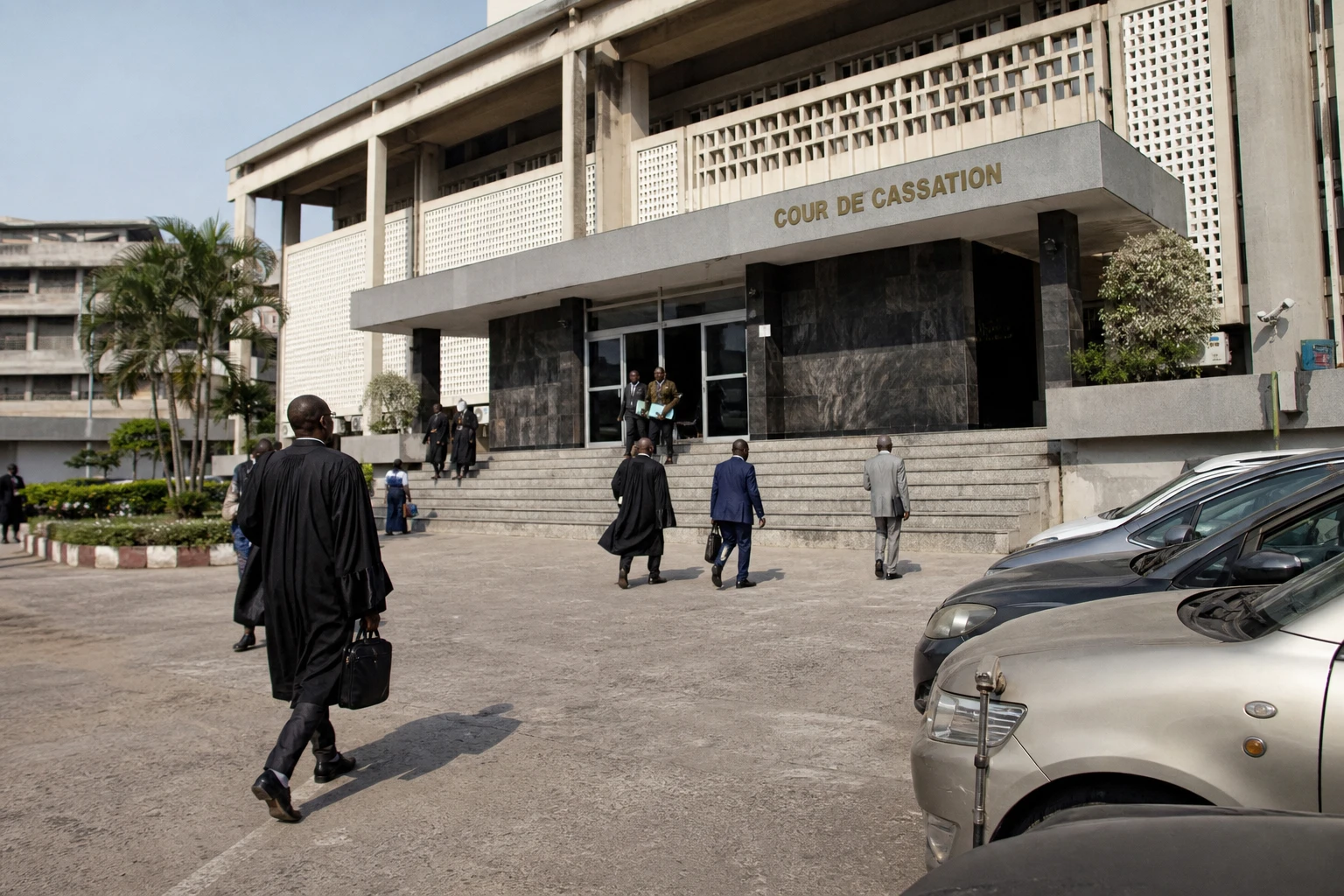
In Kinshasa, a verdict that goes beyond the fate of two men
In the Democratic Republic of the Congo, some legal cases say more than the matter they judge. The FRIVAO case touches on a simple but decisive question: how does the state protect money promised to victims when the funds themselves become a target? In Kinshasa, the justice system’s response took the form of a heavy sentence, at a time when the credibility of reparation mechanisms remains under scrutiny.
The verdict was delivered on Friday 18 September 2026 by the Court of Cassation, the highest Congolese court for appeals in civil and criminal cases. Constant Mutamba, a former justice minister, was sentenced to ten years of hard labour for embezzlement of public funds. His co-defendant, Chançard Bolukola Osony, former acting coordinator of FRIVAO, received seven years of hard labour for embezzlement and money laundering. The court also ordered their exclusion from public and para-public office, as well as the loss of their voting rights and eligibility for office for five years after serving their sentences.
FRIVAO, a promise of reparation at the heart of a sensitive case
FRIVAO, the Fund for the Repair and Compensation of Victims of Uganda’s Illicit Activities in the DRC, was designed to turn an international ruling into concrete reparation. In February 2022, the International Court of Justice set the total amount owed by Uganda to the DRC at $325 million, payable in five annual instalments of $65 million. The sum was intended to address the damage caused on Congolese territory by the violations identified by the court.
In this context, every dollar in FRIVAO carries particular political and social weight. It is not just a public account: it symbolises reparation long awaited by families, communities and individuals who have suffered harm linked to violence and armed occupations in the east of the country. When such a fund falters, it is not just the treasury that comes under question. It is the state’s word.
What the court found
The case examined in Kinshasa involved several financial transactions that the prosecution described as irregular. The prosecutor cited, in particular, $14.3 million paid to Congo Energy, $4 million allocated to the Congolese Institute for Nature Conservation, $200,000 for the Tshopo Provincial Assembly, more than $1 million paid to Divo SARL and more than $700,000 for Tropic Architecture. The defence had challenged the proceedings and alleged several irregularities, but the court ultimately found both defendants criminally liable.
On 19 August 2026, the public prosecutor had sought 15 years of hard labour for each of the accused. The verdict delivered on 18 September is therefore less severe than the sentences sought, but confirms the gravity of the offences in the court’s eyes. The judicial timetable also shifted: the ruling, initially expected in early September, had been postponed to 18 September by the Higher Council of the Judiciary.
Beyond the sentences, the fight for reparation
The Court of Cassation also ordered the sums identified in the case to be returned to the FRIVAO account. This civil dimension matters as much as the criminal penalty. It aims to return the money to its original purpose: helping victims. In a country where trust in public spending channels remains fragile, the decision seeks to re-establish a dividing line between reparation and the capture of resources.
For Congolese people, the stakes are twofold. On the one hand, the justice system has shown that it can prosecute a former minister, sending a signal of institutional authority. On the other, potential recipients of reparations are waiting for something very concrete: for the promised funds to actually reach victims. In an economy where a large share of transactions remains informal and access to public services varies widely between provinces, each compensation mechanism also serves as a test of the state’s presence.
The case also highlights a sensitive issue in Congolese governance: funds linked to international disputes can become arenas of competition between political imperatives, social needs and opportunities for predation. When the DRC implements reparations arising from a ruling by the International Court of Justice, it is not just managing a budget line. It is managing a symbol of legal sovereignty and reparative justice.
A Congolese case with regional resonance
Regionally, the case goes beyond a straightforward corruption trial. It points to the legacy of wars of intervention in the Great Lakes region and the difficulty for the states concerned of turning international rulings into tangible reparations. It also serves as a reminder that in Central Africa and East Africa, justice is played out not only in national courts, but also in relations between states, regional organisations and international institutions.
For Kinshasa, the episode comes at a time when the executive, magistrates and oversight bodies are under close scrutiny. For the African Union and African courts seeking to strengthen trust in the rule of law, the message is clear: reparation is credible only if its management is traceable. What happens next will depend on the ability of Congolese institutions to safeguard FRIVAO, clarify disbursement channels and prevent victims’ reparation from once again becoming an administrative battleground.



