Algeria
 Egypt
 Libya
 Morocco
 Sudan
 Tunisia
 Benin
 Burkina Faso
 Cabo Verde
 Côte d'Ivoire
 Ghana
 Guinea
 Guinea-Bissau
 Liberia
 Mali
 Mauritania
 Niger
 Nigeria
 Senegal
 Sierra Leone
 The Gambia
 Togo
 Cameroon
 Central African Republic
 Chad
 Equatorial Guinea
 Gabon
 Republic of the Congo
 São Tomé and Príncipe
 Burundi
 Comoros
 Djibouti
 Eritrea
 Ethiopia
 Kenya
 Madagascar
 Malawi
 Mauritius
 Mozambique
 Rwanda
 Seychelles
 Somalia
 South Sudan
 Tanzania
 Uganda
 Angola
 Botswana
 Eswatini
 Lesotho
 Namibia
 South Africa
 Zambia
 Zimbabwe
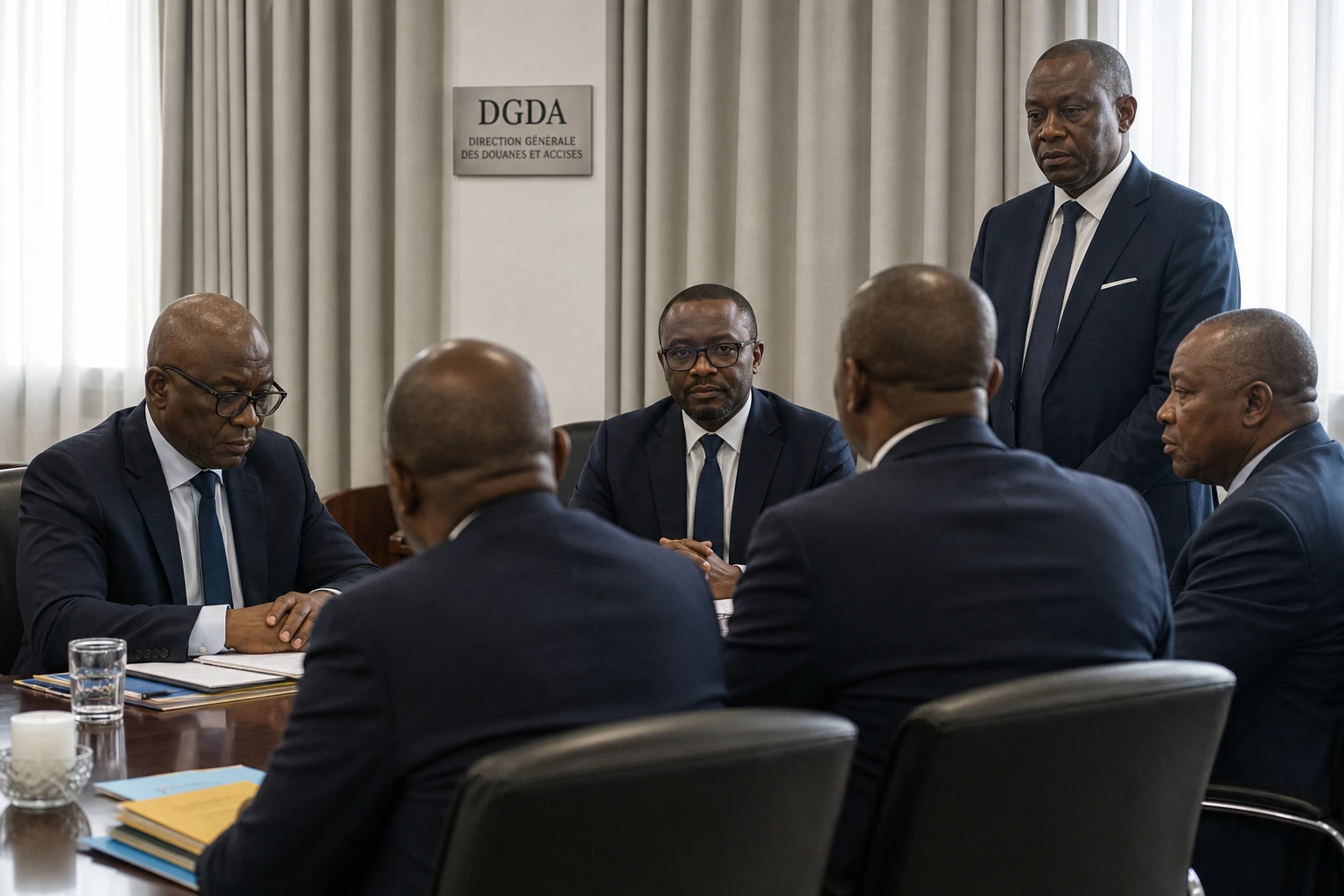
When customs exceed their target, the whole budget can breathe easier
In Kinshasa, one good month for revenue does not solve everything. But it says a great deal about the true state of Congolese public finances, especially when the state’s cash position still depends heavily on agencies that collect duties on goods, services and products consumed in the country. In the Democratic Republic of the Congo, customs remains one of the most sensitive barometers of the state’s ability to finance itself from its own resources.
The context is an ambitious 2026 fiscal year. The budget law currently in force set the state budget at 54,335.7 billion Congolese francs, or about US$22 billion, with an official trajectory aimed at gradually raising the tax burden over several years. The Budget Ministry presents this increase as a way to reduce dependence on external financing and give the government more room to act.
What the DGDA announced
On 1 August 2026, the Directorate General of Customs and Excise Duties said it had collected 804.28 billion Congolese francs in revenue by the end of July. The agency also said it had reached 123.07% of its monthly target. At the exchange rate used in the announcement, this amount corresponds to US$352.96 million.
This result is no minor matter. In June 2026, customs and excise revenue estimated by the Central Bank of the Congo had already reached 723.0 billion Congolese francs, against 613.9 billion expected, a realisation rate of 118%. A month earlier, as of 26 June, it stood at 517.2 billion Congolese francs, according to another economic update cited by the Congolese press. July’s increase is therefore part of a sustained trend, rather than a simple, isolated surge.
In its announcement, the DGDA did not give a breakdown between customs duties and excise duties. The political signal, however, is clear: the revenue agency exceeded its monthly target as the Congolese state seeks to capture more trade flows and secure its ordinary revenue. In Congolese budget terminology, current revenue includes, among others, the DGDA, the Directorate General of Taxes and the Directorate General of Administrative, State Property and Participation Revenue.
Why this performance matters beyond the figure
For the executive, such an overperformance is useful on several levels. First, it improves cash-flow visibility in a country where public spending is constrained by high needs, constant trade-offs and significant exposure to fluctuations in the Congolese franc. It also bolsters the authorities’ message of budgetary sovereignty: collecting more revenue at home also means reducing reliance on external support and emergency financing. The Central Bank of the Congo has, in recent publications, highlighted the desire to stabilise the macroeconomic framework and support the Congolese franc.
But the benefits for the public are not automatic. Higher customs revenue can result from increased imports, better monitoring of trade flows, reduced leakage or tighter controls at the border and port. Depending on how it is achieved, the result may either widen the state’s fiscal space or increase costs for businesses, particularly in sectors heavily dependent on imported goods. In DR Congo, the effects differ for large formal companies, urban market traders and small importers operating on slim margins.
The government has also launched several reforms to tighten control of the revenue chain. In recent months, the Finance Ministry has highlighted the modernisation of financial administrations, the digitalisation of some services, reform of the Treasury Single Account and the construction of the DGDA’s new headquarters in Kinshasa, officially launched on 3 June 2026. In this sequence, July’s performance serves as a measure of effectiveness: reform only counts if it translates into money actually collected.
A signal to watch for DR Congo and the region
DR Congo does not operate in isolation. Its customs and budget policy must also be viewed in the context of the Southern African Development Community, or SADC, of which the country is a member, and its trade with neighbours in Central and East Africa. Rising customs revenue may reflect better integration of formal trade. But it may also signal pressure on import prices, customs-clearance times or the movement of goods across borders.
The continental significance is the same as for many African countries undertaking budget reforms: the challenge is not simply to collect more, but to collect better. For Kinshasa, the real question now is whether the trend will last. One strong month is not enough to establish a pattern. It remains to be seen whether the DGDA can maintain the pace until the Central Bank of the Congo’s next economic update, whether other revenue agencies follow suit, and whether the Treasury turns this revenue into spending that is more predictable, traceable and useful.
For now, the message is straightforward: Congolese customs revenue can still deliver rapid gains when the administration tightens controls and captures trade flows more effectively. The question is whether this temporary improvement heralds a lasting increase in performance or is simply a good month in a fiscal year still under pressure.