Algeria
 Egypt
 Libya
 Morocco
 Sudan
 Tunisia
 Benin
 Burkina Faso
 Cabo Verde
 Côte d'Ivoire
 Ghana
 Guinea
 Guinea-Bissau
 Liberia
 Mali
 Mauritania
 Niger
 Nigeria
 Senegal
 Sierra Leone
 The Gambia
 Togo
 Cameroon
 Central African Republic
 Chad
 Equatorial Guinea
 Gabon
 Republic of the Congo
 São Tomé and Príncipe
 Burundi
 Comoros
 Djibouti
 Eritrea
 Ethiopia
 Kenya
 Madagascar
 Malawi
 Mauritius
 Mozambique
 Rwanda
 Seychelles
 Somalia
 South Sudan
 Tanzania
 Uganda
 Angola
 Botswana
 Eswatini
 Lesotho
 Namibia
 South Africa
 Zambia
 Zimbabwe
A comparison that mainly serves political debate
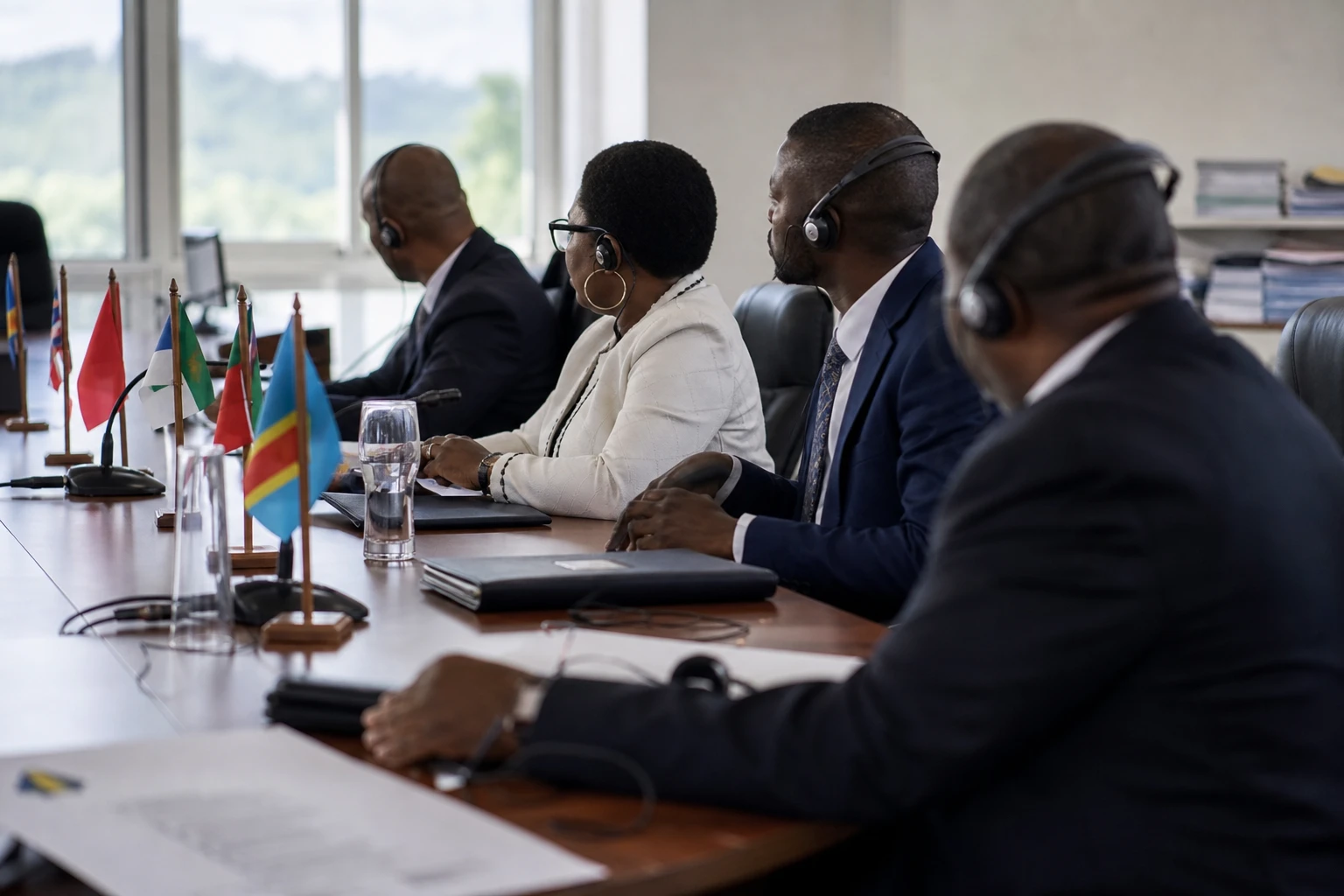
In Kinshasa, constitutional revision is never discussed in a vacuum. It touches on the duration of political power, the balance between institutions and the already fragile trust between the ruling majority, opposition and civil society. In a country where security crises in the east weigh on everything else, every argument put forward to justify reform immediately becomes a political marker.
It was in this climate that the recent amendment to the fundamental law of the State of the Vatican City was seized upon by a member of the Union sacrée de la nation, the platform backing President Félix Tshisekedi. The idea was simple: if the Vatican could revise its basic law, then the Democratic Republic of the Congo could open up its own, too. But this comparison overlooks one essential point: the Vatican is a theocratic microstate in which the sovereign pontiff concentrates legislative, executive and judicial powers, whereas DR Congo is a constitutional republic founded on the separation of powers.
In other words, two texts can be revised without the two systems being comparable. This is where political argument takes precedence over legal analysis. In the Congolese case, the question is not simply whether a Constitution can evolve. It is under what conditions, with what consensus and for what institutional purpose.
DR Congo’s Constitution provides for revision, but tightly circumscribes the debate
The Congolese fundamental law does not prohibit all amendments. It does, however, set out a specific procedure in Articles 218 to 220. Revision may be pursued through Parliament or by referendum, depending on the circumstances. Above all, several elements cannot be called into question, including the republican form of the state, universal suffrage, the representative form of government, the number and duration of presidential terms, the independence of the judiciary, and political and trade union pluralism.
This detail matters because it places the current debate in a politically sensitive area. As early as October 2024, Félix Tshisekedi had announced that he wanted to open a discussion on the Constitution, arguing that some of the constraints inherited from the 2006 text deserved to be reassessed. Since then, the issue has resurfaced in successive waves of government rhetoric, alongside the argument that a text adopted at the end of a war may no longer meet the institutional needs of 2026.
For his opponents, the problem lies elsewhere. In DR Congo, any discussion of the Constitution is immediately viewed through the lens of the political calendar. Félix Tshisekedi’s second term runs until 2028. As that date approaches, opponents fear that a debate presented as technical may in reality be intended to prepare a tightening of control over the presidential contest or to reshape the rules of the game ahead of the election.
The Vatican is not a precedent that can be applied to DR Congo
The reference to the Vatican is legally weak, even if politically astute. The Vatican’s new fundamental law, published in 2023, explicitly states that the sovereign pontiff holds the fullness of governing power. In 2026, Leo XIV also amended this framework by motu proprio, confirming that decision-making in the Vatican stems from a very particular institutional structure centred on the authority of the head of the Catholic Church.
But DR Congo is neither a religious state nor a theocratic elective monarchy. In a republican system, the Constitution organises political competition, guarantees fundamental rights and sets limits on power. This is precisely why opponents consider any comparison with a 44-hectare microstate misleading: it was created to guarantee the independence of the Holy See, not to arbitrate democratic transfers of power in a large continental country.
This nuance explains the reservations of the National Episcopal Conference of Congo. Meeting in Kinshasa in March 2026, CENCO said that opening a constitutional process in the current security context would be “risky”. The Congolese Catholic Church does not dispute the principle of revision in itself. It objects to the timing, the climate and the absence of what it considers a sufficiently broad consensus.
A constitutional debate burdened by war in the east and political divisions
The context explains much. In the east, war and population displacement remain major drivers of disruption. The United Nations says the conflict involving AFC/M23 continues to fuel insecurity, violence against civilians and new population movements. The Security Council again condemned M23 offensives in 2025, while the African Union is following ceasefire mechanisms and ongoing talks.
In this context, the constitutional question affects more than Kinshasa’s legal experts. It has implications for the credibility of the electoral calendar, the state’s ability to organise a calm national debate and citizens’ trust in institutions. A revision perceived as rushed could further weaken relations between the capital and the provinces, between central government and social forces, and between political leaders and ordinary voters.
The divisions are clear. The presidential majority presents reform as a tool for adaptation. The opposition sees it as a manoeuvre to extend political power. Civil society and part of the Church are calling for broader dialogue before any decision. This opposition is no longer confined to the traditional parties. It has organised itself into a coalition, the C64, to defend the constitutional order and make any political discussion conditional on a clear renunciation of the plan to change the fundamental law.
What this episode says about DR Congo and the region
Ultimately, the Congolese debate extends far beyond the Vatican. It raises questions about how a major African democracy, engaged both in the East African Community and SADC, arbitrates its own rules of the game amid a regional security crisis. The issue is not merely constitutional. It is institutional, political and continental. A poorly explained reform in DR Congo could fuel, beyond Kinshasa, the recurring suspicion that African constitutions change too often in response to shifting balances of power.
Conversely, a debate conducted by the book, with clear safeguards for entrenched provisions, could show that an African state can discuss its fundamental law without sacrificing stability. That is the real issue: not imitating the Vatican, but proving that the Democratic Republic of the Congo can evolve its institutions without blurring the line between democratic adaptation and the pursuit of prolonged political power.