
 Algeria
 Egypt
 Libya
 Morocco
 Sudan
 Tunisia
 Benin
 Burkina Faso
 Cabo Verde
 Côte d'Ivoire
 Ghana
 Guinea
 Guinea-Bissau
 Liberia
 Mali
 Mauritania
 Niger
 Nigeria
 Senegal
 Sierra Leone
 The Gambia
 Togo
 Cameroon
 Central African Republic
 Chad
 Equatorial Guinea
 Gabon
 Republic of the Congo
 São Tomé and Príncipe
 Burundi
 Comoros
 Djibouti
 Eritrea
 Ethiopia
 Kenya
 Madagascar
 Malawi
 Mauritius
 Mozambique
 Rwanda
 Seychelles
 Somalia
 South Sudan
 Tanzania
 Uganda
 Angola
 Botswana
 Eswatini
 Lesotho
 Namibia
 South Africa
 Zambia
 Zimbabwe
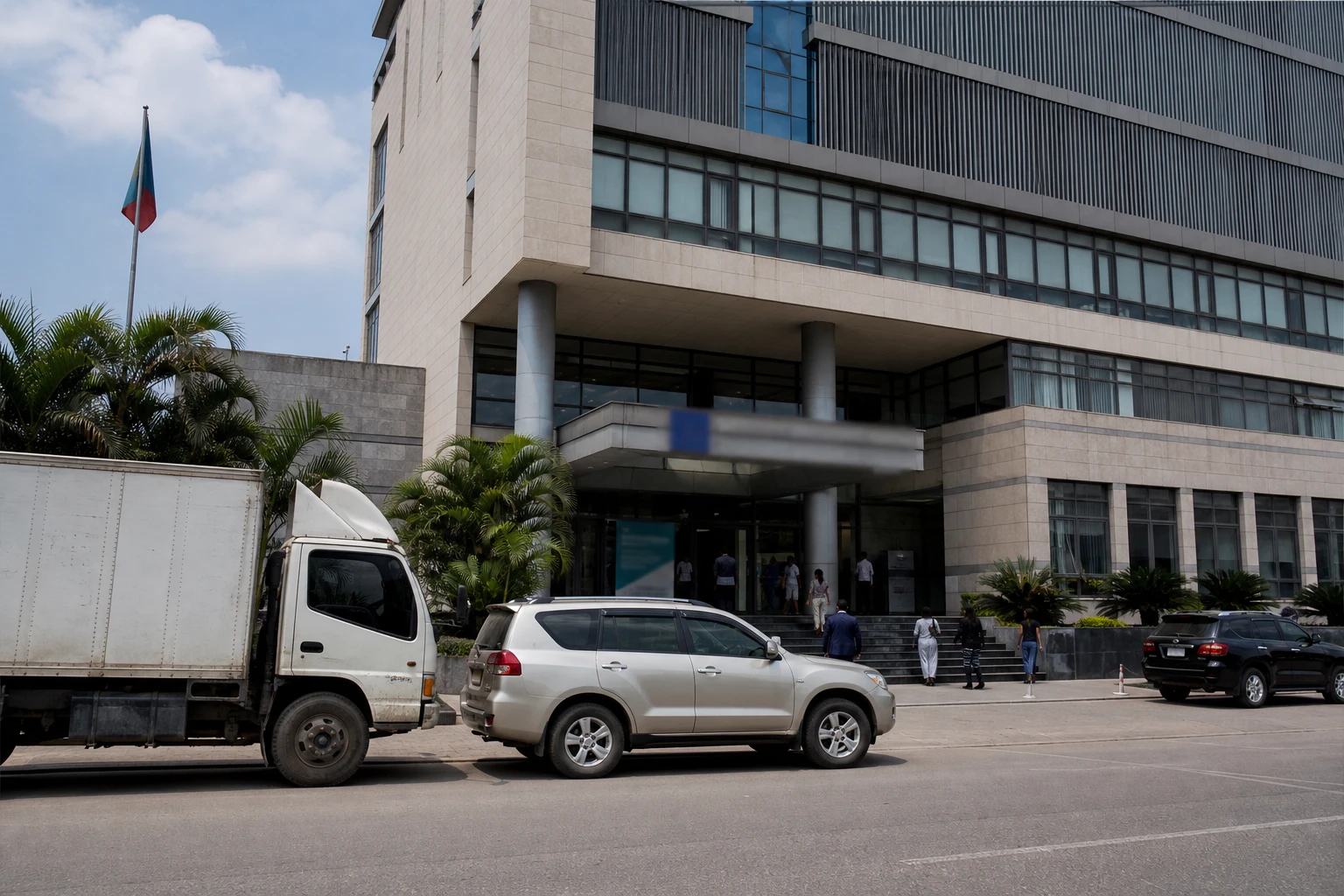
A strained cement market, as local industry seeks to take root
In Kinshasa, cement is not merely an industrial issue. It affects construction costs, the pace of public works and households’ ability to build without facing sudden price rises. In the Democratic Republic of the Congo, the state has for several years sought to reconcile two objectives that are rarely easy to bring together: protecting nascent factories and ensuring market supply.
The issue is part of a broader trajectory. In the country’s south-east and west, the DRC now has local production facilities, notably around Kimpese, Lukala, Likasi and Lualaba. The government wants to draw on this capacity to reduce dependence on imports. But distances, transport costs and the fragmentation of Congolese territory still complicate the equation.
Restrictions extended, with an exemption system
The orders signed on 29 July 2026 by Trade Minister Julien Paluku Kahongya renew temporary restrictions on imports of grey cement and clinker in the western and south-eastern parts of the DRC, as well as on lime in the south-east. The measures do not completely close the door to imports. They provide for free exemptions when consumers or businesses cannot be supplied by local producers.
To obtain an exemption, operators must specify the destination and batch number, then submit a file validated by the Single Window for Foreign Trade, SEGUCE-RDC, which centralises import, export and transit procedures. Without this file, an application is rejected. This mechanism confirms that Kinshasa is not imposing an embargo, but a stricter administrative screening process.
The government is continuing a policy already set in motion in 2024. On 5 July that year, an initial order restricted imports of grey cement and clinker in the western and south-eastern regions. A few days later, on 20 July 2024, a similar measure targeted lime in the south-east. At the time, Kinshasa presented the orders as safeguard measures for still-fragile local industries.
What the measure means for manufacturers, transporters and construction sites
On paper, the decision favours Congolese cement producers. In the west, capacity is concentrated around manufacturers based in Kongo Central, including PPC Barnet in Kimpese, Cimenterie de Lukala, CIMKO and CINAT. PPC Barnet has a stated capacity of about 1.2 million tonnes a year. In the south-east, Grande Cimenterie du Katanga operates in Likasi, while a facility linked to China’s Zijin Group has been launched in Lualaba, with stated annual capacities of 800,000 tonnes of cement and 400,000 tonnes of lime.
But protecting the market is not enough to solve the whole problem. Between production and distribution lie roads, railways, delays, cash flow and the quality of batches. In a country this vast, a product made near Lubumbashi does not automatically become accessible in Mbuji-Mayi, Bunia or Kisangani. That is why keeping the exemptions is so important: they serve as a release valve in provinces where local supply still cannot keep up with demand.
This approach also has a direct effect on prices. If local producers gain market share but cannot deliver regularly, the risk is straightforward: localised shortages or costs that are too high for private construction sites and public programmes alike. Conversely, if factories ramp up production and logistics keep pace, the measure could stabilise the sector and reduce some of the cost of imports. The potential benefit therefore depends less on the text itself than on its implementation, province by province.
Industrial policy also tests the state’s ability to strike a balance
The Trade Ministry has already used this kind of lever for other products. In 2024, for example, the authorities regulated the entry of certain imported goods, citing the protection of local factories and the need to limit imported inflation. The message is clear: the DRC wants to regain control of its domestic market, in a context where goods from neighbouring countries and regional trade networks remain widespread.
This issue goes beyond the cement trade alone. It speaks to the country’s place in the African Continental Free Trade Area (AfCFTA), which Kinshasa says it wants to support while making room for its nascent industries. In practice, the DRC is seeking a balance between continental openness and temporary protection for still-vulnerable sectors. Other African states are following a similar path, particularly in basic industries, where jobs, tax revenues and private investment are at stake.
The regional implications are real. In Central Africa and along trade corridors to Zambia, Kinshasa’s decisions influence trade flows, importers’ margins, producers’ strategies and relations with neighbouring countries. The commercial tensions surrounding some of the 2024 restrictions showed that an order on cement can quickly become a diplomatic and logistical issue. What happens next will therefore depend on the exemptions granted, how quickly SEGUCE-RDC processes them and whether Congolese cement factories can prove they are able to supply the national market sustainably.



