Algeria
 Egypt
 Libya
 Morocco
 Sudan
 Tunisia
 Benin
 Burkina Faso
 Cabo Verde
 Côte d'Ivoire
 Ghana
 Guinea
 Guinea-Bissau
 Liberia
 Mali
 Mauritania
 Niger
 Nigeria
 Senegal
 Sierra Leone
 The Gambia
 Togo
 Cameroon
 Central African Republic
 Chad
 Equatorial Guinea
 Gabon
 Republic of the Congo
 São Tomé and Príncipe
 Burundi
 Comoros
 Djibouti
 Eritrea
 Ethiopia
 Kenya
 Madagascar
 Malawi
 Mauritius
 Mozambique
 Rwanda
 Seychelles
 Somalia
 South Sudan
 Tanzania
 Uganda
 Angola
 Botswana
 Eswatini
 Lesotho
 Namibia
 South Africa
 Zambia
 Zimbabwe
A health crisis extending beyond Ituri
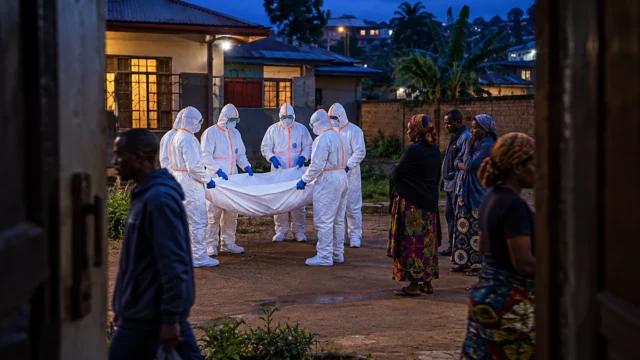
In the Democratic Republic of the Congo, epidemics can no longer be understood solely at provincial level. They cross border posts, strain health centres and require neighbouring states to coordinate their responses. That is exactly what the Ebola outbreak caused by the Bundibugyo virus demonstrates: it first affects Ituri, in the country’s north-east, before weighing on the entire Great Lakes region.
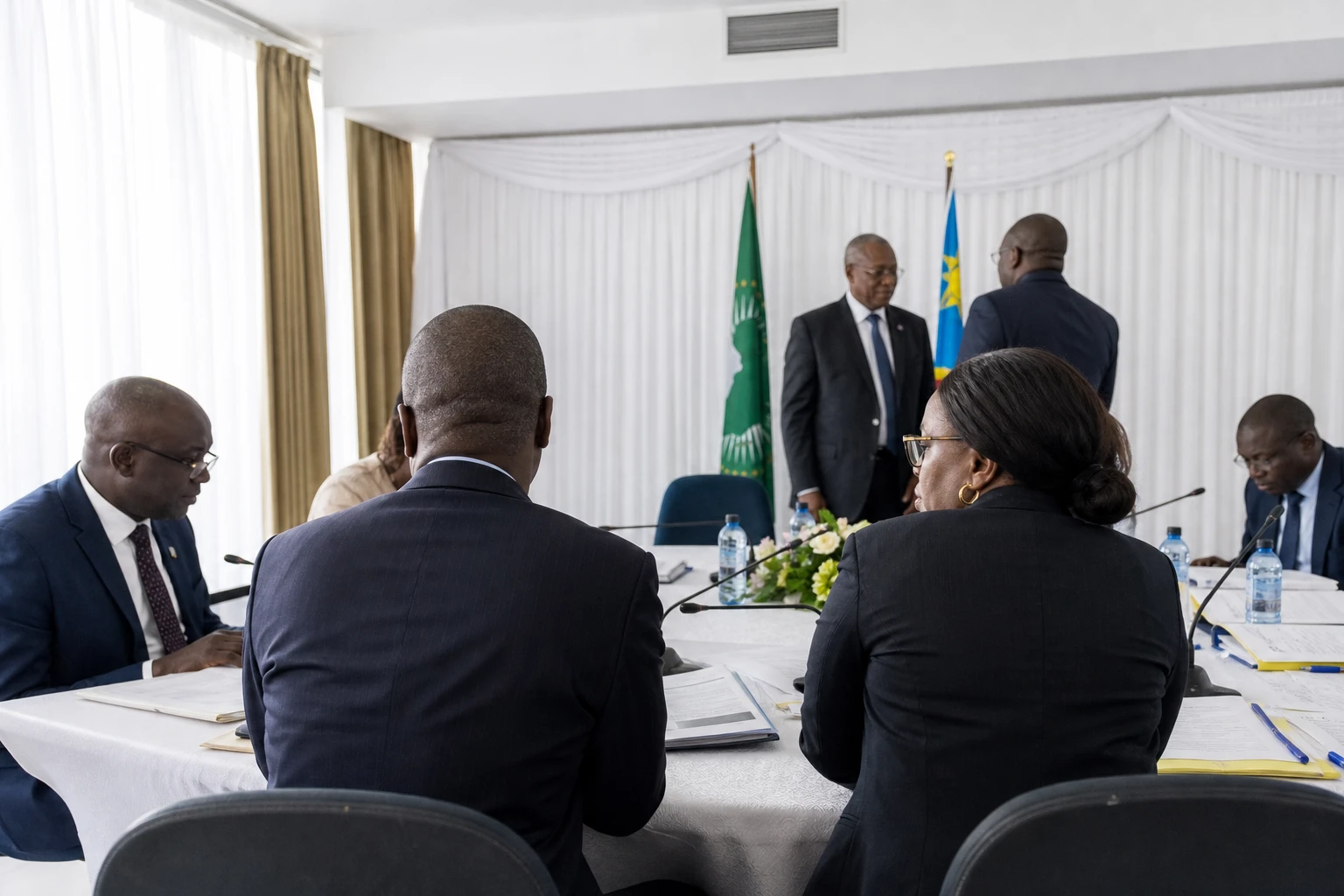
The issue takes on particular significance as the African Union brought heads of state and health ministers together in Accra around three priorities: ending AIDS as a public health threat by 2030, reducing maternal mortality and strengthening African health sovereignty. This diplomatic sequence is not just about budgets. It is about actual capacity: laboratories, supply chains, epidemiological surveillance and sustainable funding.
In this context, the Bundibugyo Ebola outbreak in DR Congo has become a stress test for the Congolese health system and regional cooperation. The WHO says the outbreak was declared on 15 May 2026 in eastern DR Congo, then classified as a public health emergency of international concern a few days later because of the risk of spreading beyond borders.
Heavy toll, response under strain
As of 21 July 2026, Congolese health authorities reported 2,536 confirmed cases and 1,033 deaths linked to the outbreak, according to data cited by international and national public health institutions. The toll is unequivocal: DR Congo is facing one of the heaviest Ebola waves in its recent history, across five provinces in the country’s north-east and east, with Ituri hardest hit.
What complicates the response is not just the virus. It is the terrain. The WHO says transmission often occurs outside known chains of contacts, many deaths occur in communities, and surveillance difficulties can lead to the true scale of the outbreak being underestimated. In an area where armed violence displaces families and access to health facilities remains uneven, every delay in diagnosis adds to the human toll.
The humanitarian dimension is just as clear. Displacement camps in Ituri have been affected or placed under surveillance, in an environment where overcrowding, a lack of drinking water and limited access to care favour transmission. The stakes are therefore not abstract: for displaced people, the difference between information, screening and treatment can be a matter of survival.
In response to this pressure, Africa’s response is taking shape. Africa CDC has classified the outbreak as a continental public health emergency, while the WHO and Africa CDC have also stressed the need for cross-border preparedness. This is important: it prevents the Congolese outbreak from being treated as an isolated incident and recognises that in Central Africa, public health is often regional before it is purely national.
Science, funding and health sovereignty
This outbreak is also distinctive because it is reshaping research. The University of Oxford launched the first phase I clinical trial of a vaccine against the Bundibugyo virus on 13 July 2026. The programme, named BD-Ebov, aims to recruit 50 healthy adults and assesses safety and the immune response. On 24 July, Oxford announced that the first volunteer had been vaccinated, a symbolic milestone but one still far from mass use.
At the same time, another trial, EBO-PEP, began on 14 July in DR Congo and Uganda, coordinated by Kinshasa’s INRB, ANRS Emerging Infectious Diseases, Inserm and ALIMA. It is testing obeldesivir as post-exposure prophylaxis, meaning a treatment given after exposure to the virus in an attempt to prevent the disease from developing. For African research, this is strategically important: it puts Congolese teams at the heart of an international protocol rather than in the mere role of host.
Funding, however, remains the blind spot in preparedness. The African Development Bank has approved $13 million in emergency assistance to support the response in DR Congo, Uganda and South Sudan, including diagnostic, surveillance and regional coordination measures. The WHO, for its part, warns that the joint continental plan with Africa CDC remains underfunded by several hundred million dollars. In other words, Africa increasingly knows what to do, but still lacks the stable resources to do it on a large scale.
This question of health sovereignty is not theoretical. It concerns the choice facing African states between dependence on emergency responses from outside and building sustainable tools on the continent: sequencing capacity, clinical trials, joint procurement and regional logistics. In the Congolese case, the presence of organisations such as the INRB, Africa CDC, the WHO and medical NGOs shows that an African response architecture already exists. But it still needs greater financial autonomy and faster deployment.
What this outbreak says about Central Africa
For DR Congo, the immediate challenge is twofold. It must break the chain of transmission in the affected provinces while ensuring that fear does not empty health centres, delay routine care or further disrupt an already highly informal local economy. For Kinshasa, the challenge is also political: to prove that the health response can remain clear, coordinated and credible despite insecurity in the country’s east.
For neighbouring countries, particularly Uganda and South Sudan, the priority is border surveillance, rapid data-sharing and training field teams. Recent experience shows that an outbreak contained on one side can still produce imported cases on the other, even when community transmission is declining. This is one reason why the WHO and Africa CDC stress the importance of points of entry, mobile teams and regional coordination.
At continental level, this sequence confirms a simple reality: health has become a matter of security, integration and sovereignty. The Accra summit, stronger cooperation between Africa CDC and the IOM, clinical trials launched in Africa and financial support from the AfDB all point in the same direction. The challenge is no longer just to contain an outbreak. It is to build lasting African capacity to prevent, detect and treat it.