Algeria
 Egypt
 Libya
 Morocco
 Sudan
 Tunisia
 Benin
 Burkina Faso
 Cabo Verde
 Côte d'Ivoire
 Ghana
 Guinea
 Guinea-Bissau
 Liberia
 Mali
 Mauritania
 Niger
 Nigeria
 Senegal
 Sierra Leone
 The Gambia
 Togo
 Cameroon
 Central African Republic
 Chad
 Equatorial Guinea
 Gabon
 Republic of the Congo
 São Tomé and Príncipe
 Burundi
 Comoros
 Djibouti
 Eritrea
 Ethiopia
 Kenya
 Madagascar
 Malawi
 Mauritius
 Mozambique
 Rwanda
 Seychelles
 Somalia
 South Sudan
 Tanzania
 Uganda
 Angola
 Botswana
 Eswatini
 Lesotho
 Namibia
 South Africa
 Zambia
 Zimbabwe
In Kinshasa, peace is being shaped as much in capitals as on the ground
In the east of the Democratic Republic of the Congo, each diplomatic advance matters less for its grand gestures than for its practical effects: a humanitarian corridor reopening, fighting receding from a village, a road where displaced people can finally travel without fear. Yet the conflict continues to be decided far from the hills of South Kivu and the routes of North Kivu, in negotiation rooms where African mediators, Western backers and Gulf facilitators meet.
The current phase is part of a diplomatic architecture now operating on two levels. On one side, the Doha process addresses the dispute between Kinshasa and the AFC/M23, an armed movement that Washington describes as backed by Kigali and that the DRC holds responsible for much of the insecurity in the east. On the other, the DR Congo-Rwanda mechanism, established under the Washington agreements, targets the interstate tensions that fuel and prolong the armed conflict. In the Great Lakes region, the two strands remain closely intertwined.
Doha at the centre, with Geneva and London in support
The talks relaunched in Switzerland from 17 to 21 August 2026 confirmed what diplomats already knew: Qatar remains in charge of direct mediation between the Congolese government and the AFC/M23. The meeting brought together the two parties, as well as Qatar, the United States, Togo, the African Union Commission and Switzerland. After five days of discussions, a new roadmap was adopted to continue negotiations and set out the next steps in the Doha process.
The roadmap does not resolve everything, but it puts a timetable back on the table. The parties also agreed that the order of the negotiated protocols would not necessarily dictate the order in which they are implemented. This is a technical but important point: in this type of negotiation, security measures, humanitarian access, detainee releases and ceasefire monitoring can proceed at different speeds without the whole process collapsing.
The basis for the dialogue remains the framework agreement signed in Doha on 15 November 2025, following a declaration of principles concluded earlier that year. Since then, mediators have sought to turn general commitments into concrete mechanisms: a ceasefire, monitoring of violations, humanitarian access, prisoner exchanges and the gradual return of public authority to affected areas. The resumption of talks in Switzerland shows above all that obstacles remain, particularly over ceasefire monitoring and the fate of detainees.
The Washington-Doha partnership, with the African Union in the middle
The DR Congo-Rwanda track follows a different logic, but remains linked to the other process. On 24 June 2026, representatives of Kinshasa and Kigali, together with the United States, Qatar, Togo as the African Union mediator, and the AU Commission, met in London for the sixth meeting of the Joint Oversight Committee. This body monitors the peace agreement signed on 27 June 2025 between the DRC and Rwanda, often presented as a political framework for stabilising the region.
In parallel, a security coordination mechanism was established to translate political commitments into operational measures. On 7 and 8 August 2025, and again at subsequent meetings, this mechanism served as a forum for information-sharing and monitoring the commitments made by the two states. For the DRC, this diplomacy is decisive, since the evolution of relations between Kinshasa and Kigali directly affects the military balance in the east.
Togo plays the role of an African bridge. As the mediator appointed by the African Union, Lomé lends continental legitimacy to a dossier in which the presence of actors from outside Africa can arouse suspicion. The African Union Commission, meanwhile, retains a formal place in both processes. This dual anchoring matters: it prevents the Congolese crisis from being viewed solely through the lens of the capitals that fund or host the talks.
On the ground, diplomatic time does not move at the pace of the guns
In Minembwe, in South Kivu, a reconnaissance mission was announced on 20 August 2026, ahead of a first ceasefire-monitoring mission scheduled for 24 August. MONUSCO is providing logistical support for this mechanism, which is to monitor commitments arising from the Doha process. In practice, this means more patrols, coordinated movements and checks in areas where front lines remain fluid.
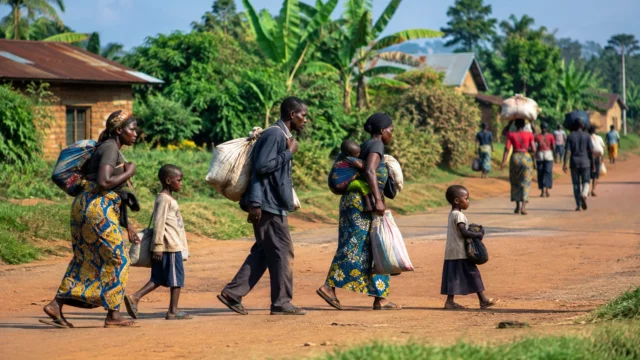
But peace cannot be reduced to a monitoring mission. The sensitive issue remains the restoration of credible public authority in disputed areas, access to roads, markets and basic services, and the fate of people detained in a conflict where distrust has become a method. For displaced people, the real test is not the signing of a document in Geneva or Doha; it is the possibility of returning home, farming, sending children to school and travelling through a town without encountering an armed roadblock.
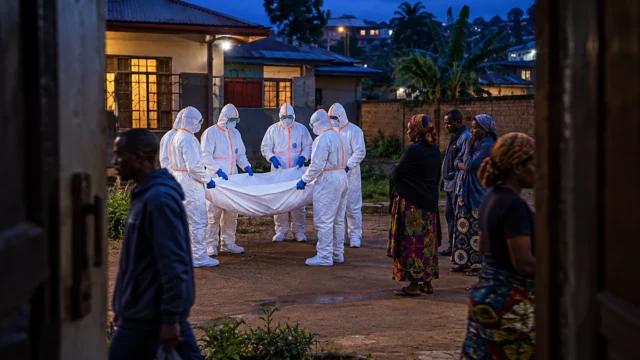
The security crisis is compounded by a severe health emergency. Since 15 May 2026, the DRC has been facing its 17th Ebola outbreak, caused by the Bundibugyo virus, with rapid spread in the east. The World Health Organization has confirmed the outbreak’s expansion and warned of the role of population movements, disruptions to surveillance and insecurity in the spread of the disease. As of 16 or 19 August, according to the bulletins, more than 5,000 confirmed cases and more than 2,300 deaths had been reported, a scale confirmed by several recent reports from the WHO and the Associated Press.
What this diplomacy says about the DRC and Central Africa
The significance of these negotiations extends far beyond the AFC/M23 issue. In Central Africa and the Great Lakes region, the DRC’s stability shapes cross-border trade, the security of commercial routes and the credibility of regional peace mechanisms. A genuine breakthrough in Kinshasa and the east would affect Rwanda, Uganda and Burundi, and more broadly the balance between the African Union, the United Nations and the powers involved in mediation.
The next milestone to watch is therefore less a symbolic date than an operational test: whether monitoring missions actually take place, whether the follow-up mechanism continues to function, and whether the parties can make progress on the most difficult protocols. Until these steps produce visible results on the ground, the roadmap will remain a useful but still fragile framework. In eastern Congo, diplomacy will be credible only when it finally changes the daily lives of Congolese women and men, from the big cities to the most exposed rural areas.