Algeria
 Egypt
 Libya
 Morocco
 Sudan
 Tunisia
 Benin
 Burkina Faso
 Cabo Verde
 Côte d'Ivoire
 Ghana
 Guinea
 Guinea-Bissau
 Liberia
 Mali
 Mauritania
 Niger
 Nigeria
 Sierra Leone
 The Gambia
 Togo
 Cameroon
 Central African Republic
 Chad
 DR Congo
 Equatorial Guinea
 Gabon
 Republic of the Congo
 São Tomé and Príncipe
 Burundi
 Comoros
 Djibouti
 Eritrea
 Ethiopia
 Kenya
 Madagascar
 Malawi
 Mauritius
 Mozambique
 Rwanda
 Seychelles
 Somalia
 South Sudan
 Tanzania
 Uganda
 Angola
 Botswana
 Eswatini
 Lesotho
 Namibia
 South Africa
 Zambia
 Zimbabwe
In Dakar, the demand for justice is about more than a suspect who is still being sought. It also raises a broader question: how can women be protected from violence by a former partner, and how can a case be moved forward when a family and neighbourhood are waiting for answers?
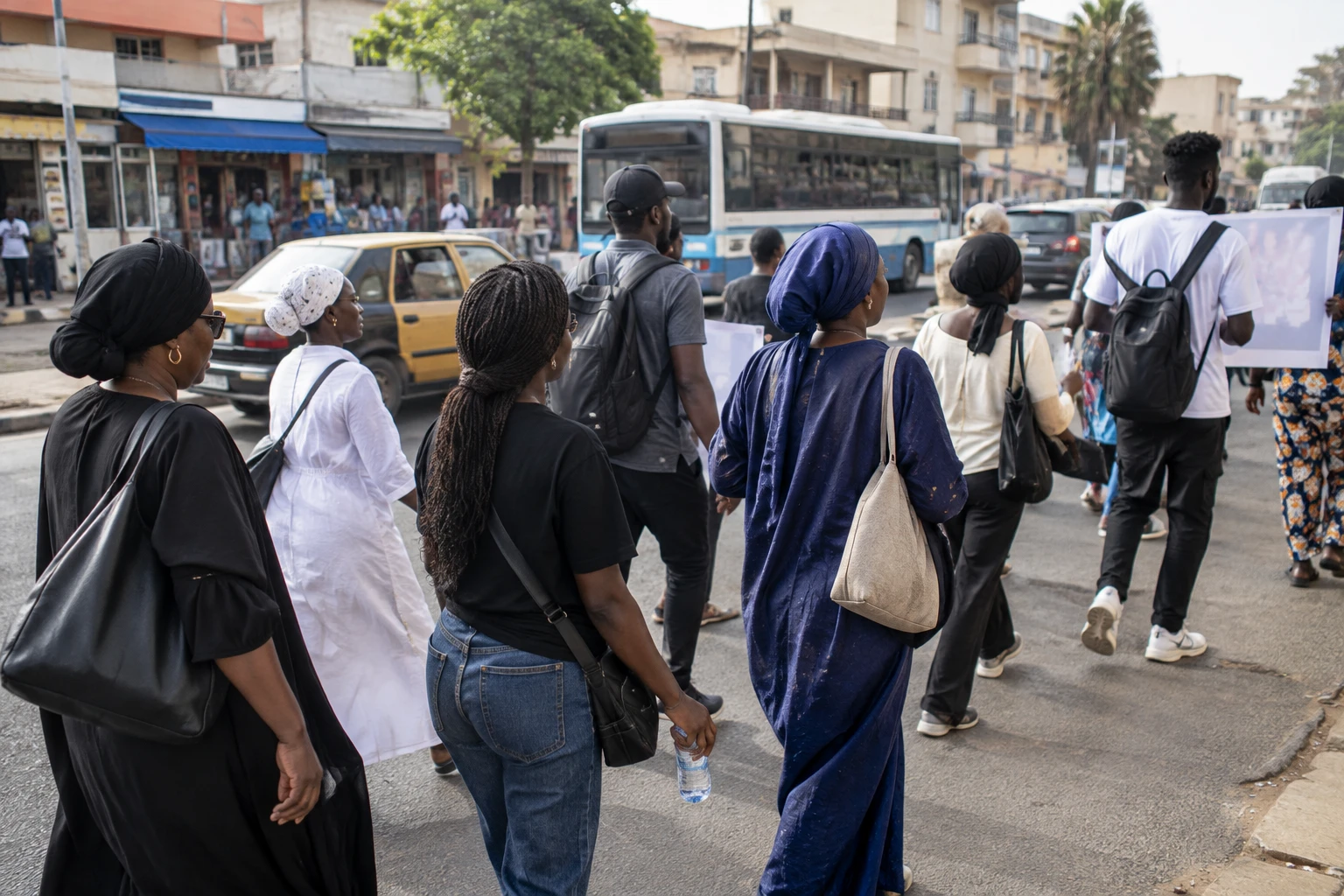
On Friday 16 October 2026, just over 200 people, according to organisers cited in reports of the march, marched to the Grand Dakar prefecture. They called for progress in the investigation into Astou Pierre’s death and for violence against women to be better recognised by Senegalese institutions.
A neighbourhood march becomes a demand for justice
Astou Pierre, 40, died on 1 October after being doused with acid in June by her alleged former partner. The march brought together relatives, neighbours and members of the Justice for Astou Pierre collective. Her family filed a complaint. At the time of the mobilisation, participants said the suspect had not been arrested.
Medical details reported after the attack vary between public accounts. It is therefore important to stick to the facts that have been corroborated: the attack took place in June, the victim was hospitalised and she died on 1 October. The precise circumstances of the case are a matter for the investigation and the justice system.
The mobilisation put the voices of relatives and women living in the neighbourhood at its centre. The victim’s brother called for «the full truth to be established and justice to be served». Friends and neighbours also voiced their concern about violence and the feeling that they were not sufficiently protected. These testimonies describe lived experience; on their own, they do not allow generalisations about the conduct of the police.
The collective called on the authorities to step up the search and consider the call for femicide to be recognised in the Criminal Code. By this term, the demonstrators mean the killing of a woman because of her gender or violence directed against her, particularly within an intimate relationship. The legal classification, however, is a matter for investigators and the courts.
A legal debate already under way in Senegal
Senegal already has criminal provisions against several forms of violence. The January 2020 law notably made rape and paedophilia criminal offences. But femicide is not, as things stand, a separate offence in the Criminal Code. Depending on the circumstances established, fatal acts can be prosecuted under general classifications of homicide and violence.
This distinction is fuelling public debate. For the associations and collectives calling for a specific offence, naming femicide would make killings linked to gender-based violence more visible and facilitate statistical monitoring. Other issues are just as urgent: the speed of investigations, access to protection before violence escalates, support for relatives and the effective application of existing laws.
Available figures shed light on the scale of violence, but do not directly measure femicides. The Senegalese Association of Women Lawyers said it had recorded 4,208 cases of violence among the people it received in 2025, 3,890 of them involving women. This tally covers cases reported to the association: it is neither an exhaustive population survey nor an official count of killings.
In March 2026, the Senegalese Press Agency reported judicial statistics showing 506 cases of rape and indecent assault involving violence in 2021, 519 in 2022 and 623 in 2023. These figures, provided by the Interior Minister during a parliamentary debate on a draft law, do not cover all forms of violence and do not directly provide information on the killings of women.
From Dakar to regional protection challenges
The scene in Grand Dakar highlights two different realities. For the family, the priority is to secure concrete progress in a specific case. For the women who mobilised, it is also about knowing whom to turn to in the event of a threat and whether warnings are taken seriously. In urban neighbourhoods, networks of relatives and collectives can make a shared demand heard; they do not replace emergency services, investigators or magistrates.
The issue extends beyond Senegal’s borders. Senegal is a member of ECOWAS, the Economic Community of West African States, whose member states work on women’s rights and safety, among other issues. But the existence of regional frameworks does not, by itself, guarantee protection in daily life. Their impact depends on national laws, available resources and the ability of institutions to deal with reports.
The next steps in the Astou Pierre case will therefore need to be assessed on two levels: verifiable progress in the investigation and legal proceedings, and the response to the collective’s broader demands. For her relatives, the priority remains establishing the facts and securing justice. For the authorities, the challenge is to show how existing mechanisms can protect women before violence becomes irreversible.