Algeria
 Egypt
 Libya
 Morocco
 Sudan
 Tunisia
 Benin
 Burkina Faso
 Cabo Verde
 Côte d'Ivoire
 Ghana
 Guinea-Bissau
 Liberia
 Mali
 Mauritania
 Niger
 Nigeria
 Senegal
 Sierra Leone
 The Gambia
 Togo
 Cameroon
 Central African Republic
 Chad
 DR Congo
 Equatorial Guinea
 Gabon
 Republic of the Congo
 São Tomé and Príncipe
 Burundi
 Comoros
 Djibouti
 Eritrea
 Ethiopia
 Kenya
 Madagascar
 Malawi
 Mauritius
 Mozambique
 Rwanda
 Seychelles
 Somalia
 South Sudan
 Tanzania
 Uganda
 Angola
 Botswana
 Eswatini
 Lesotho
 Namibia
 South Africa
 Zambia
 Zimbabwe
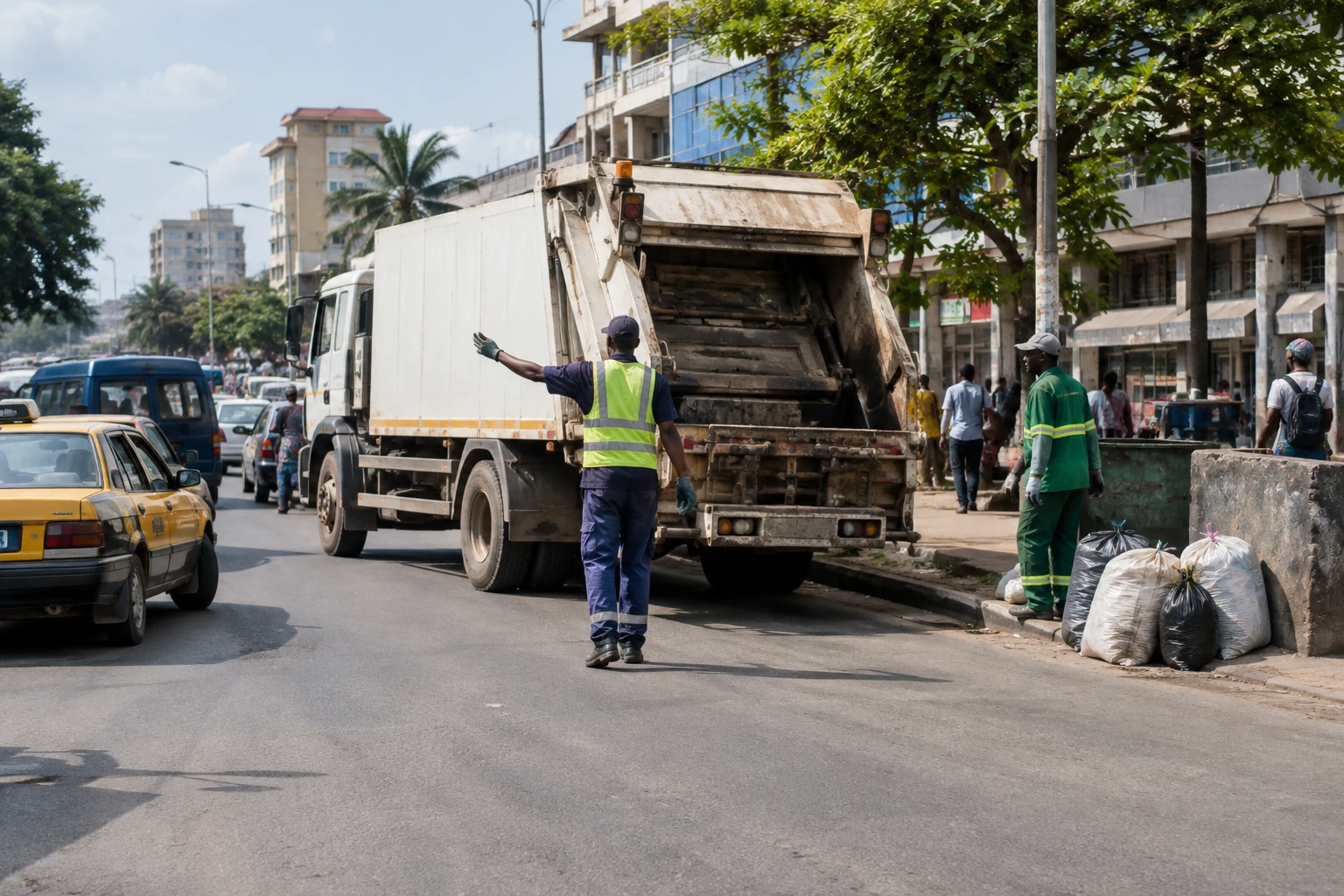
When a rubbish truck stops coming, the waste does not disappear: it piles up near homes, on pavements and at junctions. In Conakry, the closure of the main landfill after a deadly landslide has exposed a deeper weakness: Guinea’s capital does not yet have a disposal chain capable of absorbing a disruption on this scale.
A capital caught between a public health emergency and a logistical transition
The crisis is unfolding in an urban area where household waste is collected by several operators, then transported to treatment or disposal sites. Local collection relies in particular on small businesses and local operators. But the chain breaks down when the dumping site is closed or too far away, in the absence of enough trucks, transfer hubs and sufficiently clear routes.
The Dar-es-Salam disaster accelerated this transition. On 23 August 2026, a landslide swept away part of the dump and nearby homes. Figures reported by the French Red Cross and Guinée360 put the death toll at 36. The site’s closure has brought a long-deferred question into sharper focus: where should the waste produced every day by Greater Conakry go?
The proposed solution relies in particular on Baritodé, in Coyah prefecture, and on transitional facilities. But the distance from Conakry and traffic jams are making journeys more difficult. Moving a dump is therefore not enough to move the entire waste chain. Transfer arrangements must also be organised, operators equipped and continuity ensured between neighbourhoods and the final site.
Waste in neighbourhoods, collection disrupted
The consequences are immediate on the streets. Residents interviewed in the report on which this information is based describe bad smells, worms and collection delays that can last several weeks. One woman says she looked for a private solution to have her rubbish removed. Her account illustrates an additional burden on households, but does not in itself establish the scale of the situation in every municipality.
When regular services are interrupted, waste shifts to whatever spaces are available. Families able to pay for individual collection try to limit the build-up around their homes. Others are more exposed to the nuisance. Waste collectors, meanwhile, are affected by a system in which access to dumping sites and transport costs determine whether they can continue working at all.
The figure of 3,000 tonnes of waste a day in Conakry is cited in the information available on the crisis. It gives an indication of the volumes to be handled, but does not by itself show what proportion is actually collected, sorted or buried. This distinction is essential: infrastructure may be announced without collection and transfer resources keeping pace.
Siriman Condé, managing director of the SME BCEIP Environnement, says in the report that companies in the sector face difficulties accessing dumps and lack the resources to expand collection, transport, sorting and recovery. His assessment points to a public policy challenge: small businesses can contribute to the service, but cannot alone replace the heavy equipment and planning required for a capital city.
Rehabilitating Dar-es-Salam will not solve everything
On 2 November 2026, Guinea’s Prime Minister’s Office announced the launch of environmental rehabilitation works at Dar-es-Salam. The project, scheduled to last one year, covers 28.8 hectares. According to the authorities, more than nine million cubic metres of waste have accumulated at the site, causing gas emissions and risks to nearby residents. The operation concerns the former dump; it does not replace the need for a functioning site for daily waste.
The two issues are connected, but distinct. On the one hand, a site associated with a deadly accident must be made safe and rehabilitated. On the other, collection must be maintained as new solutions build capacity. A prolonged interruption could increase illegal dumping and make municipal services’ work more difficult. It could also undermine businesses that depend on regular journeys to cover their costs.
The public health issue is not limited to bad smells. Piles near homes and drains can increase exposure to nuisances and obstruct water flow. However, the available information does not make it possible to attribute any specific illness to the current accumulation. Caution requires distinguishing documented risks from medical diagnoses, which require health data and local investigations.
An urban governance test for Guinea
The crisis involves several levels of responsibility: national authorities, municipalities, sanitation services, transporters and collection companies. For residents, the results are measured by how regularly rubbish is collected. For operators, they depend on access to sites, distances and equipment. For the authorities, the challenge is to reconcile the urgent need for clean streets with sustainable waste management.
The Dar-es-Salam precedent is also a reminder that the location and safety of dumps directly affect neighbouring communities. Planning must take risks, informing nearby residents and, where necessary, relocation arrangements into account. The August disaster shows the potential human cost of an overloaded facility, but does not by itself allow the causes of the crisis to be reduced to a single factor.
Across West Africa, Conakry shares with other major cities growing urban pressure and the need to coordinate collection, transfer and treatment. ECOWAS, the regional organisation of West African countries, does not organise local waste services; the response rests first and foremost with Guinean institutions. But the way Guinea funds its infrastructure and involves municipalities and private-sector players is of interest to cities facing the same trade-offs.
The next steps to watch are concrete: progress on the rehabilitation of Dar-es-Salam, the actual capacity of Baritodé and temporary sites, and the resumption of regular collection in neighbourhoods. Without these links in the chain, closing a dangerous dump may shift waste rather than solve the problem of managing it.
Sources consulted: Guinea’s Prime Minister’s Office on the rehabilitation of Dar-es-Salam, French Red Cross on the landslide and its consequences, Guinée360 on the site’s closure and transfer constraints, report on the accumulation of waste in Conakry.