Algeria
 Egypt
 Libya
 Morocco
 Sudan
 Tunisia
 Benin
 Burkina Faso
 Cabo Verde
 Côte d'Ivoire
 Ghana
 Guinea
 Guinea-Bissau
 Liberia
 Mali
 Mauritania
 Niger
 Nigeria
 Senegal
 Sierra Leone
 The Gambia
 Togo
 Cameroon
 Central African Republic
 DR Congo
 Equatorial Guinea
 Gabon
 Republic of the Congo
 São Tomé and Príncipe
 Burundi
 Comoros
 Djibouti
 Eritrea
 Ethiopia
 Kenya
 Madagascar
 Malawi
 Mauritius
 Mozambique
 Rwanda
 Seychelles
 Somalia
 South Sudan
 Tanzania
 Uganda
 Angola
 Botswana
 Eswatini
 Lesotho
 Namibia
 South Africa
 Zambia
 Zimbabwe
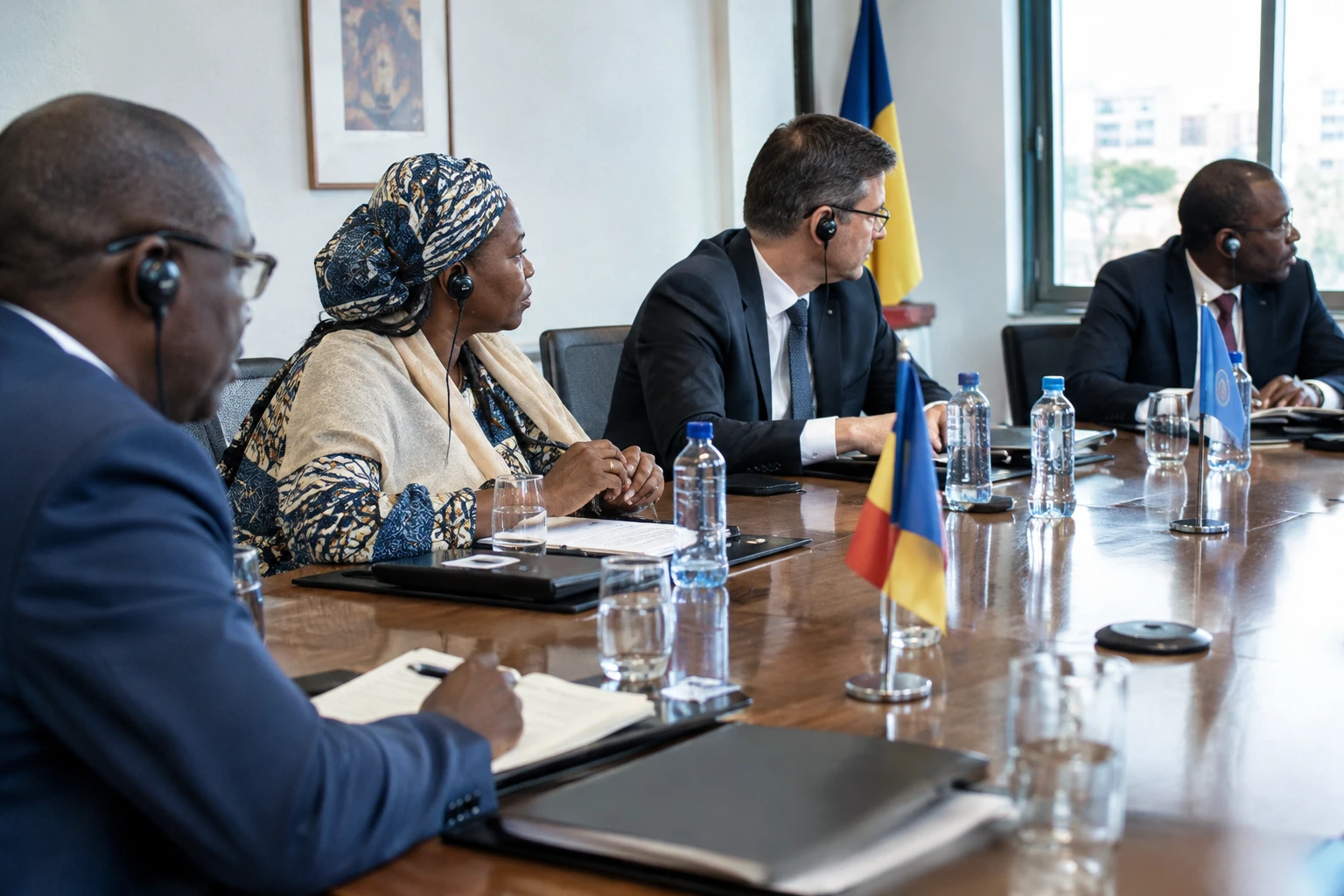
After sending French troops out of its territory, Chad is opening another path: resuming defence cooperation focused on training, technology and national capabilities. The question will be whether this rapprochement can remain compatible with the strategic autonomy claimed by N’Djamena.
From troop withdrawal to a redefined partnership
On 13 October 2026, Chadian President Mahamat Idriss Déby Itno was received in Paris by Emmanuel Macron. On the sidelines of their meeting, the two countries’ defence ministers signed a declaration of intent to structure their cooperation in the fields of training, expertise, industry and defence technology. Chadian media outlet Tchadinfos and the Anadolu agency report the signing and its main areas of focus.
The text announces a direction and a framework for work, not the details of an operational military arrangement. The publicly available information specifies neither a timetable nor a budget nor the number of personnel involved. It makes no mention of French bases returning or of an agreement authorising a permanent presence. This distinction matters: a defence partnership can cover technical exchanges without restoring the military format that existed previously.
The previous rupture dates back to 28 November 2024, when the Chadian government ended its defence cooperation agreement with France. The last French soldiers left the country on 31 January 2025. These dates are reported by Reuters and corroborated by the French Senate.
At the time, Mahamat Idriss Déby had described the agreement as “obsolete”, arguing that it no longer met the country’s security and geopolitical requirements, according to remarks reported by Reuters. Chad’s decision came amid a reassessment of military partnerships in the Sahel and West Africa. It also affirmed that the authorities in N’Djamena intended to decide for themselves which forms of cooperation were acceptable.
Sovereignty at the heart of the new balance
The new declaration is therefore not simply a reversal of the rupture. Rather, it seeks to build a relationship less dependent on a foreign military presence. Training and expertise can support the skills of Chadian forces. The industrial and technological components could, if implemented, open discussions on the acquisition, maintenance or production of equipment. But the announced document does not yet provide grounds to conclude that technology will be transferred or a local industry created.
This caution matters to Chadians. Cooperation can strengthen the state’s capabilities, but its practical effects will depend on budgetary choices, oversight mechanisms and needs defined by the national authorities. Residents of areas exposed to insecurity are first and foremost waiting for effective protection. For public finances, the cost of equipment, its maintenance and personnel training will matter as much as partnership announcements.
Both governments emphasise “mutual respect”. The phrase signals a shared desire to turn the page on the crisis, but is not enough to establish that strategic differences have been resolved. Paris is seeking a renewed relationship after the end of its permanent military installations. N’Djamena, for its part, retains control of the framework and can diversify its partners. The declaration does not specify how any disagreements would be resolved.
The rapprochement is also part of a broader resumption of political and economic exchanges. On 13 October, the presidents discussed bilateral relations after a Franco-Chadian business forum held in Paris on 25 September. According to available accounts, economic discussions cover transport, health, energy and education in particular. This does not mean that the announced commitments have already been funded or delivered: their implementation remains to be established.
Cooperation faces regional challenges
Chad’s security context remains complex. The country lies at the crossroads of several crises, notably in the Lake Chad basin, the Sahel and across its eastern border in Sudan. The war in Sudan, which began in April 2023, has led to mass arrivals in eastern Chad. The United Nations High Commissioner for Refugees estimated that more than 900,000 Sudanese refugees had crossed the border since the conflict began, as of the end of 2025. The 2026 regional plan forecasts a further increase. These figures describe pressure on services and host communities, but should not be confused with the armed forces’ missions alone.
Stability in border regions depends on several factors: security, public services, displacement management and relations with local communities. Defence cooperation alone cannot address these challenges. In the east, humanitarian needs and the reception of refugees also require the involvement of Chadian authorities and their partners. UNHCR’s figures are available in its 2026 regional response plan.
At the level of Central Africa, Chad is a member of CEMAC, the Economic and Monetary Community of Central Africa, which brings together several states around economic and monetary cooperation. This organisation is not a defence alliance. The declaration signed in Paris remains bilateral, but its consequences will have regional significance: they will show how a state can end a foreign military presence and then negotiate more targeted forms of cooperation.
The next step will therefore be less symbolic than practical. It will be necessary to see whether the two countries publish implementing agreements, verifiable objectives and funding arrangements. For N’Djamena, the challenge is to turn cooperation into lasting skills without relinquishing national control. For Paris, it is to build a relationship no longer based on its former installations. The declaration opens up this possibility; only its implementation will show its significance.