Algeria
 Egypt
 Libya
 Morocco
 Sudan
 Tunisia
 Benin
 Burkina Faso
 Cabo Verde
 Côte d'Ivoire
 Ghana
 Guinea
 Guinea-Bissau
 Liberia
 Mali
 Mauritania
 Niger
 Nigeria
 Senegal
 Sierra Leone
 The Gambia
 Togo
 Cameroon
 Central African Republic
 DR Congo
 Equatorial Guinea
 Gabon
 Republic of the Congo
 São Tomé and Príncipe
 Burundi
 Comoros
 Djibouti
 Eritrea
 Ethiopia
 Kenya
 Madagascar
 Malawi
 Mauritius
 Mozambique
 Rwanda
 Seychelles
 Somalia
 South Sudan
 Tanzania
 Uganda
 Angola
 Botswana
 Eswatini
 Lesotho
 Namibia
 South Africa
 Zambia
 Zimbabwe
In Chad, a military stopover can now carry political weight that its format alone cannot explain. The return of French aircraft to N’Djamena, after the troops left and the defence agreement ended, raises a concrete question: can the two countries co-operate without returning to the former arrangement?
A break that did not close the door to dialogue
On 28 November 2024, the Chadian government announced the end of its military co-operation agreement with France. French forces subsequently left their bases, including the one in N’Djamena, which was handed back on 30 January 2025. The decision marked a shift in Chad’s foreign policy and formed part of a broader move to redefine military partnerships in the Sahel and Central Africa. France’s armed forces ministry confirmed the withdrawal of its fighter aircraft in December 2024.
The military break did not, however, mean the end of all relations between the two states. President Mahamat Idriss Déby Itno and Emmanuel Macron met in Paris on 29 January 2026. Their communiqué referred to continuing discussions and monitoring reciprocal commitments. The renewed dialogue was followed by talks on reworked co-operation, with no announcement of a permanent return of French forces. The joint communiqué of 29 January sets out the political framework for this new phase.
An announced exercise, a reported arrival
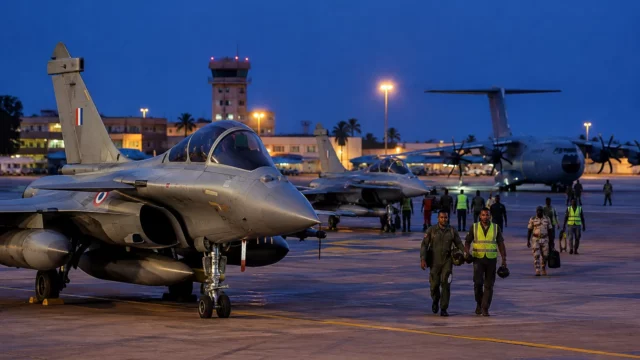
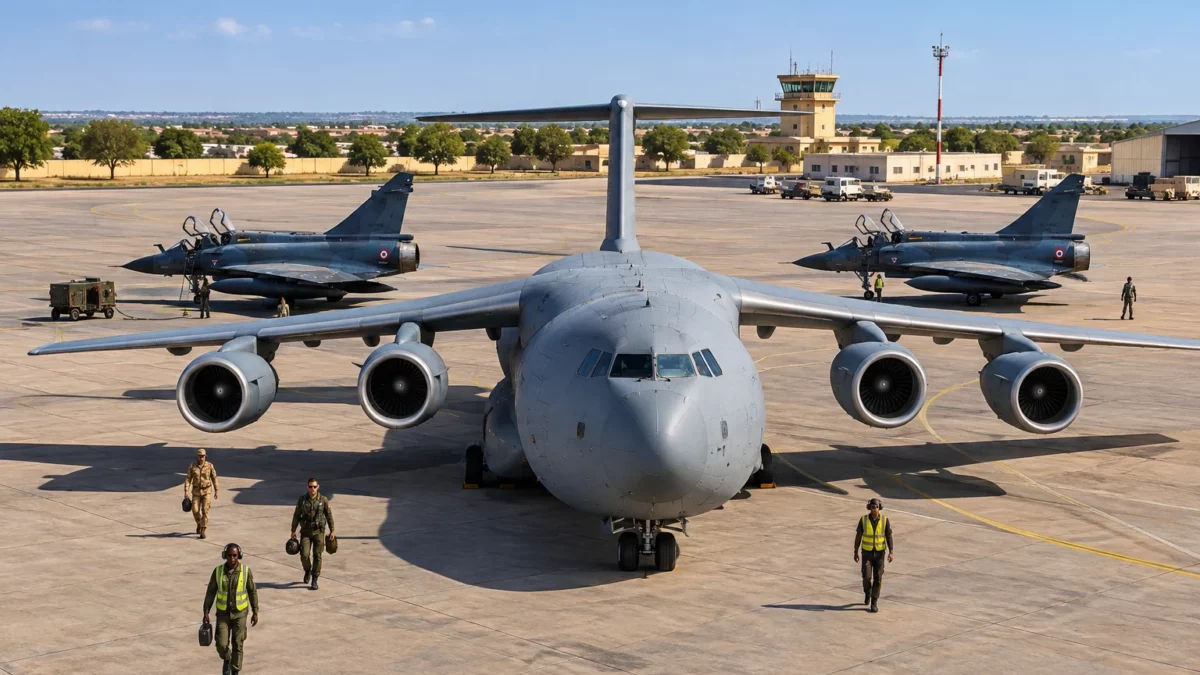
On 19 November 2026, two Mirage 2000s and a French military transport aircraft landed in N’Djamena, according to information reported by the African Press Agency and material provided about the event. Chad’s air force described their arrival as a joint exercise focused on counter-terrorism and the Lac region. Available reports refer to the threat posed by Boko Haram, an armed group active around Lake Chad.
Details of the aircraft differ between announcements made before the arrival. In late October, the French military command had referred to two Mirage 2000s and a CASA aircraft for a short technical stopover, accompanied by training activities, as part of a regional exercise organised in Côte d’Ivoire and Gabon. The report of the arrival, for its part, mentions a Hercules C-130 aircraft. In the absence of independent confirmation of this specific point, the difference in models should remain attributed rather than presented as resolved.
The two capitals also do not assign exactly the same significance to the event. Chadian officials describe it as a step towards resumption and refer to possible future exercises, with a role for aerial intelligence. Paris, according to its earlier announcements, emphasised a brief stopover linked to sub-regional manoeuvres. The format observed is therefore not, on its own, enough to conclude that there has been a lasting redeployment or a new defence agreement.
The Lake Chad basin, a shared security concern
The Lac region is directly affected by operations against Boko Haram and its factions. Chad operates there in a border area where security also depends on co-operation with Nigeria, Cameroon and Niger. The Multinational Joint Task Force, which brings together contingents from these countries, provides the regional framework for this fight. Aerial co-operation can contribute to surveillance and training, but its effects will depend on the missions actually carried out, the rules agreed and the oversight exercised by the Chadian authorities.
For N’Djamena, the challenge is to preserve national decision-making autonomy while diversifying the resources available to counter cross-border threats. For Paris, an authorised stopover offers a way to renew limited operational contact after its troops’ departure. The governments’ interests do not automatically align with those of the population: in exposed areas, residents are above all looking for lasting security, civilian protection and continuity of economic activity.
Regional significance to be assessed over time
This renewed contact is part of a broader reshaping of defence relations across the continent. Several African governments are reviewing the terms on which foreign partners are present and seeking to negotiate co-operation that better reflects their priorities. The Chadian case is a reminder that these choices cannot be reduced to a choice between partners: they also concern control of bases, intelligence-sharing, training and the terms of intervention.
The next step will matter less as a symbol of the landing than for the nature of any agreements that follow. It will be necessary to distinguish between occasional stopovers, training activities and any potential regular co-operation. At this stage, the reported arrival on 19 November marks renewed military contact, but does not demonstrate the reinstatement of France’s former arrangement in Chad.