Algeria
 Egypt
 Libya
 Morocco
 Sudan
 Tunisia
 Benin
 Burkina Faso
 Cabo Verde
 Côte d'Ivoire
 Ghana
 Guinea
 Guinea-Bissau
 Liberia
 Mali
 Mauritania
 Niger
 Nigeria
 Senegal
 Sierra Leone
 The Gambia
 Togo
 Cameroon
 Chad
 DR Congo
 Equatorial Guinea
 Gabon
 Republic of the Congo
 São Tomé and Príncipe
 Burundi
 Comoros
 Djibouti
 Eritrea
 Ethiopia
 Kenya
 Madagascar
 Malawi
 Mauritius
 Mozambique
 Rwanda
 Seychelles
 Somalia
 South Sudan
 Tanzania
 Uganda
 Angola
 Botswana
 Eswatini
 Lesotho
 Namibia
 South Africa
 Zambia
 Zimbabwe
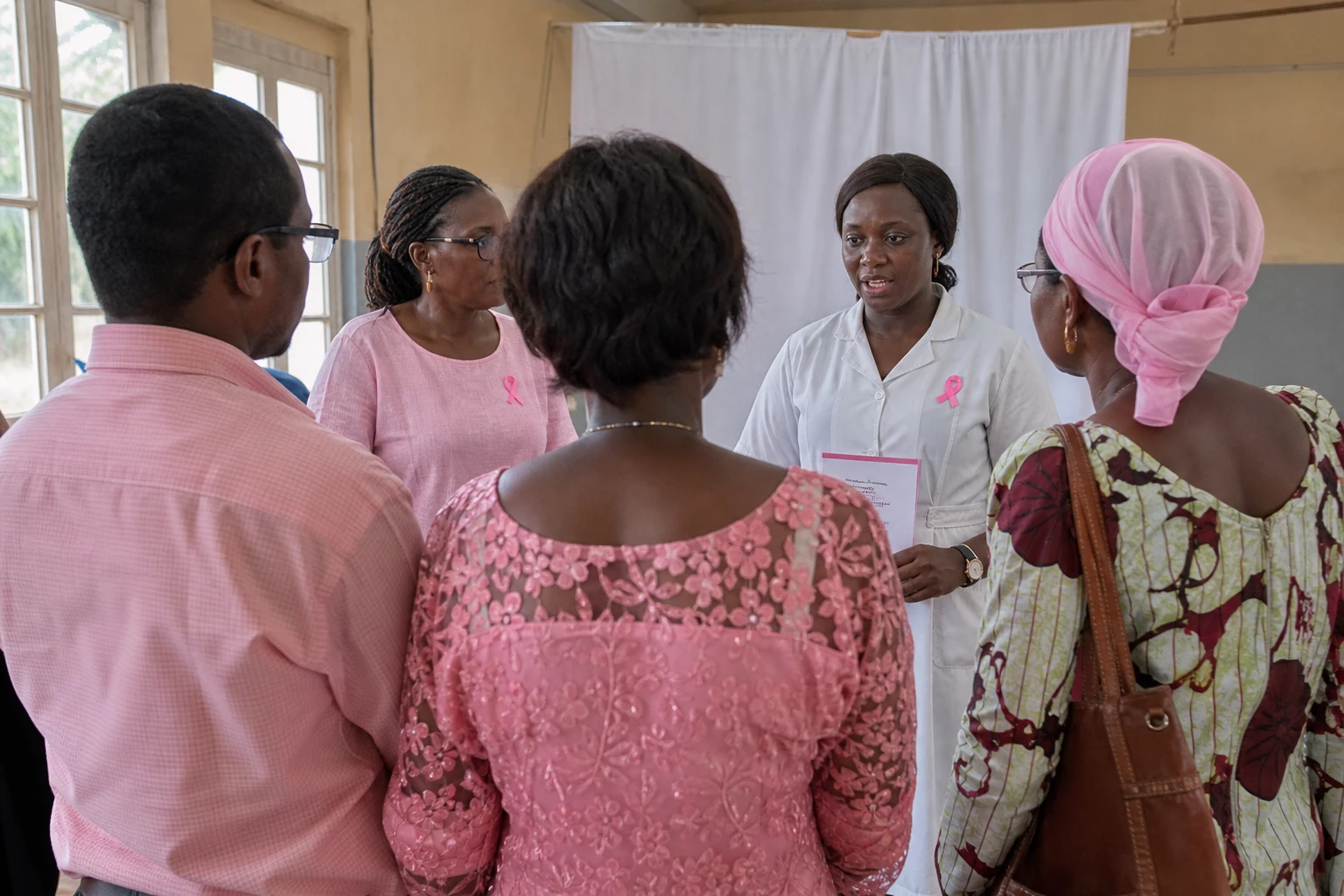
In Bangui, breast cancer is not dealt with only in consultation rooms. It is also discussed in markets, schools, businesses and families, where the disease is often still poorly understood. In the Central African Republic, associations and health professionals are now seeking to make screening a habit rather than a last resort.
In Bangui, information becomes a first health tool
The issue returns every year with Pink October, the international campaign devoted to breast cancer prevention and care. In the Central African Republic, this mobilisation has particular significance: national data remain limited and many patients still reach hospital when the disease is already advanced.
The Pasteur Institute of Bangui carries out awareness-raising and screening activities with local partners. In 2023, a free campaign was organised in several health facilities in Bangui and Bimbo, with support from civil society and health professionals. Radio Ndeke Luka documented the initiative at the time.
Activities have continued since then. In October 2023, the Pasteur Institute of Bangui announced a new campaign devoted to breast and cervical cancer. The institution said it had strengthened its diagnostic capacity following an earlier operation held on International Women’s Rights Day. The Central African outlet Corbeau News Centrafrique reported on it.
Survivors’ testimony helps break the silence
In this mobilisation, the voices of people directly affected have a central role. Mylène Limbio, a former patient, founded the Ô Fil des Femmes association in 2022 after undergoing a mastectomy. Today, she draws on her experience to encourage Central African women to seek medical advice sooner.
Her association works in places where information circulates most easily: markets, schools, businesses and professional communities. It also aims to reach a broader audience, including men. Breast cancer does not affect only women, even though the vast majority of those affected are female.
In 2023, Ô Fil des Femmes, the Central African Society of Gynaecologists and Obstetricians, and the Association of Midwives and Birth Attendants of the Central African Republic organised a campaign in Bangui and neighbouring municipalities. Screening locations were identified in several hospitals in the capital and in Bimbo. Oubangui Médias provided details of the arrangements and facilities involved.
This approach also helps clear up a common misunderstanding: screening does not mean that a person is already ill. It is about identifying an abnormality as early as possible, then referring the person to a professional who can confirm or rule out a diagnosis.
Diagnoses often come late, and capacity remains limited
Delayed consultation is one of the main obstacles. According to information reported by professionals in the oncology department of Bangui General Hospital, about 70% of patients are treated at an advanced stage. This figure should nevertheless be treated with caution, as the Central African Republic does not yet have a comprehensive national registry tracking all cases.
A fact-check by Centrafrique Check highlights this statistical weakness. The outlet cites specialists in Bangui and reports that the number of oncologists is very limited relative to the country’s population. The lack of consolidated data makes it harder to plan equipment, treatments and targeted campaigns.
International estimates nevertheless provide an indication of scale. The 2022 fact sheet from the Global Cancer Observatory, part of the International Agency for Research on Cancer, ranks breast cancer among the leading causes of new cancer cases in the Central African Republic. These figures are estimates, not an exhaustive count of patients followed in the country. The fact sheet on the Central African Republic is available here.
The challenge extends beyond the capital. In Bangui, patients have access to more facilities, specialists and occasional campaigns. In secondary cities and rural areas, travel to an adequately equipped centre can delay consultation. The cost of transport, tests and treatment also weighs on households, particularly when incomes come mainly from the informal economy.
A national issue in a regionally integrated health system
The Central African Republic is a member of the Central African Economic and Monetary Community (CEMAC), which brings together six Central African countries around common economic and monetary policies. Yet cancer care remains largely dependent on national capacity, medical partnerships and local initiatives.
In this context, the Pasteur Institute of Bangui plays an important role in diagnosis and awareness-raising. But occasional campaigns cannot replace a lasting strategy. Such a strategy requires trained staff, accessible tests, a clear care pathway and support for patients after they receive a diagnosis.
Recent initiatives nevertheless show that networks are taking shape. In 2025, the World Health Organization reported awareness-raising activities in Bangui and Bangassou, with the participation of the Pasteur Institute of Bangui. Nearly 500 young girls, students and women took part in discussions on early signs and prevention. The WHO bulletin in the Central African Republic reports on the activities.
The next challenge: moving from campaigns to follow-up
Awareness-raising can change behaviour, but it must lead to actual care. Anyone who discovers a lump or an unusual change in the breast should be able to obtain an examination promptly, receive medical confirmation and, if necessary, get treatment.
Men are also part of the challenge. Their limited presence in campaigns can reinforce the mistaken idea that breast cancer affects only women. The testimony of male patients therefore helps broaden the message and reduce the shame that sometimes delays consultation.
For the Central African Republic, the issue therefore extends beyond the month of October. It encompasses prevention, medical training, access to care and data collection. In Bangui and across the hinterland, the next step will be to turn awareness campaigns into regular, measurable and accessible care pathways. Only then can early detection become a genuine public health tool, rather than an annual appointment.