Algeria
 Egypt
 Libya
 Morocco
 Sudan
 Tunisia
 Benin
 Burkina Faso
 Cabo Verde
 Côte d'Ivoire
 Ghana
 Guinea
 Guinea-Bissau
 Liberia
 Mali
 Mauritania
 Niger
 Nigeria
 Senegal
 Sierra Leone
 The Gambia
 Togo
 Cameroon
 Central African Republic
 Chad
 DR Congo
 Equatorial Guinea
 Gabon
 Republic of the Congo
 São Tomé and Príncipe
 Burundi
 Comoros
 Djibouti
 Eritrea
 Ethiopia
 Kenya
 Madagascar
 Malawi
 Mauritius
 Mozambique
 Rwanda
 Seychelles
 Somalia
 South Sudan
 Tanzania
 Uganda
 Botswana
 Eswatini
 Lesotho
 Namibia
 South Africa
 Zambia
 Zimbabwe
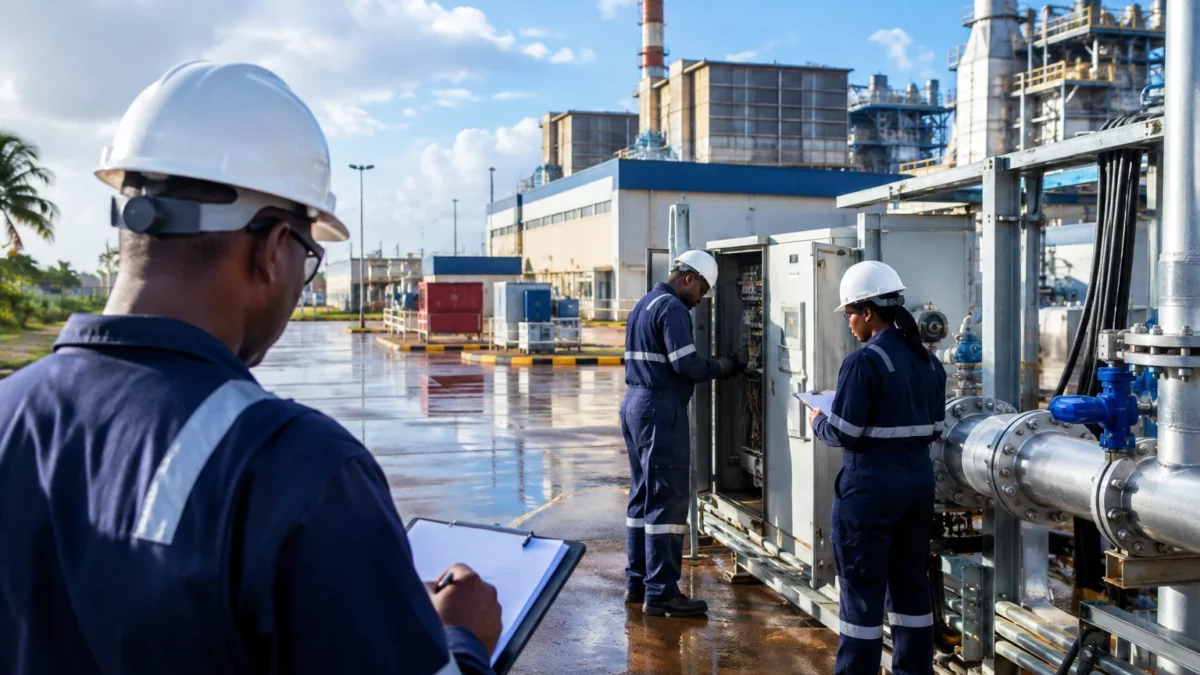
In Cabinda, having a power plant is not enough if equipment runs short of fuel or does not operate at full capacity. To reduce this vulnerability, Angola is building a major solar facility in the province, which is separated from the rest of the country by the Democratic Republic of the Congo (DRC).
An isolated grid still heavily dependent on thermal power
Cabinda lies in northern Angola, on the Atlantic coast. Its geographical isolation makes it difficult to supply the province from the national grid. It therefore relies heavily on thermal power plants, whose operation depends on the availability of fuel and equipment.
PRODEL’s 2023 activity report, published by Angola’s state-owned electricity generation company, gives a measure of this dependence: thermal power plants accounted for 99.4% of the province’s electricity production. The Malembo plant, with an installed capacity of 145 megawatts (MW), supplied nearly 93% of production. But of the 185.8 MW of thermal capacity installed in Cabinda, only 123.2 MW was available at the time.
These figures describe the situation in 2023, not the capacity currently available. They nevertheless show the potential gap between capacity on paper and electricity that can actually be supplied. For households, businesses and public services, reliability depends as much on maintenance and fuel supplies as on theoretical capacity.
Solar plant due in 2029
On 16 November 2026, Angolan authorities began work in Ngoio on a 90-megawatt-peak (MWp) photovoltaic plant, a measure of the panels’ maximum output under standard conditions. The project also includes a battery storage system with a stated capacity of 25 megawatt-hours (MWh), allowing some of the energy produced to be stored for later use.
Angola’s Ministry of Energy and Water expects the plant to enter service in June 2029, after three years of construction and installation. The project has been awarded to Egypt’s Elsewedy Electric on behalf of PRODEL. Authorities estimate that the facility could benefit more than 180,000 people; this is a stated target, and its impact will also depend on connection to the grid and local distribution.
Storage can help smooth variable solar output, but its power rating is not the same as an amount of energy. The 25 MWh figure indicates storage capacity; on its own, it does not guarantee a continuous power supply. How long the stored energy can be delivered will depend, among other things, on the size of the system and demand when the batteries are called on.
The project’s cost had been estimated at about €141.8 million in earlier documents. The financing structure referred, among other things, to agreements with HSBC, but publicly available information reviewed does not establish whether final financial close was reached on the terms originally envisaged.
Solar power cannot replace transmission lines
The plant addresses an immediate vulnerability, but does not resolve Cabinda’s energy isolation. In July 2026, an Angolan presidential decree approved the terms of a concession for an electricity corridor running through Soyo, Matadi, Inga, Cabinda and Moanda. The project envisages lines linking Angola with the DRC and is intended to strengthen the province’s supply while paving the way for regional electricity trade.
The corridor forms part of older plans for interconnection between Angola and the DRC. Their implementation will nevertheless require funding, cross-border construction and coordination between operators. Institutional announcements therefore do not mean that Cabinda is already connected, or that the new lines will be available by a specific date.
The province also has gas resources linked to oil production. Angola’s Natural Gas Master Plan, published in March 2025, includes Cabinda among the areas that could benefit from supply for the domestic market. Turning this potential availability into a reliable supply for power plants remains a matter of infrastructure and economic choices.
A local and regional challenge
For residents, the test will be the regularity of electricity supply in neighbourhoods, health facilities and businesses, not just installed capacity. Businesses and households that rely on backup solutions could also be affected by changes in generation costs and grid stability. The solar plant alone does not guarantee lower bills.
Nationally, the project adds to the diversification of Angola’s power mix, in which hydropower, thermal power and solar are expected to coexist. Regionally, interconnection with the DRC could bring the electricity systems of Central and Southern Africa closer together. Angola is a member of the Southern African Development Community (SADC), while the planned lines to the DRC also concern electricity trade in Central Africa.
The next steps will be decisive: actual progress on construction in Ngoio, confirmation of financing, connection of the plant to the provincial grid and the timetable for interconnections. How these elements come together will determine whether Cabinda gains an additional source of generation or a power supply that is genuinely more resilient to disruption.