Algeria
 Egypt
 Libya
 Morocco
 Sudan
 Tunisia
 Benin
 Burkina Faso
 Cabo Verde
 Côte d'Ivoire
 Ghana
 Guinea
 Guinea-Bissau
 Liberia
 Mali
 Mauritania
 Niger
 Nigeria
 Senegal
 Sierra Leone
 The Gambia
 Togo
 Cameroon
 Central African Republic
 Chad
 DR Congo
 Equatorial Guinea
 Gabon
 Republic of the Congo
 São Tomé and Príncipe
 Burundi
 Comoros
 Djibouti
 Eritrea
 Ethiopia
 Kenya
 Madagascar
 Malawi
 Mauritius
 Mozambique
 Rwanda
 Seychelles
 Somalia
 South Sudan
 Tanzania
 Uganda
 Botswana
 Eswatini
 Lesotho
 Namibia
 South Africa
 Zambia
 Zimbabwe
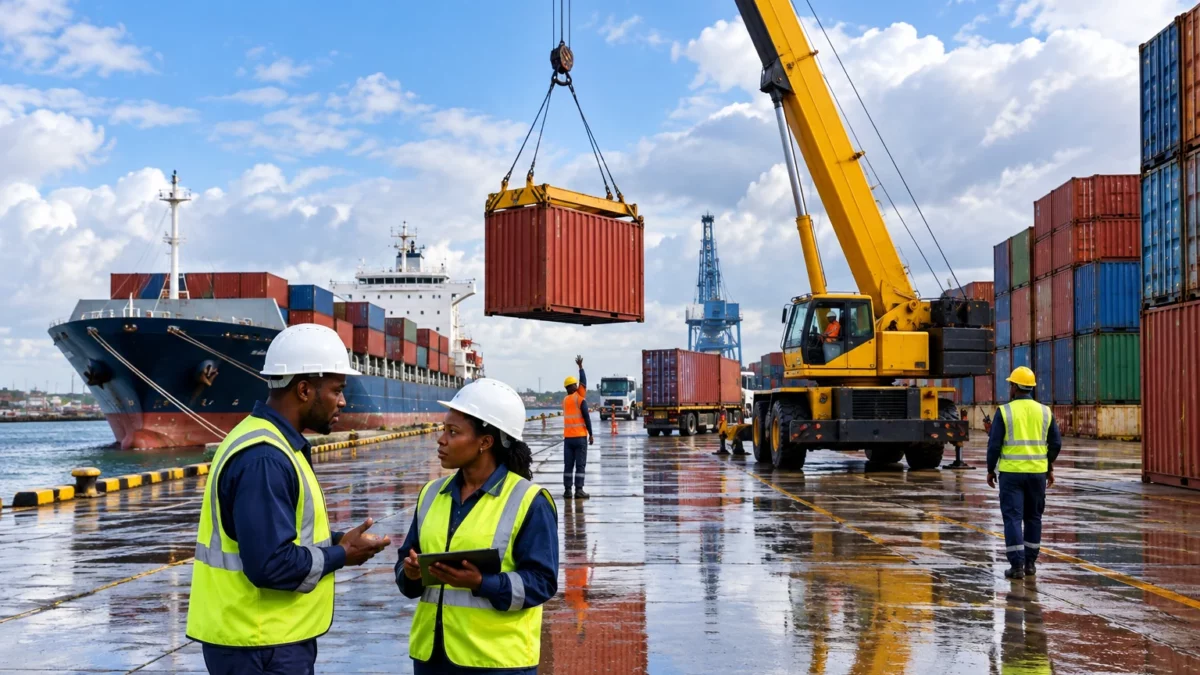
A stronger quay alone is not enough to make trade flow more smoothly. But in Luanda, the planned installation of cranes able to load and unload ships from the quay could change the pace of port operations and the terminal’s role in regional supply chains.
A strategic port in a regional network
The port of Luanda is Angola’s main maritime gateway. The country is in southern Africa and is also a member of the Southern African Development Community (SADC), the regional economic cooperation organisation. Its container terminal connects Angolan importers and exporters to international shipping routes and also serves as a transit point to neighbouring markets.
The terminal, operated by DP World, has a 610-metre quay. Until now, its operations have relied in part on mobile cranes. The announced project aims to prepare the structure for STS gantry cranes — cranes installed on rails that transfer containers between ships and the quay. DP World describes the site as a commercial gateway for Angola and neighbouring regions. Details of the Luanda terminal offer an overview of its logistics role.
Foundations reinforced for the new cranes
On 17 November 2026, Angolan business outlet Mercado reported that DP World had tasked EDECS Group with designing and carrying out the quay reinforcement. A specialist port industry publication also reported that the contract had been awarded. The project covers the existing 610 metres of quay. The companies have not made the contract value or detailed schedule public.
The programme calls for 120 piles, one metre in diameter and up to 45 metres deep. These foundations are intended to help support the loads of the future gantry cranes. Integrity tests, ultrasonic inspections, dynamic tests and load tests are planned to assess their performance. The project also includes a new reinforced-concrete rear beam, an extension of the capping beam and the installation of crane rails.
The work also includes cables, conduits, electrical substations, water networks and fire-protection equipment. This less visible part is essential: the new equipment cannot operate without power and suitable infrastructure. The technical details were reported by Mercado in Angola and Port Strategy.
Expected gains, but still to be measured
STS gantry cranes can speed up container handling and reduce the time ships spend at the quay. They should also enable the terminal to handle larger vessels, subject to the capacity of the channel, its depth and the other port facilities. These are announced objectives, not results already observed: their scale will depend on completion of the project, commissioning of the cranes and the organisation of operations.
The effects could extend beyond the port itself. More predictable operations can reduce delays for shipping companies and businesses that import or export. Conversely, an increase in capacity does not automatically guarantee lower costs for traders or consumers. Tariffs, customs procedures, road access and the management of truck queues will also affect the final cost of transport.
For port workers and logistics operators, the shift to rail-mounted equipment could change the tasks involved and the skills required. Published information does not specify the expected impact on employment or the measures planned to support staff. These factors will matter in assessing the project’s local effects, beyond its technical performance.
One part of a wider expansion programme
The project is part of a separate investment plan announced by DP World. The company is planning, among other things, three STS gantry cranes, an extension of the quay to about 830 metres and an expansion of the terminal area. These projects are linked to a targeted increase in capacity, but the announcements do not mean that the work has been completed or that future volumes are guaranteed. DP World sets out its expansion programme in Luanda.
This development echoes that of the port of Dar es Salaam in Tanzania, where EDECS and DP World are also working together on port infrastructure. It is part of regional competition to attract shipping lines and strengthen trade corridors. For Angola, the challenge is to turn port investment into more efficient connections between ports, roads, railways and the country’s economic activities.
Monitoring will therefore focus on several milestones: completion of the foundations, actual installation of the cranes and progress on the announced extension. The benefits for Luanda and its SADC partners will depend as much on this work as on the ability to connect the terminal to businesses and transport corridors, without confining the expected gains to major operators.