Algeria
 Egypt
 Libya
 Morocco
 Sudan
 Tunisia
 Benin
 Burkina Faso
 Cabo Verde
 Côte d'Ivoire
 Ghana
 Guinea
 Guinea-Bissau
 Liberia
 Mali
 Mauritania
 Niger
 Nigeria
 Senegal
 Sierra Leone
 The Gambia
 Togo
 Cameroon
 Central African Republic
 Chad
 DR Congo
 Equatorial Guinea
 Gabon
 Republic of the Congo
 São Tomé and Príncipe
 Burundi
 Comoros
 Djibouti
 Eritrea
 Ethiopia
 Kenya
 Madagascar
 Malawi
 Mauritius
 Mozambique
 Rwanda
 Seychelles
 Somalia
 South Sudan
 Tanzania
 Uganda
 Botswana
 Eswatini
 Lesotho
 Namibia
 South Africa
 Zambia
 Zimbabwe
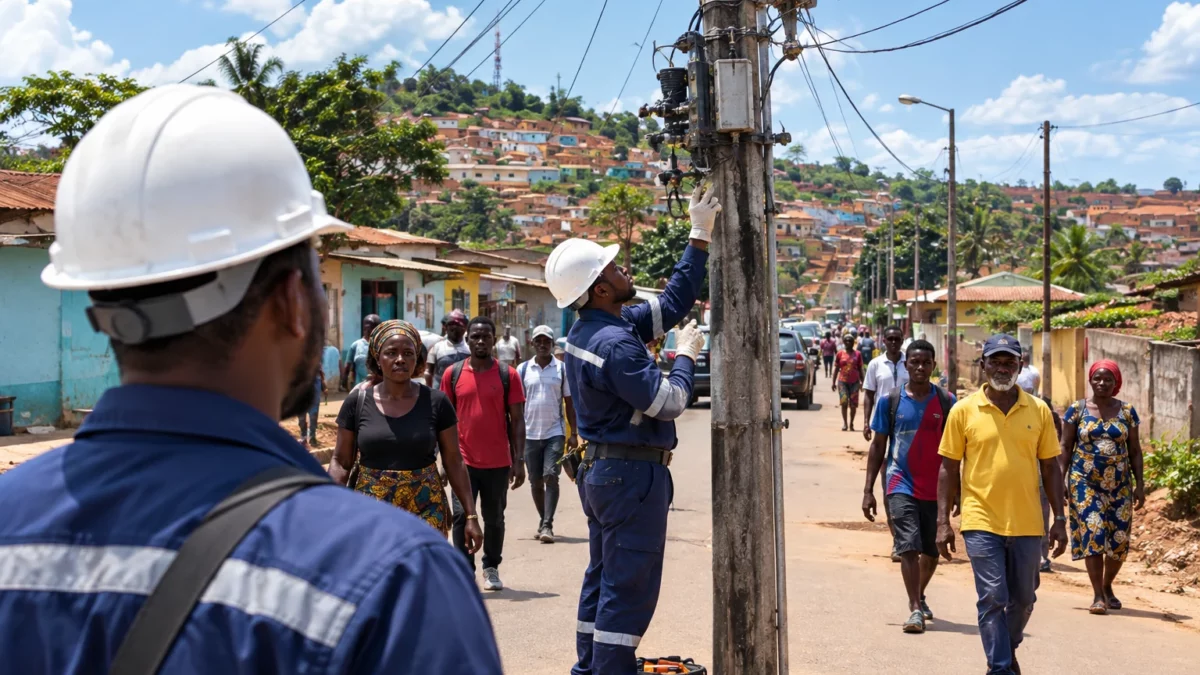
In Cabinda, access to electricity depends on more than the capacity shown on power plants’ nameplates. Some installed energy remains unavailable, while local networks struggle to deliver power reliably. The new Ngoio solar project aims to address this gap, but cannot, on its own, resolve all the province’s vulnerabilities.
A province still far from meeting its needs
Cabinda is an Angolan province separated from the rest of the national territory by a strip of coastline belonging to the Republic of the Congo and the Democratic Republic of the Congo. This geographical isolation makes the question of its connection to the national electricity grid particularly important.
Figures presented by provincial authorities in June 2026 illustrate the scale of the challenge: installed capacity stood at 198.37 megawatts (MW), but only 98.16 MW were available for supply. Governor Suzana Abreu estimated at the time that around 400 MW of capacity was needed to strengthen the system. These figures were reported by the Angolan media outlet O País. In February, the same newspaper had already described production difficulties at the thermal power plants in Malembo, Chibodo and Santa Catarina.
The distinction between installed capacity and the power actually available is essential. Ageing equipment, breakdowns or maintenance needs can reduce effective output. Even when electricity is generated, lines and substations must then be able to transport and distribute it. Urban neighbourhoods and inland communities are both affected, although interruptions are not necessarily distributed in the same way.
Ngoio project set to take three years
On 16 November 2026, Angolan authorities marked the start of construction of a photovoltaic power plant in the municipality of Ngoio. The project plans 90 megawatts-peak of solar capacity, combined with battery storage of 25 megawatt-hours (MWh). The ceremony and timetable were announced by the Angolan Ministry of Energy and Water.
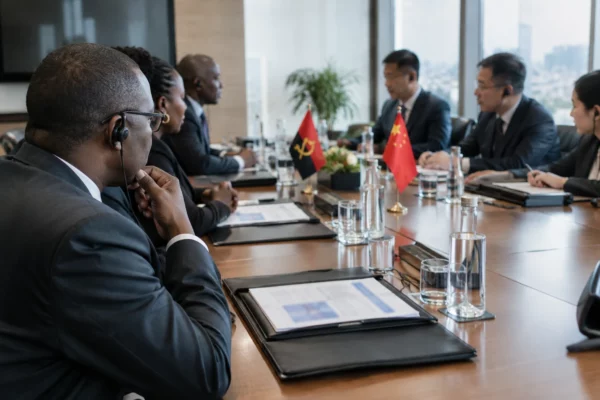
State-owned company PRODEL-EP is leading the project. Egypt’s Elsewedy group is to carry out the work, while South African engineering firm Zutari is responsible for supervision. The project also includes a 33/60-kilovolt substation and nine kilometres of overhead line. Commissioning is scheduled for June 2029, after three years of construction and installation.
Elsewedy describes the system as a grid-connected power plant complemented by a battery system. MW measure power at a given moment; MWh indicate a quantity of energy that can be stored or released. This reserve can help shift some solar generation to hours when sunlight diminishes. It does not, however, generate additional electricity or replace either dispatchable generation or a reliable grid.
The ministry estimates that more than 180,000 people will benefit from the installation. This figure is an official projection, not a record of connections already completed. Results will depend in particular on completion of the work, grid connection, battery maintenance and the capacity of the local network to distribute the energy.
Generation and transmission must advance together
The planned 90 MW represents a significant boost, but is still below the gap between the roughly 98 MW available in June and the provincial need estimated at 400 MW. This comparison gives an indication of scale, not a direct forecast: demand, the availability of existing power plants and operating conditions may change by 2029.
Solar power therefore addresses only part of the problem. Provincial figures also point to capacity losses at conventional power plants and a need to strengthen transmission and distribution. For households and small businesses, the difference will be measured less by the park’s nominal capacity than by the regularity of service, including in areas far from the main routes.
Another project is intended to connect Cabinda to the national electricity system through a link between Soyo and the province, including undersea cables. The project has faced delays in its procedures and preparatory work on land, according to the Angolan business media outlet Expansão. An operational link could provide an additional source of supply, but its timetable and delivery remain points to watch. The Ngoio solar plant and the cable thus address two different challenges: generating more power locally and better connecting Cabinda to the rest of the country.
An Angolan and regional issue
For Angola, the project is part of a strategy to diversify electricity sources. In Luanda, national decisions on infrastructure and investment must translate into tangible services in the provinces. The challenge is also institutional: PRODEL will have to oversee implementation and then ensure coordination with the bodies responsible for transmission and distribution.
At regional level, Angola is a member of the Southern African Development Community (SADC), which co-ordinates interconnection and energy co-operation projects. The country is not yet connected to the Southern African Power Pool, the regional electricity trading mechanism, according to the SADC. The community highlights, among other projects, the proposed link between Angola and Namibia. Improving supply in Cabinda therefore addresses a local need first, while forming part of a broader question: how to connect generation resources to people and neighbouring networks.
The next steps will be concrete: keep to the timetable through to June 2029, complete the associated equipment and check that the electricity generated actually reaches users. In Cabinda, success will be measured not only in installed megawatts, but also in fewer interruptions and continuity of service in the provincial capital and inland municipalities.