Algeria
 Egypt
 Libya
 Morocco
 Sudan
 Tunisia
 Benin
 Burkina Faso
 Cabo Verde
 Côte d'Ivoire
 Ghana
 Guinea
 Guinea-Bissau
 Liberia
 Mali
 Mauritania
 Niger
 Nigeria
 Senegal
 Sierra Leone
 The Gambia
 Togo
 Cameroon
 Central African Republic
 Chad
 DR Congo
 Equatorial Guinea
 Gabon
 Republic of the Congo
 São Tomé and Príncipe
 Burundi
 Comoros
 Djibouti
 Eritrea
 Ethiopia
 Kenya
 Madagascar
 Malawi
 Mauritius
 Mozambique
 Rwanda
 Seychelles
 Somalia
 South Sudan
 Tanzania
 Uganda
 Botswana
 Eswatini
 Lesotho
 Namibia
 South Africa
 Zambia
 Zimbabwe
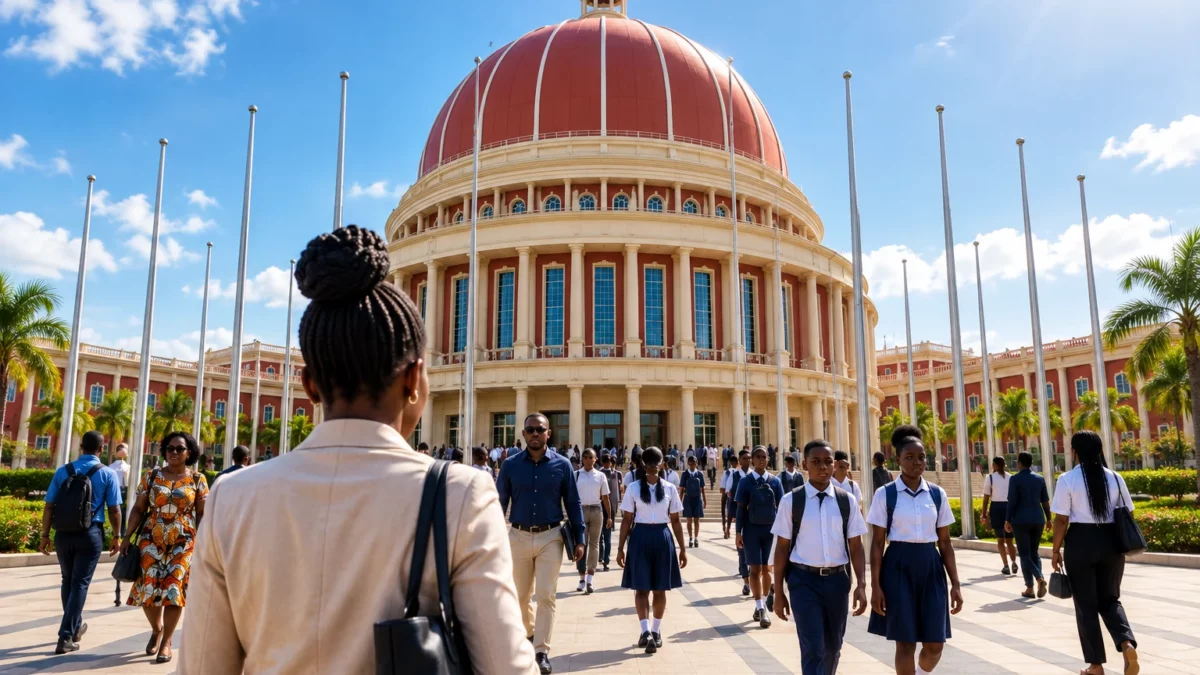
In Luanda, a visit to Parliament can open a door to its chambers and archives. On its own, it is not enough to bring elected representatives closer to citizens. In Angola, where more than one in two registered voters did not vote in 2022, the question is a concrete one: what can an institution do to ensure its role is better understood and representation makes a difference in everyday life?
A week to make the institution more accessible
The National Assembly is holding Parliament Week from 22 to 28 November 2026, marking the 34th anniversary of its institutionalisation. The programme, under the theme “Preserving history, strengthening democracy”, includes activities designed to bring the institution closer to the public. The announcement was made by its secretary-general, Manuel António Freire, according to Angolan media outlet Gira Notícias.
On 23 and 25 November, the “Open Parliament” initiative will allow visitors to discover the National Assembly palace and learn more about how it works. An exhibition of photographs and artworks, entitled “Traces of democracy”, traces Parliament’s evolution from the Council of the Revolution, created after independence, to the current legislature.
The programme also includes a session of the Children’s Parliament on 24 November. Two hundred and ten pupils representing Angola’s 21 provinces are due to debate issues related to childhood, family protection and information technology. On 26 November, a ceremony will pay tribute to members of the first legislature and unveil a monument in their memory. These events bring together history, civic education and public presence in a place usually dedicated to parliamentary business.
An institution at the heart of a lasting political landscape
Angola’s Parliament is part of a political trajectory marked by the dominance of the Popular Movement for the Liberation of Angola (MPLA), in power since independence in 1975. The first multiparty legislative elections were held in 1992. Since then, several parties have taken seats in the Assembly, although the MPLA has retained its majority and leads the government.
In the general election of 24 August 2022, the MPLA won 124 of the 220 seats. The National Union for the Total Independence of Angola (UNITA), the main opposition force, won 90. Three other parties shared the remaining six seats. These final results were published by the National Electoral Commission (CNE), which is responsible for organising elections. They describe a plural Assembly, but one dominated by two parties.
The 2022 election also highlighted low turnout. Of nearly 14.4 million registered voters, about 6.45 million voted, or 44.82%. The abstention rate was therefore 55.18%, according to the CNE’s results. The Inter-Parliamentary Union confirms the turnout figure. A study of electoral participation in Angola, based on commission data, also notes a sharp rise in abstention compared with 2017.
A visit cannot replace political accountability
Opening the doors makes the place more familiar. Visitors can see where their representatives sit and learn about the country’s institutional history. For young people, these exchanges can also give concrete meaning to concepts such as parliamentary debate, passing a law or scrutinising government action.
But trust depends less on occasional access to the building than on the work done between elections. Citizens expect MPs to represent their concerns, explain their decisions and report on their results. An exhibition or visit cannot, on its own, show whether these expectations are being met. It can, however, give visitors a frame of reference for better understanding institutions and their responsibilities.
The challenge also varies between different groups. In Luanda, students can more easily attend an event organised in the capital. For people in other provinces, distance and travel costs make a visit less accessible. The presence of pupils representing all 21 provinces at the Children’s Parliament session broadens the programme’s reach, but does not mean that all young people or communities are represented.
Election figures also serve as a reminder that abstention should not be reduced to simple distrust of elected representatives. Not voting can have several causes, related in particular to registration, access to polling or political disengagement. An Afrobarometer survey conducted in Angola in 2024 found particularly high self-reported abstention among 18- to 25-year-olds. This finding makes civic education initiatives relevant, without proving that a visit to Parliament will be enough to change voting behaviour.
A democratic challenge extending beyond the capital
Angola is a member of the Southern African Development Community (SADC), a regional organisation that brings neighbouring states together around cooperation and integration. The vitality of representative institutions, electoral participation and the place given to young people are shared concerns across the region, although each country follows its own political path.
Parliament Week therefore offers a glimpse of an institution and its history, but its impact will be judged beyond these few days. The children’s session, visits and tribute to the first MPs are the announced elements of the programme. The question is whether this opening will become part of a lasting relationship: regular access to parliamentary proceedings, exchanges with elected representatives and consideration of concerns expressed in the different provinces. As the next elections, scheduled for 2027, approach, citizen participation will remain a key indicator of this relationship.
Parliament Week programme announced in Luanda · Final results of the 2022 general election published by the CNE · Parliamentary data and voter turnout from the Inter-Parliamentary Union · Study of electoral participation in Angola, 1992-2022