Algeria
 Egypt
 Libya
 Morocco
 Sudan
 Tunisia
 Benin
 Burkina Faso
 Cabo Verde
 Côte d'Ivoire
 Ghana
 Guinea
 Guinea-Bissau
 Liberia
 Mali
 Mauritania
 Niger
 Nigeria
 Senegal
 Sierra Leone
 The Gambia
 Togo
 Cameroon
 Central African Republic
 Chad
 DR Congo
 Equatorial Guinea
 Gabon
 Republic of the Congo
 São Tomé and Príncipe
 Burundi
 Comoros
 Djibouti
 Eritrea
 Ethiopia
 Kenya
 Madagascar
 Malawi
 Mauritius
 Mozambique
 Rwanda
 Seychelles
 Somalia
 South Sudan
 Tanzania
 Uganda
 Botswana
 Eswatini
 Lesotho
 Namibia
 South Africa
 Zambia
 Zimbabwe
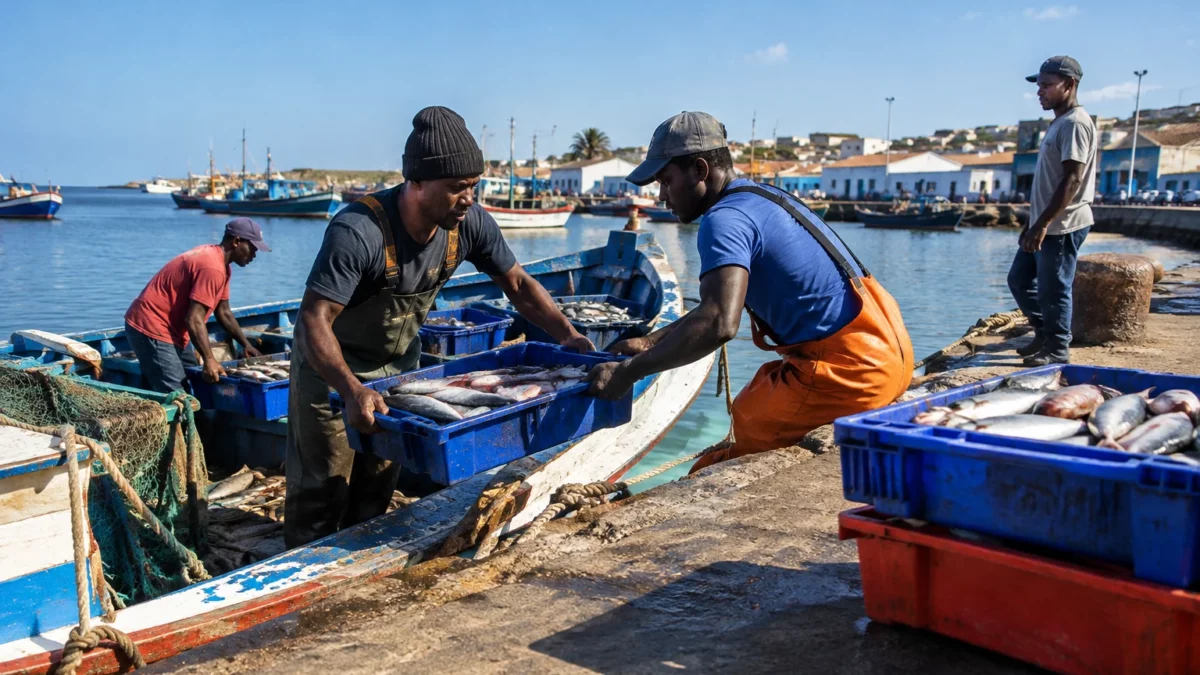
At Porto Amboim, on Angola’s Atlantic coast, a deep-water port project could open a new logistics gateway in the centre of the country. But several steps remain between authorisation for spending of nearly $500 million and the commissioning of a facility.
A project moves from studies to procurement
On 12 November 2026, President João Lourenço signed a decree authorising spending equivalent to $499.9 million to develop the port in Cuanza Sul province. Published in the Official Gazette, the text opens a simplified procurement procedure with the Japanese consortium Toyota Tsusho Corporation–TOA Corporation.
The decision marks progress on a memorandum signed in August 2025 by Angola’s Ministry of Transport and the two companies. At the time, it provided for further studies, an examination of engineering solutions and an assessment of financing. The ministry said that technical, economic and environmental feasibility studies had been completed in May 2025.
However, budget authorisation should be distinguished from construction of the project. The decree provides for external financing in the form of an export credit, but the public information consulted does not specify the lender, the credit terms or the duration of the works. The opening of the procedure does not yet mean that the contract has been signed, funds are available or work has started.
The project as announced aims to build a deep-water port and a complex of port, logistics and industrial facilities, with areas linked to maritime tourism. The planned equipment is intended to support activities in the Kwanza and Benguela maritime basins. It has not yet been built.
Connecting the port to Cuanza Sul’s economic activity
Porto Amboim is in a province where several economic activities converge, including fishing, agriculture and hydrocarbons. The project aims to expand handling and transport options. In time, greater port capacity could make it easier to move goods produced in the region and ease some logistical constraints.
Developing mining potential is also cited as part of Angola’s diversification drive. But the existence of resources does not guarantee their commercial exploitation: available volumes, extraction projects and infrastructure linking production sites to the port matter just as much as the quays. The presidential decree presents the port as a way to strengthen national logistics and support economic diversification, without detailing the expected mineral flows.
The benefits will therefore depend on reliable road and rail connections, competitive port services and sufficient demand. Exporting companies could gain from new capacity. For residents of Porto Amboim and Cuanza Sul, the impact will also depend on jobs created, access to markets and local activities actually associated with the project. These benefits are not automatic.
An additional port in a region already organised around Lobito
The project forms part of a broader transport strategy. In southern Africa, Angola is working with the Democratic Republic of the Congo and Zambia, within the Southern African Development Community (SADC), to co-ordinate the Lobito Corridor. This network links the port of Lobito to the Congolese mining basins and is due to be extended to Zambia.
SADC has supported the creation of a common framework among the three countries to harmonise rules, co-ordinate infrastructure and facilitate transit. The corridor includes the Benguela railway and connection projects. It should not be confused with Porto Amboim: they are distinct facilities and routes, even though they form part of the same effort to strengthen regional trade.
The port of Lobito already has an operational rail link to the DRC border. Porto Amboim, by contrast, still needs to clarify its connections and role in the national network. Its proximity to the Kwanza and Benguela maritime basins could expand the country’s logistics offer, but does not in itself prove that it will capture a share of mineral exports from the DRC or Zambia.
Next steps will show whether the investment delivers
For regional operators, the central question will be the total cost of transport: moving a product to the port, handling it and then exporting it. For the Angolan state, the challenge is also to diversify an economy historically dependent on hydrocarbons and better connect the provinces to markets. At the same time, the choice of external financing makes it important to monitor the financial terms and contractual responsibilities.
Success will be measured less by the announced amount than by the infrastructure actually delivered, its connection to roads and rail, and the goods it can handle. The contract timetable, credit terms and technical specifications of the future port therefore remain to be clarified.
At SADC level, Porto Amboim adds to efforts to diversify access to the sea and bring landlocked economies closer to international markets. For Angola, whose capital is Luanda, the challenge is to turn these projects into complementary services rather than isolated infrastructure. The next step will be the conclusion of the contract and publication of more precise details about its financing and implementation.
Details of the decree and amount are reported in the official text and corroborated by an Angolan media outlet. The Ministry of Transport confirms the history of the studies and the 2025 memorandum; SADC documents the regional framework for the Lobito Corridor.