Algeria
 Egypt
 Libya
 Morocco
 Sudan
 Tunisia
 Benin
 Burkina Faso
 Cabo Verde
 Côte d'Ivoire
 Ghana
 Guinea
 Guinea-Bissau
 Liberia
 Mali
 Mauritania
 Niger
 Nigeria
 Senegal
 Sierra Leone
 The Gambia
 Togo
 Cameroon
 Central African Republic
 Chad
 Equatorial Guinea
 Gabon
 Republic of the Congo
 São Tomé and Príncipe
 Burundi
 Comoros
 Djibouti
 Eritrea
 Ethiopia
 Kenya
 Madagascar
 Malawi
 Mauritius
 Mozambique
 Rwanda
 Seychelles
 Somalia
 South Sudan
 Tanzania
 Uganda
 Angola
 Botswana
 Eswatini
 Lesotho
 Namibia
 South Africa
 Zambia
 Zimbabwe
A financial investigation opened in Belgium has brought a central question for the Democratic Republic of the Congo back into focus: who really benefits from the revenues generated by copper and cobalt in Katanga? Searches announced in Brussels give a judicial follow-up to allegations made by Congolese organisations. They do not, however, constitute proof of guilt.
Allegations originating in Katanga
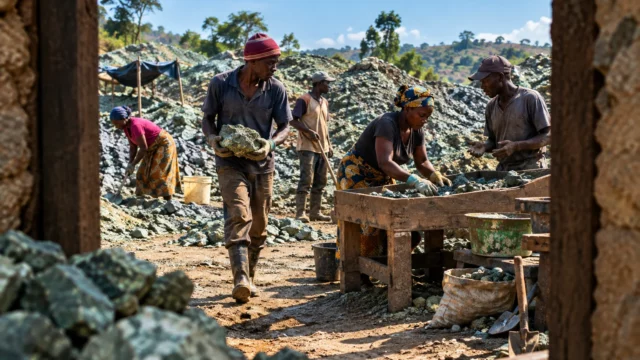
The legal action has its roots in the provinces of Haut-Katanga and Lualaba, in the south-east of the DRC. This region, often referred to by its historic name of Katanga, accounts for a significant share of Congolese copper and cobalt activity. These minerals supply global industrial supply chains, particularly those for batteries and electrical equipment.
On 8 July 2025, Katangese civil society organisations and former officials of the state-owned mining company Gécamines filed a complaint with the Belgian federal prosecutor’s office. The complainants allege embezzlement linked to mining resources, followed by the laundering of funds in Belgium. These allegations remain to be established in court. The Congolese outlet Opinion Info reported the filing of the complaint. Separate accounts, including those by Le Monde and Deutsche Welle, confirm this stage of the proceedings.
The NGOs maintain that people close to President Félix Tshisekedi may have benefited from mining revenues that bear no relation to their declared resources. The Congolese presidency had not commented on the case in the information available. Those implicated have not been convicted, and the filing of a complaint is not enough to confirm the facts it describes.
What the searches establish — and what they do not
Searches in Brussels and its outskirts were reported on 15 October 2026. According to available accounts, the Belgian federal prosecutor’s office confirmed operations as part of an investigation into suspected money laundering, without making public the names of those targeted. It also did not confirm that the searched premises belonged to members of the presidential family. Africanews reported the prosecutor’s confirmation, while Focus Actu relayed the response of the complainants’ group.
This distinction is essential: public information confirms that investigative measures have taken place, but does not make it possible to independently verify the identities of those concerned or the details of the material seized. A search is intended to find evidence; on its own, it does not prove that an offence has been committed. The prosecutor’s office has not publicly confirmed all the claims made by the complainants.
Lawyers Bernard Maingain and Hervé Diakese represent the group, according to reports on the proceedings. The complainants say that some of the individuals concerned may be Belgian nationals or reside in Belgium. In the absence of public judicial confirmation of their identities, these details must remain attributed to their sources and not be presented as established facts.
Mining transparency and local benefits
For residents of mining areas, the issue is not limited to assets that might be found abroad. It also concerns how contracts, public revenues and economic benefits are distributed locally. The allegations made by the NGOs specifically concern a possible gap between the value of the resources extracted and the benefits accruing to the state and local communities.
Gécamines, a Congolese state-owned company, has historically played a prominent role in the sector. But mining also involves private companies, subcontractors and international trading networks. Workers, traders and local services are not affected in the same way as company executives or public officials: the former experience the practical effects of the activity, while decisions on concessions and revenues are often made at other levels.
An investigation in Belgium can examine possible financial flows or assets located on its territory, if prosecutors gather the necessary evidence. It does not replace Congolese scrutiny of contracts, payments and the use of public revenues. To verify the allegations in full, investigators will therefore need to establish links between the presumed origin of the funds, their movement and the people who may have benefited from them.
A case being followed across borders
The proceedings are taking place amid political tensions in the DRC. The country faces persistent insecurity in the east, while domestic debate also concerns institutions, the opposition and the rules governing power. According to the information available, these issues are not linked to the Belgian investigation. They nevertheless make any allegation involving the president’s circle politically sensitive.
The cross-border dimension also matters. The DRC belongs to the Southern African Development Community (SADC) and the East African Community (EAC), two regional blocs that bring countries closer on economic and security issues. The Belgian case is a reminder that part of the Congolese mining chain extends beyond the continent: revenues and investments can cross several jurisdictions, making judicial cooperation important, without relieving Congolese institutions of their own oversight responsibilities.
What happens next will depend on decisions by the prosecutor’s office and any findings from the investigation. At this stage, public information reports neither established guilt nor a final conclusion. The case puts two requirements to the test at once: seriously examining civil society’s allegations while preserving the presumption of innocence of those concerned.