Algeria
 Egypt
 Libya
 Morocco
 Sudan
 Tunisia
 Benin
 Burkina Faso
 Cabo Verde
 Côte d'Ivoire
 Ghana
 Guinea
 Guinea-Bissau
 Liberia
 Mali
 Mauritania
 Niger
 Nigeria
 Senegal
 Sierra Leone
 The Gambia
 Togo
 Cameroon
 Chad
 DR Congo
 Equatorial Guinea
 Gabon
 Republic of the Congo
 São Tomé and Príncipe
 Burundi
 Comoros
 Djibouti
 Eritrea
 Ethiopia
 Kenya
 Madagascar
 Malawi
 Mauritius
 Mozambique
 Rwanda
 Seychelles
 Somalia
 South Sudan
 Tanzania
 Uganda
 Angola
 Botswana
 Eswatini
 Lesotho
 Namibia
 South Africa
 Zambia
 Zimbabwe
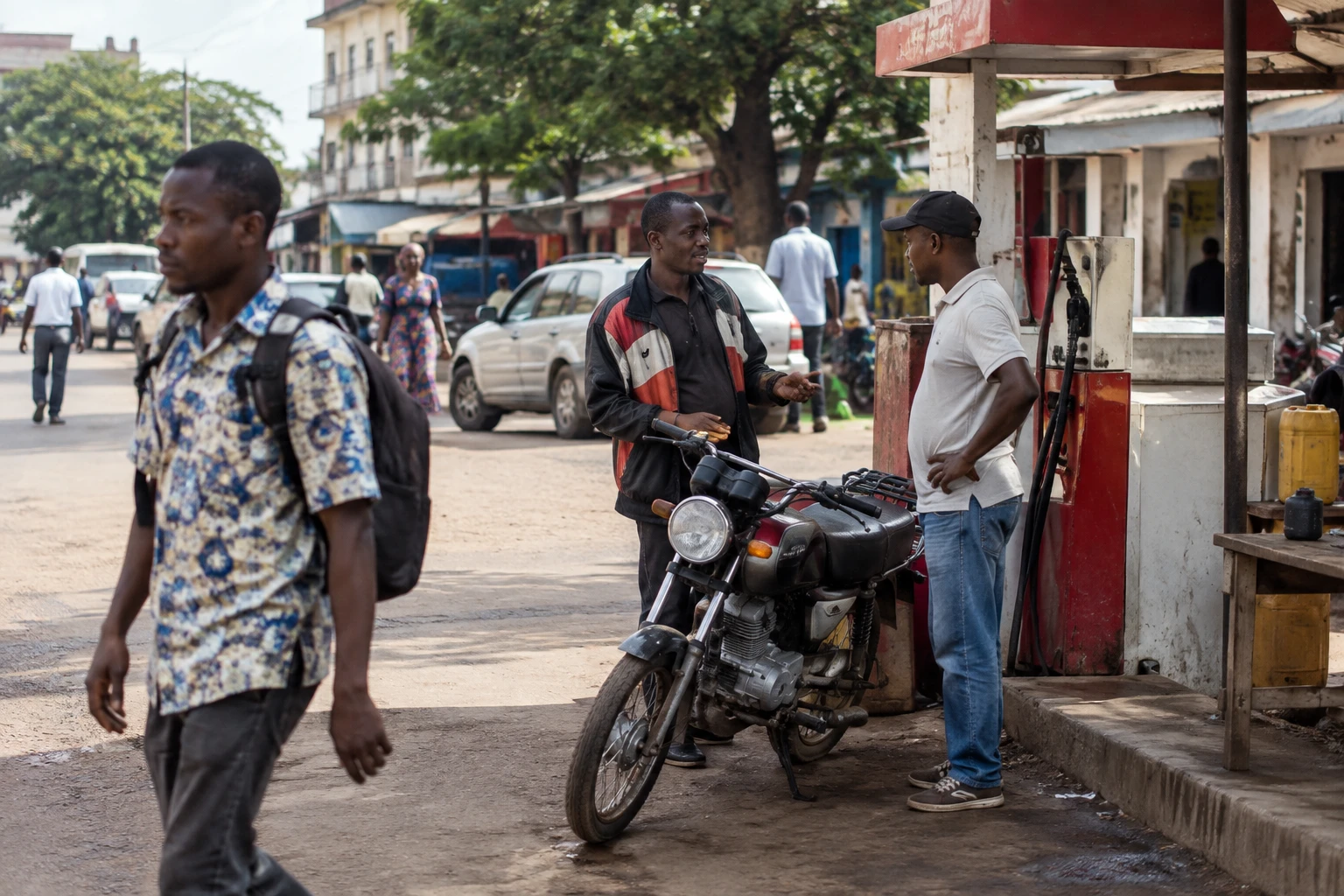
In Bangui, the cost of daily travel also depends on decisions made far from service stations: when the price per litre rises, drivers, customers and traders have to absorb the extra cost or scale back their activities. This Monday, 12 October 2026, a call to suspend economic life in the capital has brought this tension to the fore, but has not won unanimous support among those who earn their living from transport.
A recent increase, with prices varying by buyer
The Central African government announced a new fuel price schedule on 1 October. For private customers, the price of a litre of petrol rose from 1,050 to 1,150 CFA francs, while diesel went from 1,250 to 1,400 CFA francs. The increase is therefore not uniform: it amounts to 100 francs for petrol and 150 francs for diesel in these categories. Prices charged to large consumers are different.
Two Central African media outlets reported these figures and the date they came into effect. The government justified the decision by citing supply difficulties and pressure on public finances. The organisations opposing the increase, for their part, have highlighted the lack of consultation and its cost to households. These explanations reflect distinct interests; on their own, they are not enough to establish precisely the respective shares of import costs, taxes and margins in the final price.
Civil society platform I Gwé and the Observatory for Democratic Governance in the Central African Republic (OGDC) have called for a “dead city” day in Bangui on 12 October. Their call targets transport, shops and everyday activities in particular. This is a call for mobilisation: the available information alone does not make it possible to conclude how widespread it will be or whether it will be fully observed across the capital.
Drivers and passengers do not bear the same costs
For moto-taxi drivers, the increase directly affects each day’s earnings. In the testimony gathered for this article, Éric Pavel explains that he is struggling to buy fuel at the new price. He also says that raising fares risks driving away customers, while keeping the old fares reduces his margin. This testimony illustrates a practical difficulty, but is not a representative measure of all drivers.
The moto-taxi union has taken a different position from the organisations behind the call. Its president, Marcel Nzapayembi, says the increase affects its members, but rejects a day without work. He is urging drivers to work and favouring dialogue with the authorities. He says his organisation represents around 50,000 drivers; this figure is the union’s own claim and has not been confirmed by an independent source consulted.
This disagreement reveals an economic as well as a political dilemma. A day without earnings may increase pressure on the government, but it also deprives daily wage workers of immediate income. Conversely, continuing to work allows drivers to earn for the day, while leaving them and their passengers to manage the extra cost. Traders and households may also be affected if the transport of people and goods becomes more expensive.
The government, for its part, has urged the public to continue with their activities and says it favours dialogue. The issue is therefore both the level of prices and the way the decision was made, explained and potentially discussed with the parties concerned.
A precedent that highlights the trade-offs facing the CAR
This increase follows several recent price revisions. In January 2023, prices rose sharply; then a reduction announced in May 2025 brought the price of a litre of petrol down to 1,050 CFA francs and diesel to 1,250 francs. These reference points, reported by Radio Ndeke Luka and Radio Guira, put the October 2026 change into perspective: for private customers, the new prices reverse that reduction for both products concerned.
The issue extends beyond Bangui. The Central African Republic is landlocked and depends on supplies routed through regional corridors. The pump price therefore depends on transport costs, fuel availability and national pricing decisions. When transport becomes more expensive, the effects can feed through to travel, services and the delivery of goods to markets. The scale of the impact varies by location: residents of the capital, where moto-taxis operate, do not face exactly the same constraints as people in secondary towns or rural areas.
The CAR is a member of the Central African Economic and Monetary Community (CEMAC), which brings six countries together through economic cooperation and a common currency. This does not mean that pump prices are identical across the sub-region: pricing policies and supply chains remain national. However, regional trade and the routes taken by petroleum products mean that developments in neighbouring markets matter to Bangui.
Dialogue, the authorities’ next test
The 2023 precedent also shows that changing a price does not automatically resolve difficulties accessing fuel. A report by the International Monetary Fund on the CAR describes the trade-offs between public revenue, regulated prices and supply. It notes, in particular, that domestic prices can interact with the informal market and cross-border flows. This finding points to the need to examine pricing and distribution mechanisms, rather than reducing the debate to a choice between protest and a return to normal activities.
For the authorities, the challenge is to make the price structure understandable and address concerns about purchasing power without ignoring budgetary and logistical constraints. For civil society organisations and unions, the challenge is to make demands heard that are sometimes different: the former seek the increase’s withdrawal or revision, while the latter favour dialogue and protecting incomes.
In Bangui, 12 October is therefore a test of mobilisation and the capacity to negotiate. What happens next will depend on the government’s response, whether discussions are opened and how prices evolve. For Central Africans, the immediate question remains very practical: who will bear the extra cost of fuel, and under what rules?