Egypt
 Libya
 Morocco
 Sudan
 Tunisia
 Benin
 Burkina Faso
 Cabo Verde
 Côte d'Ivoire
 Ghana
 Guinea
 Guinea-Bissau
 Liberia
 Mali
 Mauritania
 Niger
 Nigeria
 Senegal
 Sierra Leone
 The Gambia
 Togo
 Cameroon
 Central African Republic
 Chad
 DR Congo
 Equatorial Guinea
 Gabon
 Republic of the Congo
 São Tomé and Príncipe
 Burundi
 Comoros
 Djibouti
 Eritrea
 Ethiopia
 Kenya
 Madagascar
 Malawi
 Mauritius
 Mozambique
 Rwanda
 Seychelles
 Somalia
 South Sudan
 Tanzania
 Uganda
 Angola
 Botswana
 Eswatini
 Lesotho
 Namibia
 South Africa
 Zambia
 Zimbabwe
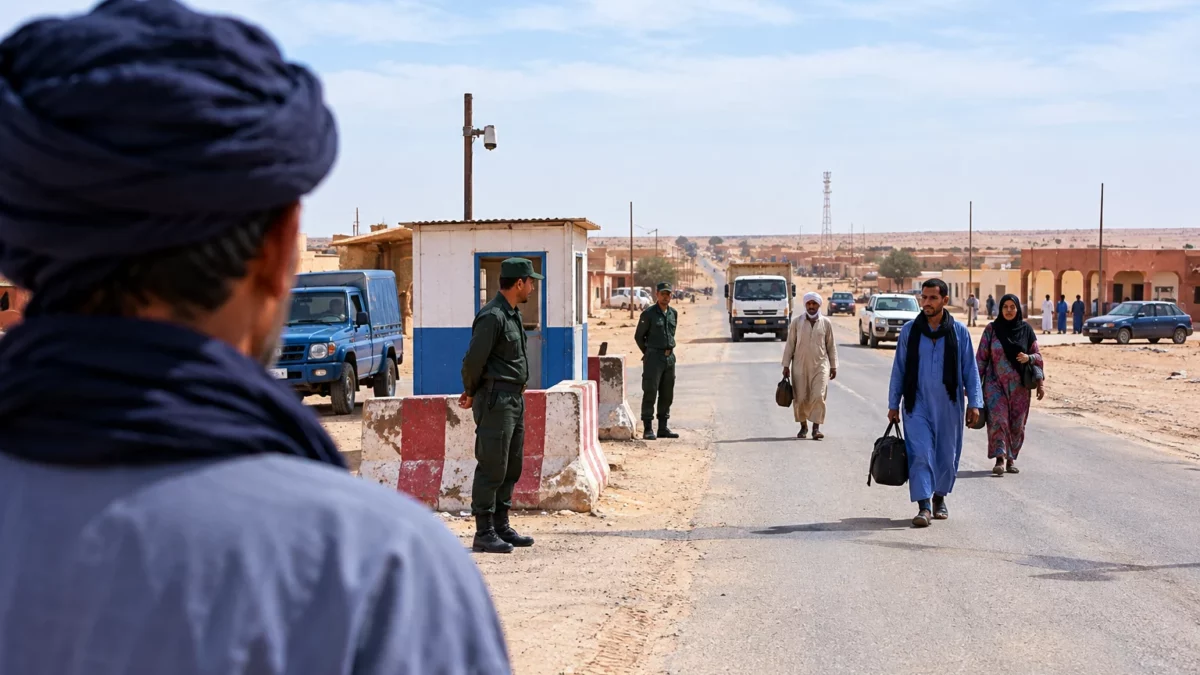
In Algeria’s far south, the discovery of an arms cache raises an immediate question: who assembled it, and for what purpose? In Bordj Badji Mokhtar, near Mali, the Algerian army has announced the seizure of an arsenal. But its origin and intended recipients remain unknown. This uncertainty matters in a region where border security and relations between states are closely linked.
A long border, relations in flux
Bordj Badji Mokhtar lies in southern Algeria, close to Mali. The two countries share a 1,376-kilometre border, according to the Algerian embassy in Bamako. People across this vast area have longstanding ties, while the authorities have established bilateral mechanisms devoted in particular to border cooperation.
This geography gives any arms seizure significance beyond the military operation itself. The Sahel-Sahara region is marked by cross-border movements and armed conflicts. Yet the proximity of a cache to a border is not enough to establish where the weapons came from, who transported them or who was supposed to retrieve them.
Relations between Algiers and Bamako have recently gone through a period of acute tension. In April 2025, the two states recalled their ambassadors and closed their respective airspaces after Algeria destroyed a Malian drone near their border. Bamako disputed Algeria’s account of events at the time. In July 2026, the two countries reinstated their ambassadors and reopened their airspace, marking a diplomatic thaw without resolving their differences.
Algeria’s role as a mediator remains another sensitive issue. Algiers led the efforts that resulted in Mali’s 2015 peace agreement. But Bamako denounced the agreement in 2024. Since then, disagreements have also concerned the management of northern Mali and which parties should be involved in any possible resolution of the crisis. The agreement and its legacy have therefore become a political as well as a diplomatic issue.
What the army says it seized
Algeria’s Ministry of National Defence announced on Saturday, 21 November 2026 that a combined detachment of the People’s National Army had discovered a cache in Bordj Badji Mokhtar during the week. Algeria’s state news agency APS confirms the location, the period and the presence of weapons of various calibres as well as a substantial quantity of ammunition.
In its detailed account, Anadolu Agency reports the seizure of an off-road vehicle, three mortars, five RPG-7 rocket launchers, several machine guns and four Kalashnikov-type submachine guns. The tally also reportedly includes two drones, ammunition and rockets. The scale and composition of the seizure are therefore reported by this agency; APS confirms the discovery but does not provide the same inventory in its brief report.
The ministry says the operation is part of efforts to secure the borders and was made possible through the use of intelligence. It cites the risk of infiltration and arms trafficking. However, its statement, as reported publicly, specifies neither the origin of the equipment nor the exact date it was deposited, or whether any arrests were made in connection with the cache.
These limitations make it impossible to link the arsenal directly to an armed group, a smuggling network or an event in Mali. It is also important to distinguish between the facts announced by the Algerian authorities and conclusions that an investigation might establish. At this stage, none of the public information cited in the reports consulted makes it possible to identify those responsible.
Securing the south without overinterpreting the seizure
For the Algerian authorities, monitoring the south is a matter of sovereignty and domestic security. A seizure of this kind may point to a successful intelligence operation. It also serves as a reminder that protecting such an extensive border does not rely solely on patrols: it depends on the flow of information, local cooperation and monitoring the routes used by criminal networks.
For people living in border areas, the issue is more immediate. Security affects travel, trade and family ties on both sides of the border. Control measures can limit certain threats, but they also affect mobility. The information available about this operation does not make it possible to assess its practical impact on the local population.
The case also comes amid a shift in Algerian regional policy. In October 2026, Algeria’s parliament authorised the deployment of military units to Niger, as part of co-operation between the two countries. This marks a closer relationship with Niamey. It does not, however, mean that the same arrangement applies to the Malian border, or that the discovery in Bordj Badji Mokhtar is linked to the agreement with Niger.
The contrast between these two relationships is notable: Algiers is strengthening military cooperation with Niamey while seeking to consolidate the thaw with Bamako. At the same time, Niger, Mali and Burkina Faso — united in the Alliance of Sahel States — have already expressed reservations about Algiers following the drone incident in 2025. Regional coordination therefore remains fragile, even with diplomatic channels restored.
The next challenge: establish the facts and preserve dialogue
The significance of this discovery will depend less on the list of weapons than on what follows from the investigation: identifying their origin, tracing any possible perpetrators and sharing information with neighbouring countries, if the authorities consider it useful. Without such evidence, attributing the cache to a Malian actor or a particular organisation would be premature.
For Algiers and Bamako, the incident is a reminder that border security is also a diplomatic issue. The restoration of relations in 2026 reopened channels for discussion, but disagreements over northern Mali and the former peace agreement remain. How the two capitals handle future security issues will show whether the thaw can lead to practical cooperation.
Across the Sahel, the seizure also highlights the difficulty of separating national security, cross-border trafficking and political crises. On its own, it does not prove that a conflict is spreading or that a foreign actor is involved. For now, the established fact is more limited: the Algerian army says it has discovered a major cache near Mali; the origin of the equipment remains to be determined.