Egypt
 Libya
 Morocco
 Sudan
 Tunisia
 Benin
 Burkina Faso
 Cabo Verde
 Côte d'Ivoire
 Ghana
 Guinea
 Guinea-Bissau
 Liberia
 Mali
 Mauritania
 Niger
 Nigeria
 Senegal
 Sierra Leone
 The Gambia
 Togo
 Cameroon
 Central African Republic
 Chad
 DR Congo
 Equatorial Guinea
 Gabon
 Republic of the Congo
 São Tomé and Príncipe
 Burundi
 Comoros
 Djibouti
 Eritrea
 Ethiopia
 Kenya
 Madagascar
 Malawi
 Mauritius
 Mozambique
 Rwanda
 Seychelles
 Somalia
 South Sudan
 Tanzania
 Uganda
 Angola
 Botswana
 Eswatini
 Lesotho
 Namibia
 South Africa
 Zambia
 Zimbabwe
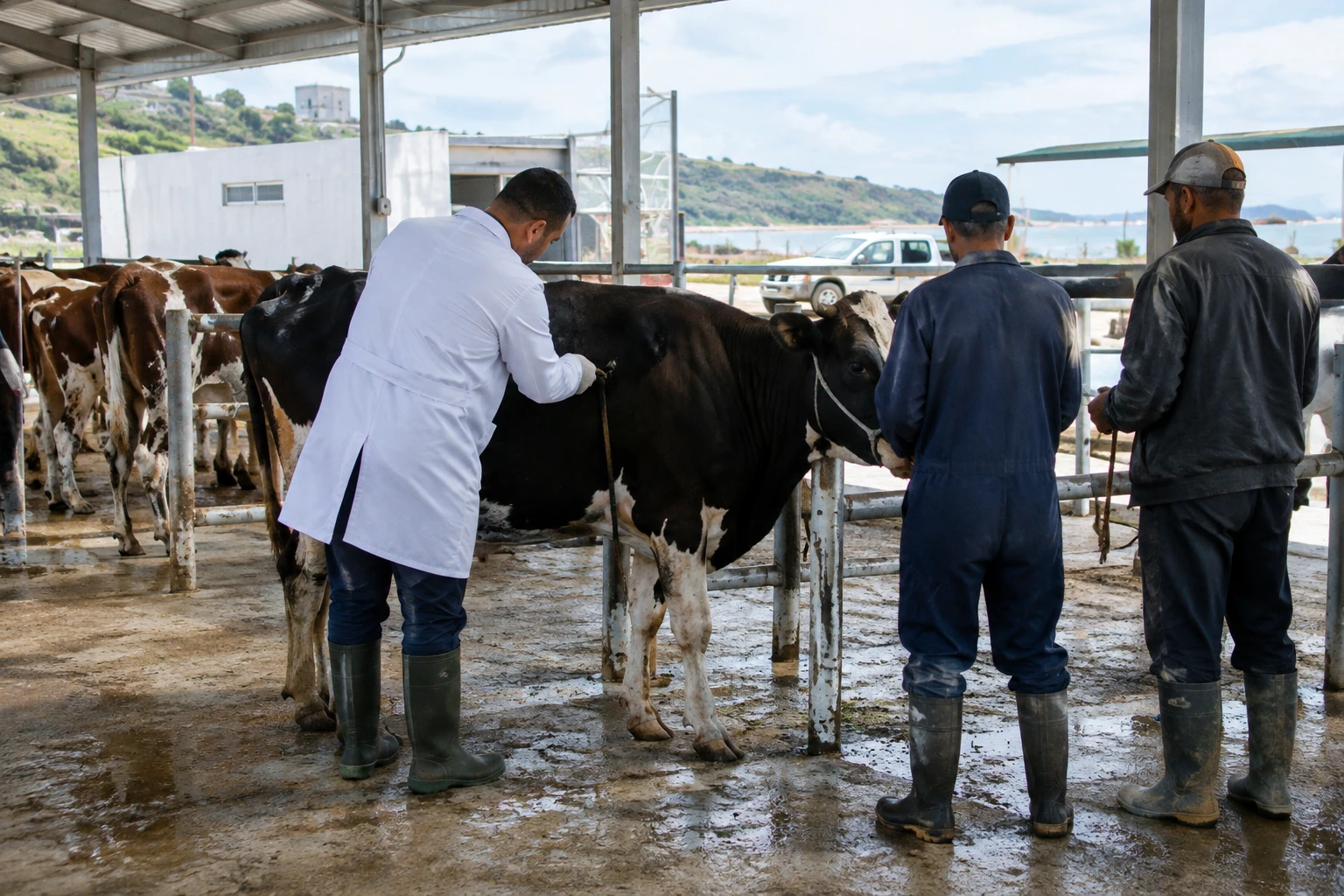
For livestock farmers in eastern Algeria, the closure of a cattle market cuts off an outlet as well as restricting the movement of animals. At national level, the suspension of live cattle imports adds a constraint to a meat market already under pressure.
A health response affecting the entire supply chain
On 22 October, the Directorate General of Veterinary Services (DGSV) informed operators that imports of live cattle were suspended “until further notice” for health reasons. Valid import exemptions have been cancelled, according to the notice reported by Algerian media. The measure concerns live animals; the public information consulted does not support the conclusion that there is a general ban on meat imports.
The decision follows the confirmation of foot-and-mouth disease outbreaks in Jijel by the Central Veterinary Laboratory. The wilaya authorities have closed cattle, sheep and goat markets and restricted livestock movements. Similar measures have been reported in Sétif. The confirmation in Jijel and the local restrictions have been described by several Algerian media outlets, including La Sentinelle and Le Provincial. In Sétif, details of the outbreaks remain based on press reports and are not accompanied here by an accessible official assessment.
Foot-and-mouth disease is a highly contagious viral disease that affects cattle, sheep and goats, among other animals. It can reduce production and lead to restrictions on movement and trade. It should not be confused with a human disease linked to eating meat: the immediate concerns are animal health, the continuity of livestock farming and trade. The World Organisation for Animal Health (WOAH) asks countries to report outbreaks and available information, including the serotype, through its WAHIS system.
Local restrictions, economic consequences
Closing a livestock market is intended to limit contact between herds. But it also changes sales and supply practices. Farmers may find it harder to sell their animals or move them to slaughterhouses and buyers outside their wilaya. Traders and transporters, meanwhile, must contend with stricter rules and uncertainty over how long the measures will last.
In rural areas, where livestock farming contributes to household incomes and the work of many small operators, these obstacles can have a rapid impact. In Algiers and other major urban centres, the effect is felt more in availability and retail prices. However, a suspension of live cattle imports does not automatically mean an immediate shortage: stocks, local production, meat deliveries and the duration of the ban will also matter.
Veterinary checks, animal traceability, isolation of outbreaks and vaccination are among the tools used to combat the disease. Their effectiveness depends on how they are implemented on the ground and on the rapid flow of information between veterinary services, farmers and operators. The episode in Jijel therefore highlights the importance of local services as well as decisions taken at national level.
A sector already dependent on imports
The health measure comes as Algeria seeks to secure supplies and contain the cost of meat. On 18 October, President Abdelmadjid Tebboune ordered an investigation into the practices of some importers, accused in the official statement of contributing to the monopolisation of supply and rising prices. Algeria Press Service (APS) also reported a request to examine price differences between wilayas and neighbourhoods, and to prepare rules governing intermediaries.
Supply pressures are explained in part by the gap between consumption and production. According to the French Livestock Institute (Idele), beef consumption in Algeria rose by 42% in 2024, to 246,000 tonnes in carcass-weight equivalent, while domestic production fell by 5%, to 154,000 tonnes. These estimates describe a specific year; they are not sufficient to measure the volumes available in October 2026. Idele also highlights the growing role of meat imports in meeting demand.
Algeria’s 2026 Finance Law provided for a reduced customs duty of 5% until 31 December 2026 on certain imports of live cattle and sheep intended for slaughter, as well as certain categories of fresh or vacuum-packed chilled beef and sheep meat. The measure illustrates the authorities’ two-pronged approach: facilitating external supplies while supporting sales channels. The health-related suspension of live cattle imports does not, by itself, abolish other rules applicable to meat.
The next challenge: controlling risk without disrupting supply
The duration of the suspension and the conditions for lifting it remain unknown in the information consulted. In the short term, veterinary services will need to monitor the development of outbreaks and the movement of animals. Importers and distributors, for their part, will need to distinguish purchases of live livestock from meat imports and adjust their operations within the current health framework.
For consumers, the central issue will be availability and price, but a rise cannot be inferred from the announcement alone. The outcome will also depend on the volumes of meat already imported, local slaughter and the possible reopening of markets. The announced investigation into prices should also shed light on the role of intermediaries in passing costs on to butchers.
Across North Africa, foot-and-mouth disease is a reminder that animal health and trade do not stop at borders. The Arab Maghreb Union (AMU), a regional organisation of Maghreb countries, is the relevant regional political framework, although the information available does not indicate any joint decision on this episode. Monitoring reports to WOAH and coordination between neighbouring veterinary services therefore remain issues to watch, as Algeria seeks to protect its livestock without further undermining access to meat.