Algeria
 Egypt
 Libya
 Morocco
 Sudan
 Tunisia
 Benin
 Burkina Faso
 Cabo Verde
 Côte d'Ivoire
 Ghana
 Guinea
 Guinea-Bissau
 Liberia
 Mali
 Mauritania
 Niger
 Nigeria
 Senegal
 Sierra Leone
 The Gambia
 Togo
 Cameroon
 Central African Republic
 Chad
 DR Congo
 Equatorial Guinea
 Gabon
 Republic of the Congo
 São Tomé and Príncipe
 Burundi
 Comoros
 Djibouti
 Eritrea
 Ethiopia
 Kenya
 Madagascar
 Malawi
 Mauritius
 Mozambique
 Rwanda
 Seychelles
 Somalia
 South Sudan
 Tanzania
 Uganda
 Angola
 Botswana
 Eswatini
 Lesotho
 Namibia
 South Africa
 Zambia
 Zimbabwe
Building a refinery does not, by itself, guarantee that the wealth generated by gold will remain in the country. Supplies must also be secured, traceability controlled and buyers found for the gold bars produced. In 2026, several African states are focusing on these links to gain greater influence in the gold value chain.
From Kalemie to Luanda, a new industrial phase
The trend spans several regions, without following a single model. In the Democratic Republic of the Congo, the country’s first pilot refinery was launched on 11 March in Kalemie, in Tanganyika province. In Burkina Faso, Raffinor-BF opened in Ouagadougou in September. Ethiopia then inaugurated its National Precious Metals Refinery on 10 October in the Bole Lemi special economic zone in Addis Ababa. According to the Ethiopian state news agency ENA and the Prime Minister’s Office, its announced capacity exceeds 600 tonnes of precious metals a year at full capacity.
Guinea inaugurated Nimba Gold Refinery in Gbessia, in the capital Conakry, on 1 November. The African news agency APA and Guinean authorities confirm the date. However, figures on capacity circulated in connection with the project should be treated with caution: public announcements are not enough to establish the volume actually processed or the rate of production.
In Angola, a southern African country whose economy remains heavily reliant on oil, the first gold refinery was inaugurated on 20 November in the Viana industrial hub in Luanda. The government and Angolan media report that state-owned company Endiama financed and built the facility, which is designed to process up to 25 kilograms a day. It also includes a laboratory and a service to check the purity of precious metals.
This expansion comes as Africa accounted for 27.9% of global gold production in 2023, according to data compiled by the World Bank. But extracting a significant share of the metal does not mean controlling the subsequent stages: refining, certification, marketing and access to markets.
Refining locally is not enough
Local refining can develop specialised skills, from purity analysis to the production of gold bars. It can also reduce some of the costs of processing abroad and improve oversight of export flows. However, the benefits depend on the facilities’ actual activity, the quality of controls and the share of national gold they can buy.
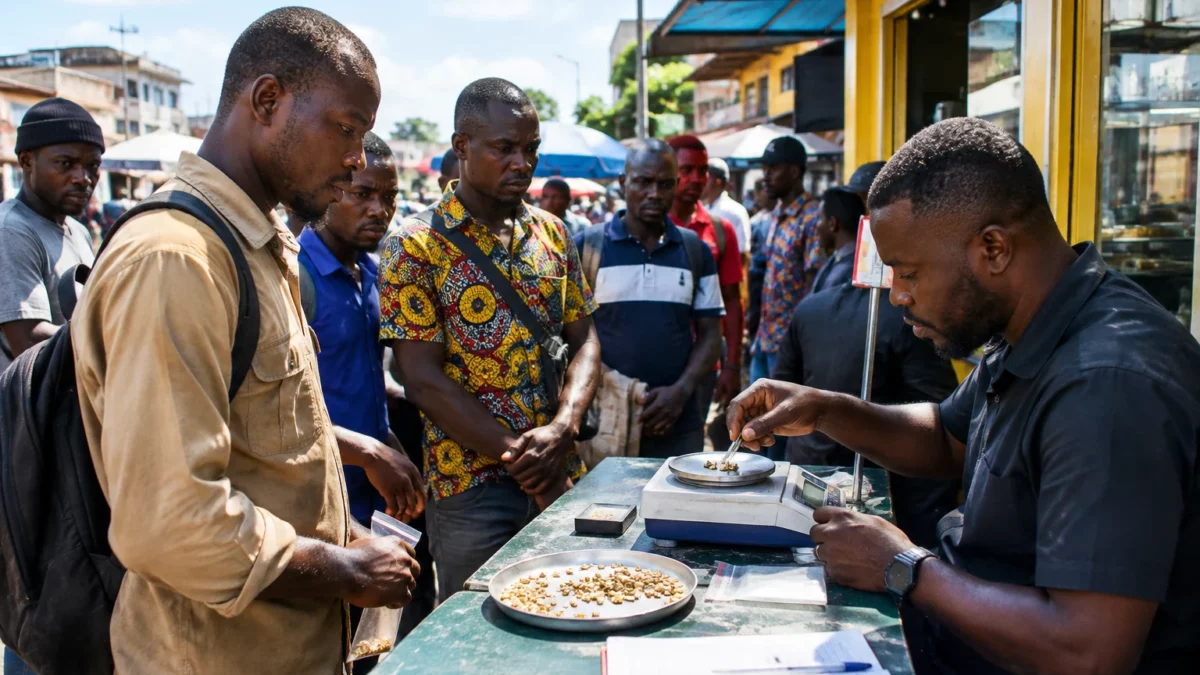
Securing supplies is a central challenge. A refinery can have substantial nominal capacity without receiving enough metal to operate at full capacity. Industrial producers, gold-buying centres and artisanal miners face different constraints. For the latter, the prices offered, access to legal channels and speed of payment can determine whether they sell locally or use other routes.
Ghana offers an example of a policy combining public purchasing and processing. GoldBod, the public body responsible for the artisanal and small-scale gold market, said that 5.4 tonnes of the 5.7 tonnes it bought during a partial period in October had been refined in the country. The figure, published by the organisation and reported by Ghanaian media outlet 3News, points to an expansion, but is not a full-month tally. It also shows that supply depends on purchasing and export rules, not just the presence of factories.
Compliance with international standards also matters if gold is to be added to the Bank of Ghana’s reserves or sold on certain markets. Recognised certification, particularly by the London Bullion Market Association (LBMA), can facilitate access to institutional buyers. Domestic refining is therefore one step; certification, traceability and commercial trust are others.
Projects at different stages
The wave of openings does not mean that all announced projects are already operational. In Mali, a Sahelian country and member of the Alliance of Sahel States, the SOROMA-SA site is described as under construction, with an announced capacity of 200 tonnes a year. In Côte d’Ivoire, the government plans to bring the Société ivoirienne des métaux précieux facility into operation in the first half of 2027, with a target capacity of 100 tonnes a year. These figures describe project targets, not volumes already refined.
Côte d’Ivoire links this infrastructure to expected growth in its gold production, with an official target of 100 tonnes a year by 2035. In southern Africa’s Malawi, NICO Holdings and NBS Bank have discussed possible involvement in a refinery with the Ministry of Mines. At this stage, this is an option under consideration, not a plant under construction.
These different paths raise a common question: what share of the added value will actually remain in the local economy? Tax revenues, jobs and skills may benefit the towns where the facilities are located. Mining communities, often far from the capitals, also expect tangible effects on incomes, services and transparency in purchasing. There is no guarantee that these benefits will be distributed automatically.
The next battle: controlling flows
For governments, refining is linked to goals including foreign-currency earnings, the formalisation of trade and, in some cases, the accumulation of reserves. For mining companies, it adds a domestic stage to the export chain. For local workers and traders, its value will depend on markets and the conditions for accessing them.
The spread of facilities could also reshape trade between neighbouring countries: gold collection, testing services, secure transport and gold-bar sales could cross national borders. But regional coordination will be needed to limit regulatory disparities that encourage flows to move towards the least controlled channels.
Success will not be measured by the number of opening ceremonies. It will be reflected in the volumes actually processed, the verifiable origin of the metal, the regularity of supplies and the certifications obtained. In 2027, the start-up of the Ivorian facility and the ramp-up of recently opened plants will help distinguish announced capacity from actual industrial results.