Algeria
 Egypt
 Libya
 Morocco
 Sudan
 Tunisia
 Benin
 Burkina Faso
 Cabo Verde
 Côte d'Ivoire
 Ghana
 Guinea
 Guinea-Bissau
 Liberia
 Mali
 Mauritania
 Niger
 Nigeria
 Senegal
 Sierra Leone
 The Gambia
 Togo
 Cameroon
 Central African Republic
 Chad
 Equatorial Guinea
 Gabon
 Republic of the Congo
 São Tomé and Príncipe
 Burundi
 Comoros
 Djibouti
 Eritrea
 Ethiopia
 Kenya
 Madagascar
 Malawi
 Mauritius
 Mozambique
 Rwanda
 Seychelles
 Somalia
 South Sudan
 Tanzania
 Uganda
 Angola
 Botswana
 Eswatini
 Lesotho
 Namibia
 South Africa
 Zambia
 Zimbabwe
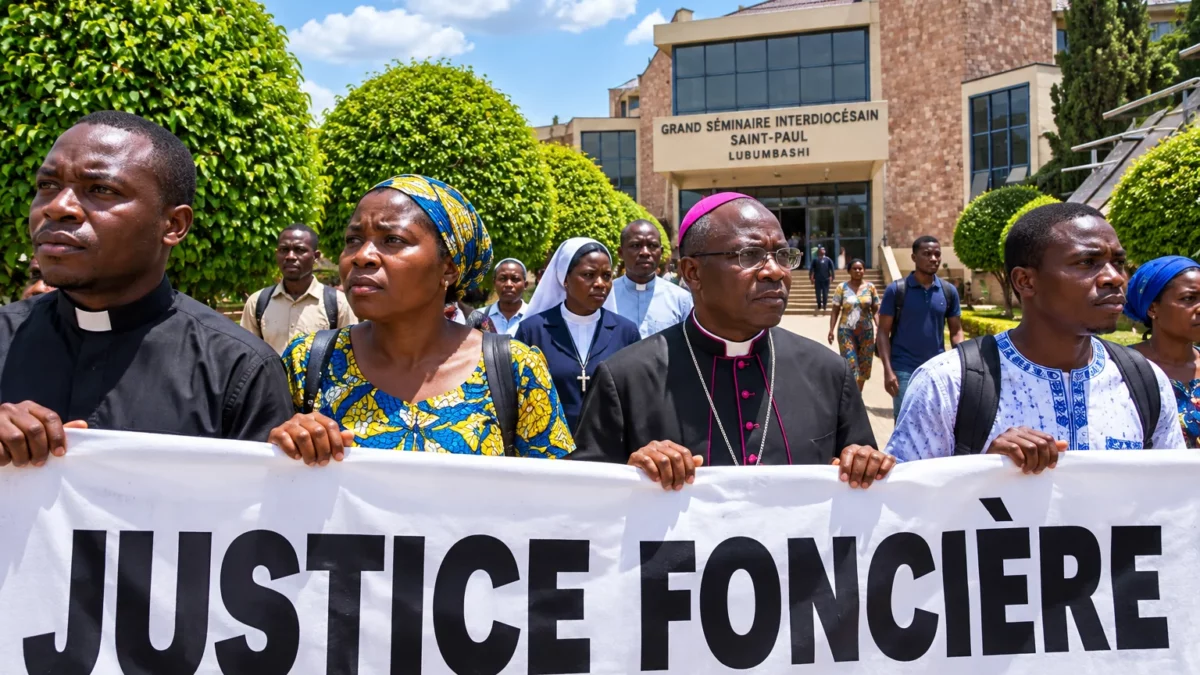
In the Democratic Republic of the Congo, can a security decision prevent a Mass in a stadium and a march linked to a court ruling? Events on 22 and 23 November in Kinshasa and Lubumbashi raise a practical question: how can public order be protected without undermining freedom of worship or the enforcement of court decisions?
Two cities, two disputes
In Kinshasa, a celebration planned at Tata Raphaël Stadium for the feast of Christ the King, along with a meeting with young people, could not take place there on Sunday 22 November. Cardinal Fridolin Ambongo was due to preside over the Mass. The celebration was moved to another venue, according to reports published by Congolese media. The government cited security measures relating to large gatherings. The archdiocese, for its part, challenged the circumstances of the ban.
The following day, in Lubumbashi, in Haut-Katanga province, Catholic officials and worshippers sought to march to demand the implementation of a court decision concerning the property of the Saint Paul Interdiocesan Major Seminary. Congolese media report that police dispersed the gathering, including with tear gas. The dispute concerns real estate that the Church says it should recover under a court ruling. The details of the proceedings and the arguments of all parties have not been made public in the accounts consulted.
These events prompted distinct reactions. The National Episcopal Conference of Congo (CENCO), which brings together the country’s Catholic bishops, denounced violations of freedoms and described the situation as «tyranny». This wording expresses the position of the Church institution; it is not an independent assessment of the authorities’ decisions.
Kinshasa seeks to contain the crisis
On Tuesday 24 November, Deputy Prime Minister for the Interior Jacquemain Shabani met the apostolic nuncio, Mitja Leskovar, the Holy See’s representative in the DRC, in Kinshasa. He expressed regret over the incidents and defended the need to take the security context into account. He also said the government respected the Catholic Church and wanted to avoid a «crisis of confidence».
On the Lubumbashi case, Shabani said the state remained willing to discuss with the Church, the beneficiary of the ruling, how to implement the decision. This stated willingness does not, however, resolve either the land dispute or the central question: when and under what procedure will the ruling be enforced? The available accounts also do not specify the security threats that may have prompted the measures in Kinshasa.
The events and statements were reported by the Congolese Press Agency and several DRC media outlets, including UNE.CD and 7sur7.cd. Their accounts agree on the dates, locations and meeting with the nuncio. They differ on the justification and scope of the security decisions, so these should remain attributed.
An institutional relationship under strain
The events come in a country where the Catholic Church plays a role extending beyond parish life. CENCO regularly participates in public debates, particularly on governance, rights and electoral processes. This presence gives its statements national weight, but also places relations with the authorities under particular scrutiny. The current tensions do not, by themselves, prove a lasting rift between the state and the Church.
The two episodes raise different issues. In Kinshasa, the question is access to a public facility for a large-scale religious celebration. In Lubumbashi, the gathering sought the enforcement of a court decision in a land dispute. Treating both cases solely as matters of public order risks obscuring this distinction. In both, however, how the authorities justify their decisions matters as much as the outcome.
For political leaders, the immediate challenge is to prevent restrictions presented as security measures from being seen as sidelining the Church. For bishops and worshippers, the issue is being able to carry out their activities and seeing a court decision enforced. For residents of both cities, trust also depends on clear rules: stated grounds, consistent decisions and accessible avenues of appeal.
A signal watched beyond the two cities
The DRC is a member of the Southern African Development Community (SADC) and the East African Community (EAC), two regional organisations. The November incidents do not in themselves constitute a regional issue. They nevertheless serve as a reminder that the credibility of national institutions — security, justice and public freedoms — also shapes the country’s standing with its African and international partners.
The next step will depend less on statements than on action: a formal discussion between the state and the Catholic hierarchy, clarification of the reasons for the ban in Kinshasa, and tangible progress on the land case in Lubumbashi. At this stage, no public deadline for enforcing the ruling or resolving the disputes has been announced in the information cross-checked. How these two cases are handled will show whether the call for dialogue can restore trust or whether the disagreements will persist.