Algeria
 Egypt
 Libya
 Morocco
 Sudan
 Tunisia
 Benin
 Burkina Faso
 Cabo Verde
 Côte d'Ivoire
 Ghana
 Guinea
 Guinea-Bissau
 Liberia
 Mali
 Mauritania
 Niger
 Nigeria
 Senegal
 Sierra Leone
 The Gambia
 Togo
 Cameroon
 Central African Republic
 Chad
 Equatorial Guinea
 Gabon
 Republic of the Congo
 São Tomé and Príncipe
 Burundi
 Comoros
 Djibouti
 Eritrea
 Ethiopia
 Kenya
 Madagascar
 Malawi
 Mauritius
 Mozambique
 Rwanda
 Seychelles
 Somalia
 South Sudan
 Tanzania
 Uganda
 Angola
 Botswana
 Eswatini
 Lesotho
 Namibia
 South Africa
 Zambia
 Zimbabwe
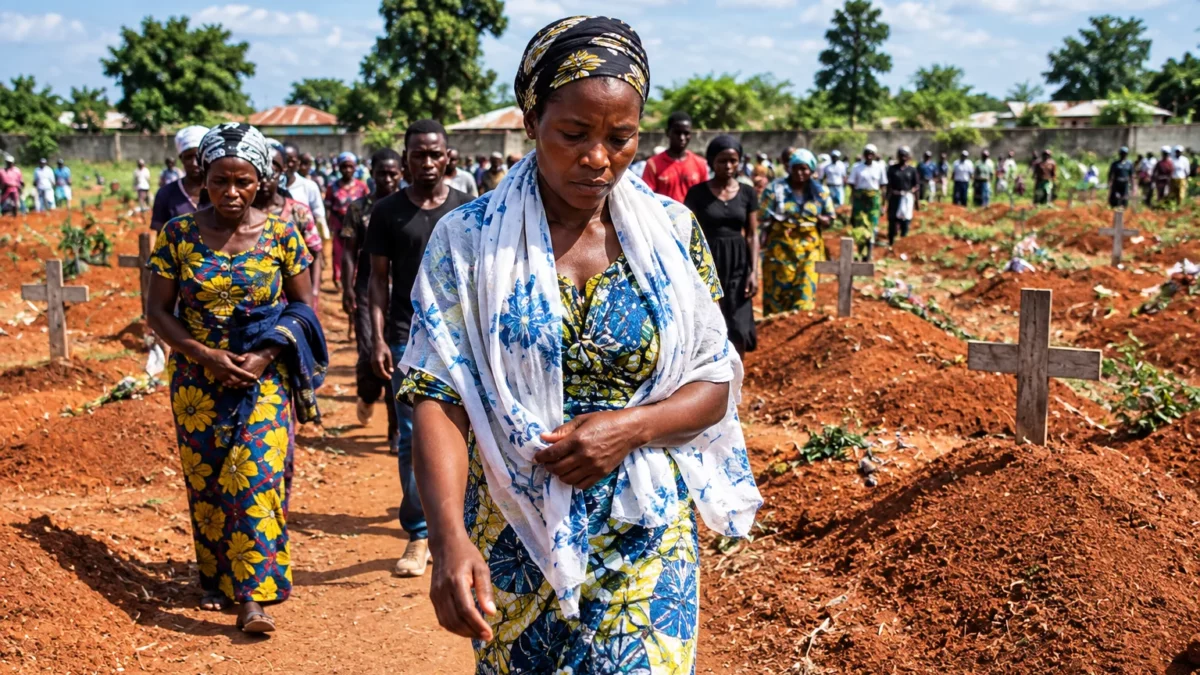
In Bunia, the number of graves tells part of the story of the epidemic that health records do not always capture. But an additional burial does not, by itself, prove that Ebola was the cause. That is the central issue in excess-mortality estimates published as the disease continues to hit the east of the Democratic Republic of the Congo.
Cemeteries shed light on blind spots
Ituri province, in the country’s north-east, is the epicentre of the epidemic caused by the Bundibugyo virus, an Ebola strain. Congolese authorities declared the outbreak on 15 May 2026. In Bunia, the provincial capital, health services have had to track a surge in cases in a city that also receives people displaced by insecurity and armed violence.
An investigation published by Reuters on 23 November compared satellite images of three cemeteries in Bunia and one cemetery in Mongbwalu with images taken before the epidemic. The team assessed changes in the number of new graves and compared them with deaths officially attributed to Ebola. This method estimates excess mortality: deaths above those recorded during a reference period. It cannot establish the cause of each death.
According to the analysis, by the end of June Bunia had more than 580 excess deaths, about seven times the official Ebola toll then recorded in the city. The gap subsequently narrowed. By early November, the estimate still exceeded 1,000 excess deaths, compared with 707 deaths officially attributed to the virus in Bunia. Reuters also reports a sharp rise in burials in Mongbwalu, where local officials said many deaths were not recorded by the civil registry.
These figures are estimates, not a newly confirmed toll of Ebola victims. They may include deaths directly caused by the virus, as well as deaths linked to the consequences of the epidemic: for example, people who were ill but did not reach a health centre. They also depend on the comparison method and the sites observed. The cemeteries studied do not necessarily represent all burials in the region.
Why the official toll may be incomplete
The gap between burials and health records is not, on its own, proof of a cover-up. It may reflect limits in detection and registration, especially when people die at home or far from a treatment centre. Teams cannot test every death after the fact. Without a sample or contact investigation, the authorities cannot attribute every death to Ebola.
Official figures nevertheless remain essential for tracking confirmed cases, organising care and targeting the response. As of 17 November, the World Health Organization had recorded 11,613 confirmed cases and 5,678 deaths in the DRC. This national toll is not directly comparable with the excess-mortality estimate for Bunia: one counts reported deaths linked to the virus in the country, while the other estimates the excess number of burials in one city compared with a previous year.
The difference also matters to families. An undocumented death can leave relatives without answers about the illness, without appropriate support and facing difficult administrative procedures. For health teams, deaths outside medical facilities make contact tracing and the identification of transmission chains more difficult. Safe burials carried out with communities are therefore both a public health measure and a matter of trust.
The obstacles are particularly severe in areas where travel, insecurity and limited access to healthcare complicate interventions. An effective response depends on the ability to listen to residents, make services accessible and clearly explain funeral measures. The WHO has described community dialogue initiatives in Ituri, while Congolese health authorities publish situation reports and co-ordinate operations with their partners.
An emergency extending beyond provincial borders
The epidemic has mobilised national and continental institutions. The Congolese health ministry and the National Institute of Public Health are monitoring the data and the response. Africa CDC, the African Union’s public health agency, and the WHO have called for stronger early detection, contact tracing and access to healthcare. In September, Africa CDC said transmission remained active and that observed trends did not yet allow it to conclude that the epidemic had been durably interrupted.
The regional dimension is tangible: people move between provinces and also cross national borders. Surveillance in neighbouring countries and the co-ordination of alerts are therefore important, without treating all movement as a risk. For the DRC, a member of the Economic Community of Central African States (ECCAS), the challenge is to share health information rapidly and maintain continuity of care in a context where movement can make follow-up difficult.
What happens next will depend in particular on trends in new cases, the ability to investigate community deaths and access to affected areas. Estimates drawn from satellite images can point to a blind spot and help raise new questions. They do not replace tests, records or field investigations. In Bunia, their main contribution is to underline that the epidemic toll also depends on the quality of systems able to count, provide care and support families.
Cross-checked sources: Reuters investigation into burials and excess mortality ; Associated Press on the course of the epidemic ; World Health Organization ; WHO Africa on community dialogue in Ituri ; Africa CDC on trends and response challenges ; Congolese Press Agency on the situation in Bunia.