Algeria
 Egypt
 Libya
 Morocco
 Sudan
 Tunisia
 Benin
 Burkina Faso
 Cabo Verde
 Côte d'Ivoire
 Ghana
 Guinea
 Guinea-Bissau
 Liberia
 Mali
 Mauritania
 Niger
 Nigeria
 Senegal
 Sierra Leone
 The Gambia
 Togo
 Cameroon
 Central African Republic
 Chad
 DR Congo
 Equatorial Guinea
 Gabon
 Republic of the Congo
 São Tomé and Príncipe
 Burundi
 Comoros
 Djibouti
 Eritrea
 Ethiopia
 Kenya
 Madagascar
 Malawi
 Mauritius
 Mozambique
 Rwanda
 Seychelles
 Somalia
 South Sudan
 Tanzania
 Angola
 Botswana
 Eswatini
 Lesotho
 Namibia
 South Africa
 Zambia
 Zimbabwe
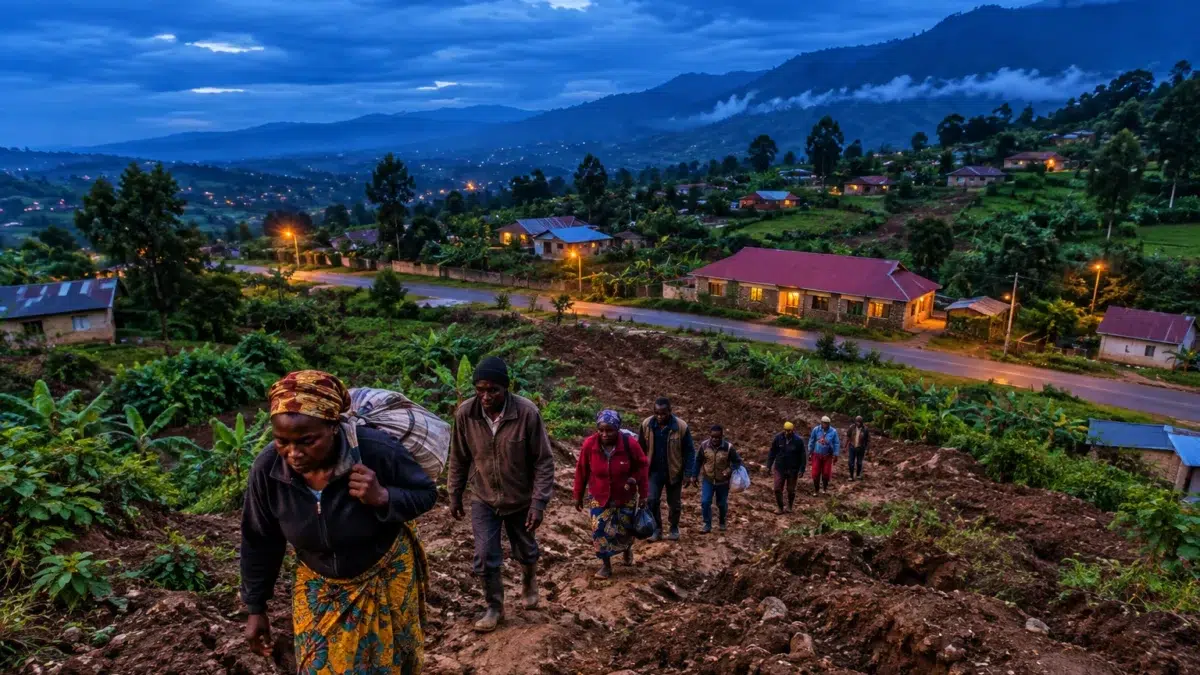
In Bududa, eastern Uganda, the question is no longer only how to rescue families after a landslide. Survivors are also asking who must prevent the next disaster, and how to guarantee their safety without erasing their rights, land and livelihoods.
Their initiative puts disaster preparedness at the heart of a wider debate about human rights and climate adaptation. It comes as Ugandan authorities continue relocation programmes in the Mount Elgon region, which is exposed to recurring landslides.
In Bududa, a long-known risk
On 3 December 2019, landslides struck Bushika sub-county in Bududa district, near the Kenyan border. The 48 petitioners say they were displaced and lost relatives. In the national proceedings, they said that 20 members of their families had died. The overall death toll from the disaster is reported as 53, including at least 33 children, by the BBC. The figures therefore refer to different groups: one covers the complainants’ relatives, the other the disaster as a whole.
The slopes of Mount Elgon have seen deadly landslides for several decades. Heavy rainfall, topography and soil degradation all contribute to the risk. Climate change can alter rainfall patterns, but on its own it is not enough to explain every event. Researchers and the complainants also point to communities’ long-standing exposure and the limitations of prevention measures.
In October 2020, the survivors brought a case before the High Court in Mbale. They challenged the authorities’ response and invoked the rights to life, property, health and a healthy environment. Their action targeted, among others, the state, the National Environment Management Authority and the Bududa local council. According to case tracking published by the Ugandan organisation Greenwatch, the Court dismissed their application in August 2024 after considering preliminary objections. The petitioners subsequently sought a review of that decision.
A case brought before the UN
On 19 November 2026, 48 survivors brought their claim before the United Nations Human Rights Committee, with the support of Greenwatch and the UK-based organisation ClientEarth. They are seeking compensation for their losses and practical measures in at-risk areas, including accessible warning systems and safer relocation.
The body examines whether states parties comply with the International Covenant on Civil and Political Rights. It is not a national court tasked with directly organising rescue operations or relocating residents. The submission therefore does not mean that the Committee has found the state responsible, or that it has already agreed to examine the merits. Available information confirms that the complaint has been submitted, but does not support a conclusion that a decision on admissibility has been made.
The development described by supporters of the case as novel is the explicit request for climate adaptation measures before this Committee. The case could help clarify how human rights obligations apply when known natural hazards threaten populations. It is not, however, a legal precedent at this stage: no ruling has been made on the merits.
Relocation alone cannot guarantee safety
The Ugandan government has launched several relocation operations in the Mount Elgon region. The Office of the Prime Minister says that 1,224 households were moved in 2024 to Bunambutye, in neighbouring Bulambuli district. A more recent programme provides, among other things, for two acres of land and ten million Ugandan shillings per household to help with rebuilding. These figures describe schemes announced by the authorities; they do not prove that all exposed families have already been brought to safety.
Moving people can reduce their immediate exposure to unstable slopes. But it also disrupts social ties and access to farmland, schools, healthcare and markets. For households whose income depends on agriculture or informal work, the cost of moving goes beyond building a house. Success therefore also depends on the quality of the receiving land, the services available and the opportunity to rebuild an income.
Prevention, too, is measured in villages. A warning must reach residents in time and in a form they can use. Responsibilities between national and local authorities must be clear. Finally, those affected must be able to take part in decisions, especially when evacuation affects their land and livelihoods. These are the issues that link the survivors’ claim to the practical challenges of public action.
An issue for East Africa
The case concerns Ugandans first and foremost, and decisions taken in Uganda, whose capital is Kampala. It nevertheless resonates across a region where heavy rains, floods and landslides regularly test prevention systems. The East African Community, a regional organisation that includes Uganda and Kenya, provides a relevant framework for cooperation on warnings, weather data and cross-border risk management.
At continental level, the case raises a specific question: when a recurring hazard is documented, how far must the state go to protect residents, and how should it compensate them for harm already suffered? If the complaint clears the procedural stages, the Committee’s response could inform debates on human rights and climate adaptation beyond Uganda. For Bududa residents, the issue remains immediate: whether relocation and prevention programmes will reach communities still at risk before the next heavy rains.
Background sources: BBC report on the complaint and survivors’ demands; case tracking published by Greenwatch; Daily Monitor report on the proceedings in Mbale; information from the Office of the Prime Minister on relocation; legal record of the national case.