Algeria
 Egypt
 Libya
 Morocco
 Sudan
 Tunisia
 Benin
 Burkina Faso
 Cabo Verde
 Côte d'Ivoire
 Ghana
 Guinea
 Guinea-Bissau
 Liberia
 Mali
 Mauritania
 Niger
 Nigeria
 Senegal
 Sierra Leone
 The Gambia
 Togo
 Cameroon
 Central African Republic
 Chad
 Equatorial Guinea
 Gabon
 Republic of the Congo
 São Tomé and Príncipe
 Burundi
 Comoros
 Djibouti
 Eritrea
 Ethiopia
 Kenya
 Madagascar
 Malawi
 Mauritius
 Mozambique
 Rwanda
 Seychelles
 Somalia
 South Sudan
 Tanzania
 Uganda
 Angola
 Botswana
 Eswatini
 Lesotho
 Namibia
 South Africa
 Zambia
 Zimbabwe
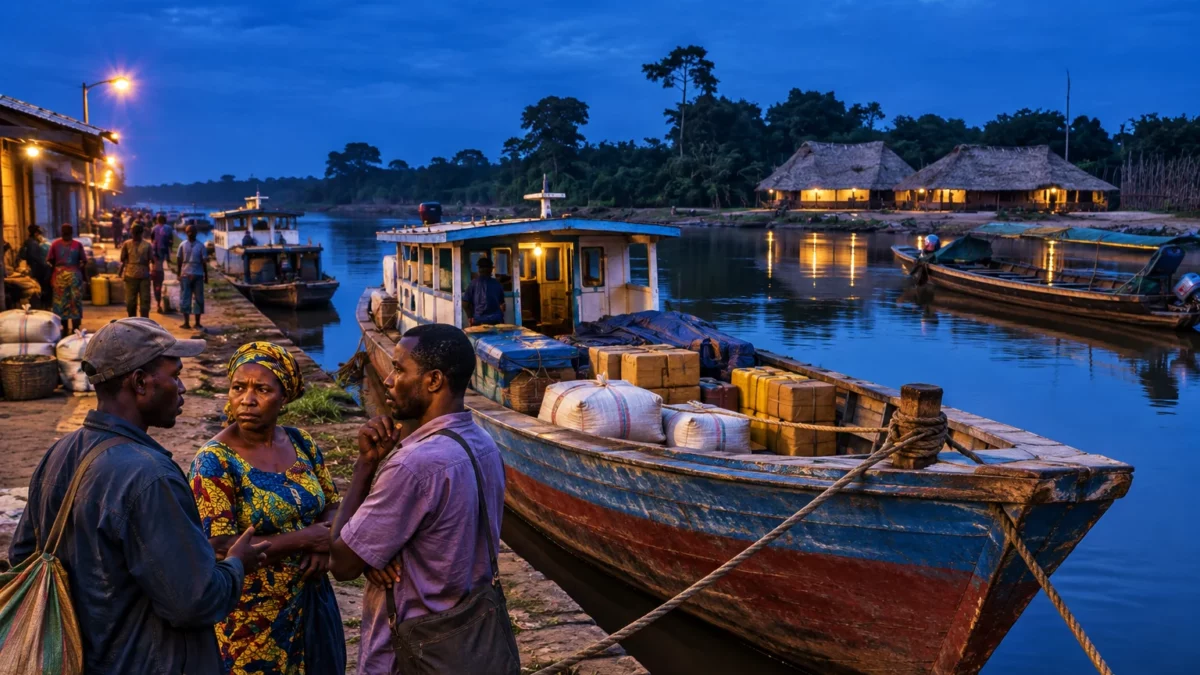
In Isangi, in Tshopo province, disruption to river traffic is already driving up prices. Since the boat owners’ strike began, the price of a litre of petrol has risen, according to residents, from 5,000 to 6,000 or 7,000 Congolese francs. The price of a cup of beans has increased from 2,500 to 3,000 francs. These local figures, reported on 18 November, show how a safety decision can quickly affect everyday spending.
A transition decided in Kinshasa, applied on vital routes
In the Democratic Republic of the Congo, the river and its tributaries serve as roads where land links remain limited or difficult. Wooden boats carry goods and passengers between urban centres and riverside communities. For Kisangani, the capital of Tshopo province, they connect agricultural areas with markets and supply chains in particular.
This network is based on an economy with several layers. Boat owners operate the vessels, crews make the journeys, and traders often accompany their goods to sell them at stops along the way. Research by anthropologist Peter Lambertz, published by the Université libre de Bruxelles, describes the boats as an important link in exchanges between cities and producing communities, rather than simply a means of transport.
The debate therefore concerns two concrete and urgent priorities: reducing accidents and keeping goods moving. Shipwrecks, overloading and night-time navigation are among the risks regularly cited by the authorities. But replacing boats cannot be decreed without taking account of the routes they serve, the costs and the time operators need to renew their fleets.
A ban with limited exemptions
The Transport Ministry has set 15 November 2026 as the date when the ban on wooden boats on the Congo River will take effect. The decree signed on 10 November nevertheless allows certain short crossings on inland rivers for a maximum period of three months, provided they remain within a single province.
The exemption requires boats to operate during daylight hours, between 6am and 6pm, carry life jackets and comply with authorised tonnage limits. It does not allow interprovincial routes using the Congo River. The text and its provisions are available on the Congolese Transport Ministry’s website.
The Association of Congo Boat Owners has called a strike starting on 16 November. It disputes a timetable it considers too short and is calling for dialogue and support to renew the vessels. In Basoko, residents said that five boats scheduled to depart on 16 November had remained at the quay. Radio Okapi has also reported disruption in Tshopo and concerns about supplies reaching Kisangani.
The initial consequences differ from place to place. In Isangi, reported increases concern everyday goods and fuel. In Basoko, the suspension of departures mainly threatens the transport of agricultural produce and access to goods from other centres. In Kinshasa, the impact will depend on the volumes transported by river and the transport options available on each route.
Replacement remains the main point of contention
The government has announced a transition to metal vessels and plans to acquire around a hundred barges to supplement the fleet of the National Transport Office, ONATRA. Financing mechanisms for boat owners have also been discussed. However, the official information consulted does not specify the amounts available, the delivery schedule or the number of vessels immediately available on the routes concerned.
This gap between the ban and replacement capacity is fuelling opposition. On 15 November, provincial MPs from Équateur called for a suspension until a sufficient number of metal boats had been deployed. In Tshopo, elected representatives have also argued for a gradual transition. These calls do not necessarily challenge the safety objective: they highlight the risk of cutting off trade routes before other means are ready.
The authorities have also announced inspections and the distribution of life jackets, subject to administrative and technical conditions. On 18 November, the Congolese Press Agency reported that only certain boats meeting specific criteria would be eligible. These measures may strengthen prevention in the short term, but they do not replace vessel inspections, efforts to tackle overloading or a fleet large enough to serve the routes.
For crews, the transition period means uncertain incomes if boats stop operating. For traders and producers, it may make it harder to reach markets or slow the arrival of essential goods. Passengers, meanwhile, may face both fewer departures and higher transport costs. The observations from Isangi already give an indication of how these effects are being passed on, although they do not make it possible to measure the scale of the impact across all provinces.
A national issue with regional repercussions
Navigation safety is primarily the responsibility of the Congolese authorities, but the continuity of trade affects more than boat owners alone. Waterways connect production areas, provincial markets and cities of different sizes. Peter Lambertz’s study highlights the importance of these vessels to the country’s river economy. Their replacement therefore also tests the state’s ability to enforce rules while maintaining accessible links.
What happens next will depend on verifiable decisions: how many barges will actually be deployed, what financing will be available to operators and how inspections will be carried out during the transition. The strike has already seen partial resumptions following local talks, while price rises have been reported in Isangi. Kinshasa’s challenge now is to make the transition concrete enough to improve safety without leaving riverside communities facing a lasting disruption to trade.