Algeria
 Libya
 Morocco
 Sudan
 Tunisia
 Benin
 Burkina Faso
 Cabo Verde
 Côte d'Ivoire
 Ghana
 Guinea
 Guinea-Bissau
 Liberia
 Mali
 Mauritania
 Niger
 Nigeria
 Senegal
 Sierra Leone
 The Gambia
 Togo
 Cameroon
 Central African Republic
 Chad
 DR Congo
 Equatorial Guinea
 Gabon
 Republic of the Congo
 São Tomé and Príncipe
 Burundi
 Comoros
 Djibouti
 Eritrea
 Ethiopia
 Kenya
 Madagascar
 Malawi
 Mauritius
 Mozambique
 Rwanda
 Seychelles
 Somalia
 South Sudan
 Tanzania
 Uganda
 Angola
 Botswana
 Eswatini
 Lesotho
 Namibia
 South Africa
 Zambia
 Zimbabwe

Producing sustainable aviation fuel is not enough: producers must also convince financiers and find buyers before the plants even exist. In Morocco and Egypt, two Green Sky Capital projects are relying on agreements with Shell to take this step. But the announcements do not yet mean that fuel will be flowing on a large scale.
North African projects in an emerging sector
Sustainable aviation fuel, often referred to by its English acronym SAF, can be made from renewable feedstocks or waste. Some production pathways convert used oils and fats, among other materials. Blended with conventional kerosene in accordance with applicable rules, it can be used in existing aircraft. Its production, however, remains more costly and less developed than that of fossil fuels.
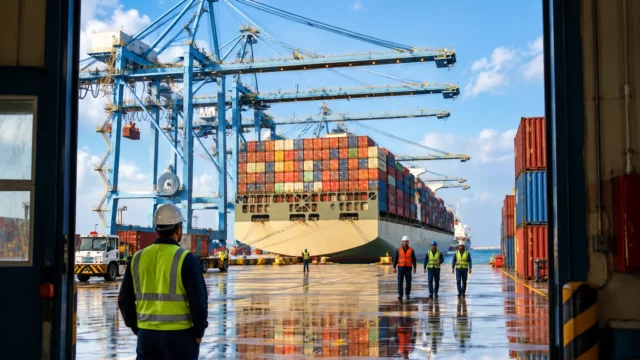
Geography matters. The Moroccan project is at Nador West Med, on Morocco’s north-eastern Mediterranean coast. The Ain Sokhna project is located in Egypt’s Suez Canal Economic Zone. These sites connect the projects to port infrastructure and regional and international trade routes. They do not, in themselves, guarantee local feedstock supplies or equitable benefits for the communities concerned.
Global supply remains limited. The International Air Transport Association (IATA) estimates that SAF production could reach 2.4 million tonnes in 2026, equivalent to 0.8% of annual aviation fuel consumption. This is a forecast, not a volume already produced. The organisation also notes that not all announced capacity comes to fruition and that plants can manufacture several products, not just SAF.
In Morocco, sales planned before construction
On 2 November 2026, Shell announced a long-term supply agreement with Green Sky Manara, which is linked to Green Sky Capital, for a planned facility at Nador West Med. The energy group will have exclusive rights to about 150,000 tonnes a year of SAF, or an equivalent volume of renewable diesel. The agreement also covers co-products, including bionaphtha and biopropane. Operations are scheduled to begin in October 2028.
The project represents a total investment of $239 million. The European Bank for Reconstruction and Development (EBRD) is considering financing of up to $135 million. The bank’s published project summary states that the loan is still under consideration and that the project remains at an exploratory stage. It describes a design capacity of 200,000 tonnes of SAF a year, while the agreement announced by Shell covers about 150,000 tonnes of SAF or an equivalent volume of renewable diesel. These figures therefore do not refer to the same thing.
For the EBRD, the long-term offtake agreement strengthens the project’s financial viability by giving lenders an identified commercial outlet. The bank also says the facility is to process used oils, fats and other residual materials. It expects feedstocks to be collected in Morocco, with imports supplementing local supplies if volumes are insufficient. The actual availability and traceability of these resources will therefore affect both the project’s economics and its environmental record.
In Egypt, financing already secured
At Ain Sokhna, the project has reached a further financial milestone. Green Sky Capital and its local subsidiary SAF Fly Egypt are behind a facility valued at $212.4 million. In May 2026, the Emerging Africa & Asia Infrastructure Fund and Ninety One announced total debt financing of $142.9 million, mobilised from several institutions. Shell is to buy the output under a “take-or-pay” agreement: the buyer commits to take the agreed volumes or pay in accordance with the contract’s terms.
The available announcements do not present capacity in the same way. The financing describes a plant designed to produce up to 200,000 tonnes a year of biofuels, including SAF, renewable diesel and co-products. The initial project information states that SAF production could reach 145,000 tonnes a year, with commissioning targeted for the end of 2027. These biofuel volumes must be distinguished from the SAF component alone: total capacity does not mean that all production will be destined for aviation.
The agreement secures revenue, not yet local benefits
In both countries, the agreement with Shell reduces some of the commercial risk. It does not, however, resolve the questions of full financing, construction, supply or plant operations. In Morocco, the EBRD says that its environmental and social review is continuing. It cites studies on water, emissions, noise, traffic and engagement with affected parties.
The benefits will also depend on how supply chains are organised. For Nador, the EBRD plans training for used-oil collectors and aggregators, as well as a pilot project to involve women-led cooperatives. These are stated objectives, not results already achieved. In Egypt, the challenge also lies in how value is shared among financiers, the operator, suppliers and workers at the site.
The commercial outlet must also be put in context. European rules on aviation fuels are creating demand for certified and traceable volumes. This demand could provide a market for Moroccan and Egyptian producers. It could also direct a significant share of production towards exports, while costs, jobs and effects on local resources are felt in the countries where the plants are located.
The next test will be delivery
The next steps for these projects are concrete: finalising financing, securing permits, construction, feedstock supply contracts and compliance with sustainability criteria. In Morocco, the EBRD’s final decision remains one to watch. In Egypt, the announced timetable targets commissioning at the end of 2027; at Nador, operations are expected to begin in October 2028.
Their significance extends beyond the two sites. If completed, the facilities could make Morocco and Egypt among the first producers of SAF at commercial scale in North Africa and strengthen the role of ports in new energy supply chains. But announced capacity is not the same as actual production. In a global market where SAF remains a minority fuel, the test will be turning contracts and financing into certified fuel, while establishing clearly where the resources come from and who benefits from their transformation.