Algeria
 Libya
 Morocco
 Sudan
 Tunisia
 Benin
 Burkina Faso
 Cabo Verde
 Côte d'Ivoire
 Ghana
 Guinea
 Guinea-Bissau
 Liberia
 Mali
 Mauritania
 Niger
 Nigeria
 Senegal
 Sierra Leone
 The Gambia
 Togo
 Cameroon
 Central African Republic
 Chad
 DR Congo
 Equatorial Guinea
 Gabon
 Republic of the Congo
 São Tomé and Príncipe
 Burundi
 Comoros
 Djibouti
 Eritrea
 Ethiopia
 Kenya
 Madagascar
 Malawi
 Mauritius
 Mozambique
 Rwanda
 Seychelles
 Somalia
 South Sudan
 Tanzania
 Uganda
 Angola
 Botswana
 Eswatini
 Lesotho
 Namibia
 South Africa
 Zambia
 Zimbabwe
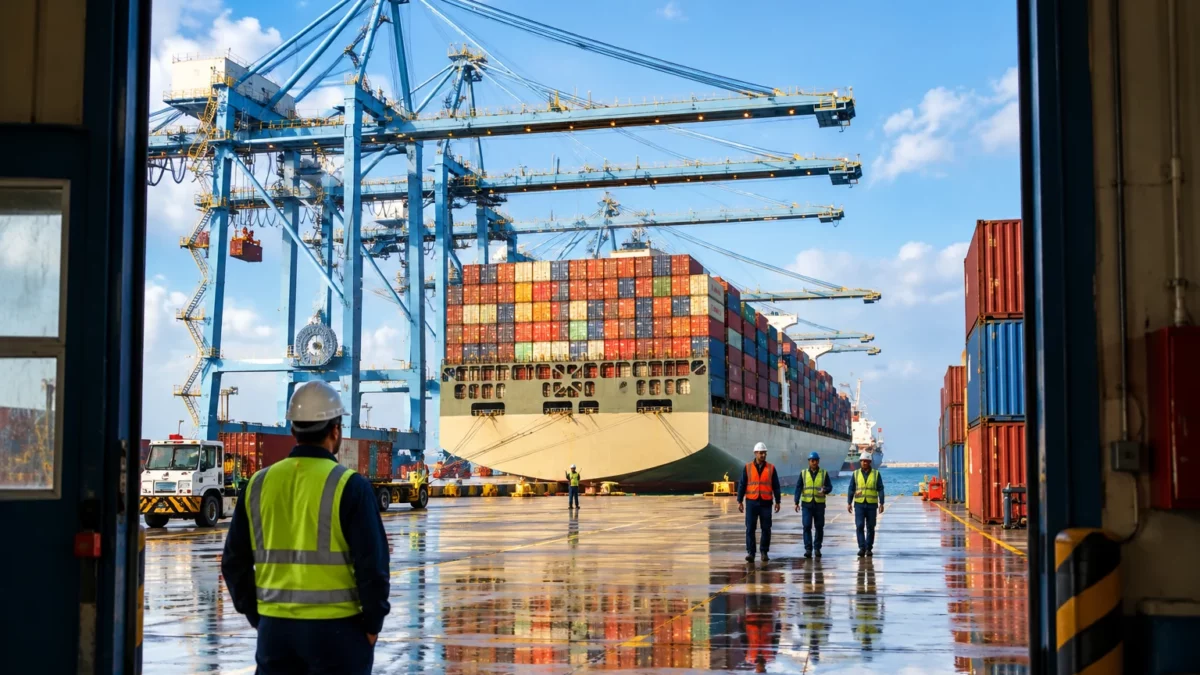
For a port to become a regular stop in trade between China and the Red Sea, receiving a very large vessel is not enough. It must also persuade shipping companies and businesses to entrust it with cargo, then ensure it is transported inland.
That is the ambition at Sokhna, on the Gulf of Suez. The Red Sea Container Terminals (RSCT), which recently began commercial operations, is highlighting its equipment and seeking to attract new Chinese customers. The results of this outreach remain to be seen: neither announced calls nor trade meetings have so far produced figures for volumes actually handled or contracts concluded.
Sokhna, a link in Egypt’s logistics strategy
The port of Sokhna lies at the southern entrance to the Suez Canal, on a route linking Asia, the Red Sea and the Mediterranean. For Egypt, it is part of a broader plan: to develop the port and industrial infrastructure of the Suez Canal Economic Zone, linking terminals with production and logistics activities.
The Suez Canal Economic Zone, or SCZONE, is an area dedicated to ports, industry and logistics services. It gives the Egyptian authorities a central role in developing the site, while private operators provide capital, equipment and expertise. This combination of public investment and commercial operations is intended to turn installed capacity into sustainable activity.
The regional dimension is tangible. Sokhna serves the Red Sea, while the Suez Canal is a major passage between the Indian and Atlantic oceans. Egypt does not belong to a regional economic community comparable to ECOWAS or CEMAC. For this issue, the most relevant frameworks are instead the African Union and the African Continental Free Trade Area (AfCFTA), which aims to facilitate trade between countries on the continent. But a high-performing port does not, on its own, create African trade links: roads, railways and efficient customs procedures are also needed.
A giant vessel as a test of capacity
On 16 November 2026, the CMA CGM Benjamin Franklin called at Sokhna. At 399.2 metres long, it can carry about 18,000 TEU, the equivalent of twenty-foot containers. The stated capacity describes the vessel, not the quantity of goods loaded or unloaded during its call. The public data consulted do not specify that volume.
This distinction matters. A call demonstrates that the terminal can receive a vessel of this size under the conditions of the operation. It does not, in itself, prove that the port has already attracted a regular flow of goods. A second specialist report also covers the call and the vessel’s dimensions. The Egyptian authorities, for their part, had announced the commercial launch of RSCT on 15 January 2026, after a month of trials, with the arrival of the CMA CGM Iron.
The terminal is operated by a consortium comprising Hutchison Ports, CMA CGM and COSCO Shipping. Its announced initial capacity is 1.7 million TEU a year. The project envisages an expansion that could bring this to 3.5 million TEU. These are theoretical capacities: actual traffic will depend on the number of rotations, load factors, demand and the smooth running of operations at the quayside.
From technical demonstration to contracts
RSCT is also seeking to broaden its customer base in China. According to information published by the operator, its teams met representatives of sixteen companies in Yiwu, at the offices of COSCO Shipping Lines and CMA CGM. Teams based in Ningbo, Hangzhou, Wenzhou, Taizhou and Shaoxing are said to have joined a session remotely. The operator says it presented the facilities and discussed businesses’ needs. No commercial commitments with figures attached have been made public.
A regular shipping service already provides a foothold. CMA CGM’s REX2 service connects several Chinese ports with Singapore, Djibouti, Jeddah, Sokhna and Aqaba. The shipping company advertises a weekly frequency. This service can facilitate trade between Asia and Egypt, but the presence of a route guarantees neither sufficient cargo nor competitive rates for every business.
Shippers will also compare the total cost of transport, transit times, the reliability of port calls and options for moving containers after they are unloaded. Large importers can negotiate directly with shipping companies. Smaller businesses, by contrast, depend more on freight forwarders, consolidated services and the regularity of inland connections. For workers and local businesses, the benefits will also depend on jobs created and links established with Egyptian suppliers.
The next test will be regularity
For Egypt, then, the challenge goes beyond the size of the vessels it receives. It is about turning new infrastructure into a platform that is used consistently, rather than reducing its role to a showcase for capacity. The next indicators will be the volumes actually handled, the regularity of port calls and the development of links between the port, industrial zones and regional markets.
Across Africa, the case illustrates competition between ports to capture global flows and better connect the continent’s economies. The AfCFTA could increase the value of logistics infrastructure capable of supporting intra-African trade. But this effect will depend on concrete connections between countries, not simply on the passage of giant container ships. At Sokhna, the decisive question is now whether traffic will be recurring: outreach announcements and available capacity will have to translate into cargo, rotations and controlled transit times.