Egypt
 Libya
 Morocco
 Sudan
 Tunisia
 Benin
 Burkina Faso
 Cabo Verde
 Côte d'Ivoire
 Ghana
 Guinea
 Guinea-Bissau
 Liberia
 Mali
 Mauritania
 Niger
 Nigeria
 Senegal
 Sierra Leone
 The Gambia
 Togo
 Cameroon
 Central African Republic
 Chad
 DR Congo
 Equatorial Guinea
 Gabon
 Republic of the Congo
 São Tomé and Príncipe
 Burundi
 Comoros
 Djibouti
 Eritrea
 Ethiopia
 Kenya
 Madagascar
 Malawi
 Mauritius
 Mozambique
 Rwanda
 Seychelles
 Somalia
 South Sudan
 Tanzania
 Uganda
 Angola
 Botswana
 Eswatini
 Lesotho
 Namibia
 South Africa
 Zambia
 Zimbabwe
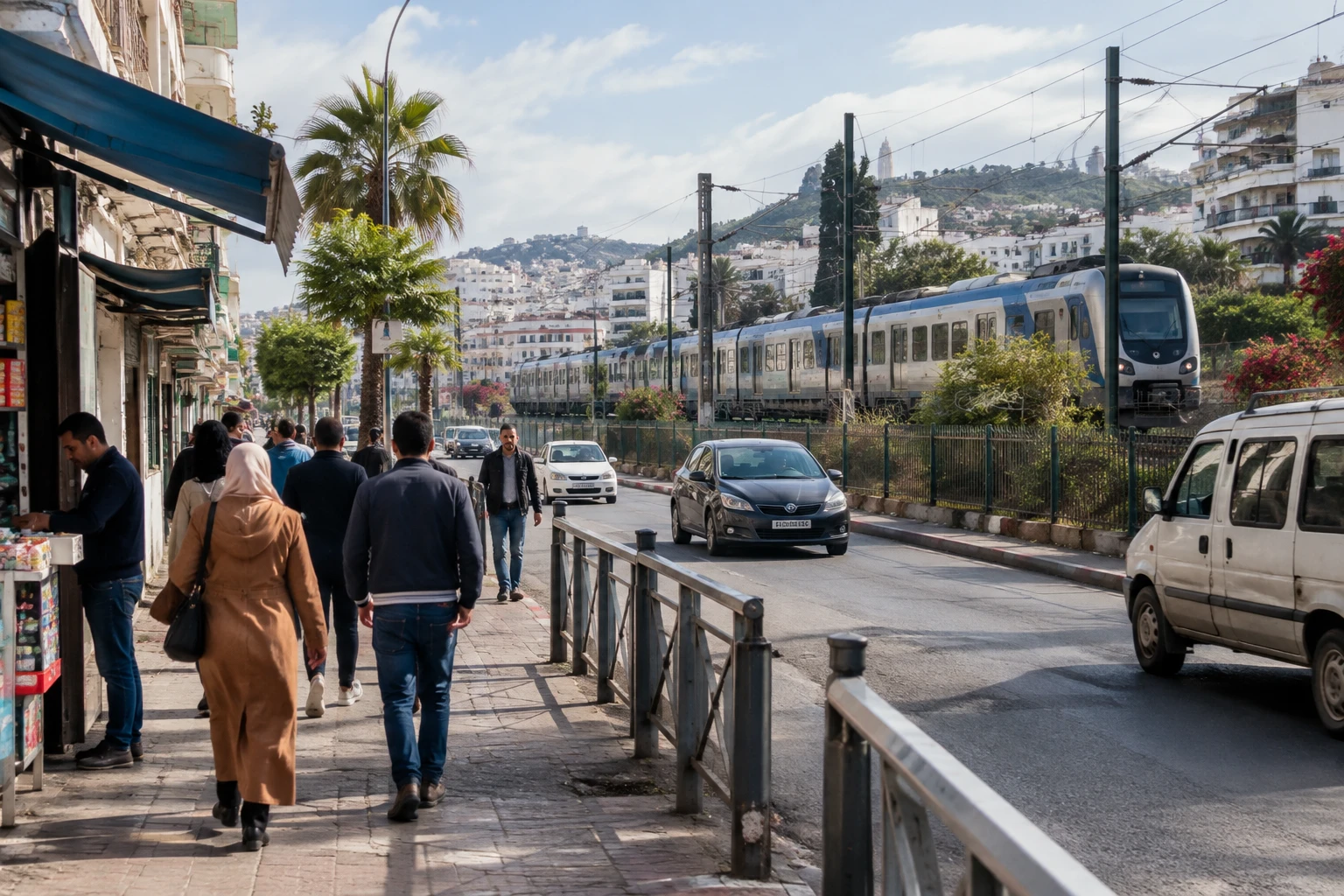
A railway line to the South, ore processed locally and fertiliser produced in the East: Algeria is banking on major projects to broaden its economy. But their weight in the budget raises a central question: will this infrastructure create sustainable activity beyond hydrocarbons?
Ore and rail at the heart of the programme
The 2027 draft finance bill provides 3,689.93 billion dinars for so-called structural projects. Presented on 12 October by Finance Minister Mohammed Lamine Lebbou to the relevant committee of the National People’s Assembly, this allocation is aimed mainly at mining, transport and industrial infrastructure. The APS confirmed the presentation of the bill and its stated aim of supporting productive investment and economic diversification.
Three projects account for most of the announced funding. Development of the Gara Djebilet iron ore deposit in Tindouf province is valued at 963 billion dinars. The integrated phosphate project at Blad El Hadba, in the East, accounts for 717.749 billion. The proposed railway line between Algiers and Tamanrasset has the highest cost, at 1,910 billion dinars. These figures were also reported by the Algerian daily La Sentinelle.
The total announced for Gara Djebilet is close to 963 billion dinars, of which 944.5 billion is said to have already been authorised or to be in the process of authorisation. The phosphate project will mobilise 717.749 billion, with 694.749 billion authorised. In budget terminology, an authorisation signals the commitment of planned spending; on its own, it does not mean that construction is complete or that the sum has already been disbursed.
The programme also includes tracks and connections to electricity and gas for industrial projects and agricultural areas in the South. An allocation of 107.18 billion dinars is set aside for them. Such facilities matter to residents and local businesses: a mine or factory cannot operate sustainably without access to networks, roads and services.
An investment budget under constraint
The government is forecasting growth of 4.2% in 2027, following estimated growth of 4.3% in 2026. The Algerian Press Service has also reported this forecast. Non-hydrocarbon activities are expected to become more important, but oil and gas revenues remain a major component of the country’s public finances and exports.
The draft provides for budget revenues of 9,251.1 billion dinars, including 6,598.8 billion excluding oil taxation. It estimates spending at 17,882.65 billion dinars in payment appropriations, meaning the sums planned to pay expenses during the year. Revenues therefore cover only part of the programme. Budget decisions will also have to preserve social transfers and fund housing, healthcare and education.
The framework uses a fiscal reference oil price of $60 a barrel. The economic forecast, meanwhile, is based on an assumption of $70. These assumptions underline a persistent vulnerability: if hydrocarbon revenues perform less favourably than expected, the capacity to fund major projects and current spending at the same time may shrink.
The debate is therefore not only about the volume of funding. It also concerns execution, completion times and economic returns. For Algerian businesses, the projects could open up markets in construction, metallurgy, logistics and services. For households, the effects will depend in particular on the jobs actually created, how long they last and how benefits are shared across regions.
Connecting regions and transforming resources
The line to Tamanrasset is important for regional development. The proposed route is intended to connect the capital with cities in the South, crossing several provinces. In areas far from major centres, better access to rail could facilitate the transport of goods and people. It could also reduce logistics costs for agricultural and industrial activities. However, these benefits will depend on the line entering service and on the frequency of connections.
The African Development Bank is supporting a section of the Trans-Saharan railway corridor. It has announced $878.09 million in financing for the second phase of the Laghouat–Ghardaïa–El Meniaa line. This funding concerns a section in the centre of the country; it is not, on its own, financing for the entire Algiers–Tamanrasset link. The institution describes the project as a driver of transport and regional integration.
In mining, the challenge is to move beyond raw extraction. The sector is estimated to account for about 1% of Algeria’s gross domestic product, despite the country’s mineral resources. Processing iron and phosphate locally could supply the steel and fertiliser industries, while creating opportunities for national companies. But these outcomes depend on complementary infrastructure, sufficient commercial demand, and control of energy and environmental costs.
A test for Algeria and its neighbours
The strategy balances two priorities: investing to broaden the productive base and maintaining spending that supports purchasing power and public services. Economist Brahim Guendouzi, in an analysis published by TSA Algérie, notes that the ability to generate non-hydrocarbon revenues will weigh on the sustainable financing of development. This is a concrete issue for small businesses and workers in the informal sector, who do not automatically benefit from major contracts.
Across North Africa, rail and mining projects are part of a region where cross-border trade remains limited by political tensions and incomplete infrastructure. The Arab Maghreb Union, which brings together Algeria and its neighbours, provides a regional framework, but its economic integration remains weak. Domestic connections can strengthen trade between Algerian regions; their pan-African reach will also depend on effective links with Sahelian and continental networks.
The draft bill is now continuing its passage through parliament. The next step will be to track the funding ultimately approved, the financing secured and the actual progress of the projects. The decisive measure of diversification will not be only the amount invested: it will be the share of new production, jobs and revenue created in Algeria beyond hydrocarbons.