Algeria
 Egypt
 Libya
 Sudan
 Tunisia
 Benin
 Burkina Faso
 Cabo Verde
 Côte d'Ivoire
 Ghana
 Guinea
 Guinea-Bissau
 Liberia
 Mali
 Mauritania
 Niger
 Nigeria
 Senegal
 Sierra Leone
 The Gambia
 Togo
 Cameroon
 Central African Republic
 Chad
 DR Congo
 Equatorial Guinea
 Gabon
 Republic of the Congo
 São Tomé and Príncipe
 Burundi
 Comoros
 Djibouti
 Eritrea
 Ethiopia
 Kenya
 Madagascar
 Malawi
 Mauritius
 Mozambique
 Rwanda
 Seychelles
 Somalia
 South Sudan
 Tanzania
 Uganda
 Angola
 Botswana
 Eswatini
 Lesotho
 Namibia
 South Africa
 Zambia
 Zimbabwe
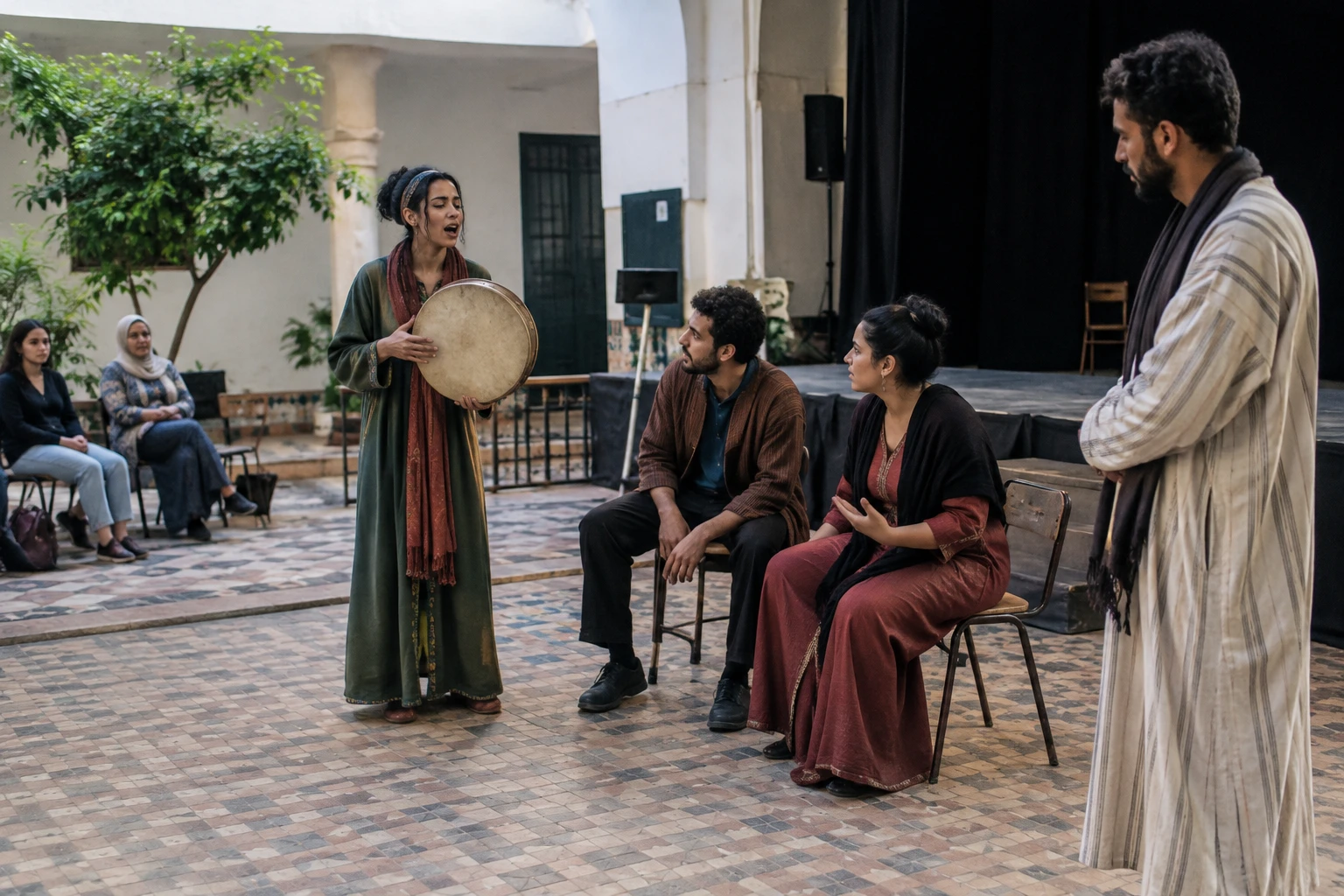
When a family prepares for a wedding, gestures and polite formulas can preserve appearances. In Kenza Berrada’s new play, they are no longer enough to contain a secret that upends the entire household.
A family story beneath the veneer of propriety
Presented at the Théâtre de Gennevilliers from 7 to 11 October 2026, as part of the Festival d’Automne à Paris, Paradis Plage (une vie comme dans du miel) is set in a Moroccan bourgeois family. The production was previously presented at the Théâtre national de Strasbourg, from 22 September to 2 October. These dates are confirmed by the theatre’s programme and a review published after the premiere. The play’s programme at the Théâtre de Gennevilliers and an interview with Kenza Berrada about the production outline its journey.
The story begins with Benti’s return to Morocco for her wedding. She refuses to let her elder brother attend the ceremony. Gradually, the reason for her refusal emerges: as a child, she suffered incestuous sexual abuse. The play also explores the silence of those close to her and the codes of swab, an art of knowing how to behave that governs manners, speech and hospitality in the milieu portrayed.
The title plays on the contrast. “A life as sweet as honey” suggests a sweetness on the surface, while Paradis Plage refers to a real place south of Agadir, which the author associates with childhood memories. Kenza Berrada says she wants to examine family secrets without caricaturing the Moroccan bourgeois milieu she portrays. In an interview, she discusses swab and family silences.
Cabaret as chorus and counterpoint
To bring this story to the stage, Berrada has brought together the Kabareh Cheikhats, an artists’ collective from Casablanca. The performers play both female and male characters, drawing on song, music, dance and acting. Their practice of theatrical cross-dressing is part of the form of the production: it does more than illustrate the roles, creating distance from a painful story.
Music gives speech another way to travel. The play brings together songs associated with the cheikhates, notably aïta — literally, the “cry” — and contemporary sound creation. Speech breaks into fragments, and voices take turns. The stage thus places the wedding ceremony and family obligations in tension with what can no longer remain unspoken.
This choice follows on from Berrada’s first production, Boujloud (l’homme aux peaux), which also addressed sexual abuse suffered in childhood. But the form has changed: instead of carrying several voices alone, the artist now builds an ensemble. In an interview, she says she wants this story to be carried “by others, not only by the victims”. This artistic approach does not turn theatre into an investigation or a judicial process. It opens up a space in which silence and its effects become visible.
A production rooted in its setting, without reducing Morocco to its subject
The story unfolds in a specific milieu. It does not claim to sum up Moroccan society, which varies across regions, social classes and life paths. This setting matters precisely because the rules of propriety, family reputation and the wedding ceremony shape relations between the characters. Staging them makes it possible to observe how protecting appearances can come into conflict with a victim’s voice.
The author’s background also connects Morocco and France. Born and raised in Morocco until the age of 17, Kenza Berrada works in the two languages of the play, Darija — spoken Moroccan Arabic — and French. At Gennevilliers, the production has French surtitles and is advertised for audiences aged 15 and over, with a warning about incest and sexual violence. It is also part of the 2026 Mediterranean Season, a framework for cultural cooperation between the shores of the Mediterranean.
Regionally, the play highlights how contemporary Moroccan theatre travels through its own artists, collectives and references, while engaging with international stages. Casablanca is not merely a backdrop here: the Kabareh Cheikhats artists live there and bring their stage practice to the production. Their presence shifts the gaze often directed at Moroccan culture from outside, allowing Moroccan artists to shape the portrayal of their society.
What the stage can say — and what it cannot replace
The production does not present art as a solution to abuse. Berrada distinguishes artistic transformation from the concrete responsibilities of families, the justice system and institutions. This distinction matters: making an experience heard can help break isolation, but it cannot replace child protection or support for those affected.
The play runs at Gennevilliers until 11 October 2026, following its premiere in Strasbourg. Its tour and reception in Morocco remain to be seen, and will help gauge how the work travels among different audiences. Its purpose, however, goes beyond distribution: to make audible, through a chorus of voices and bodies, what a family would prefer to keep hidden behind ritual and good manners.