
 Algeria
 Egypt
 Libya
 Sudan
 Tunisia
 Benin
 Burkina Faso
 Cabo Verde
 Côte d'Ivoire
 Ghana
 Guinea
 Guinea-Bissau
 Liberia
 Mali
 Mauritania
 Niger
 Nigeria
 Senegal
 Sierra Leone
 The Gambia
 Togo
 Cameroon
 Central African Republic
 Chad
 DR Congo
 Equatorial Guinea
 Gabon
 Republic of the Congo
 São Tomé and Príncipe
 Burundi
 Comoros
 Djibouti
 Eritrea
 Ethiopia
 Kenya
 Madagascar
 Malawi
 Mauritius
 Mozambique
 Rwanda
 Seychelles
 Somalia
 South Sudan
 Tanzania
 Uganda
 Angola
 Botswana
 Eswatini
 Lesotho
 Namibia
 South Africa
 Zambia
 Zimbabwe
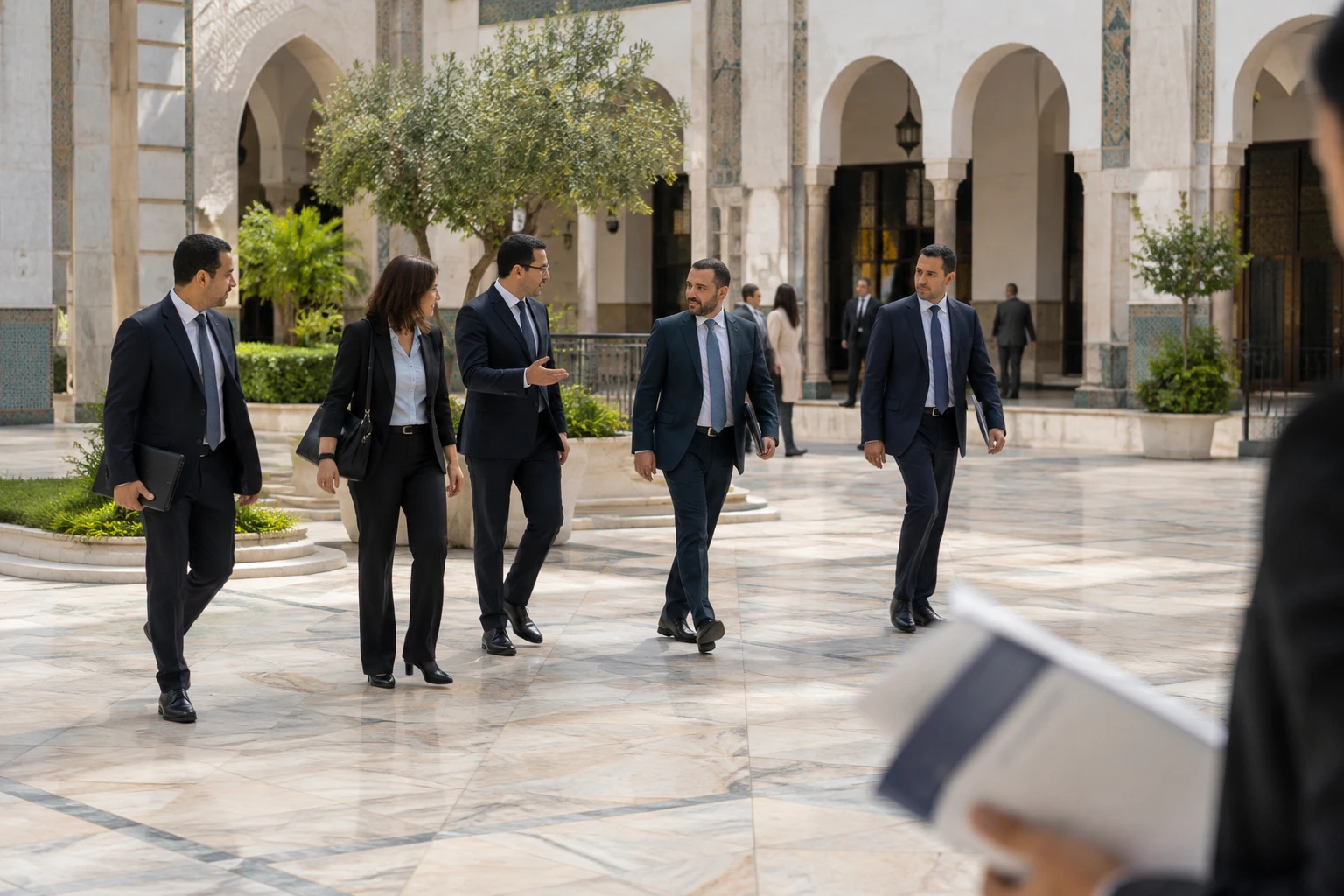
In Morocco, military rapprochement with Israel is continuing as the war in Gaza has widened the divide between Rabat’s diplomatic choices and a section of public opinion. The visit of Israeli officials to Rabat on 9 and 10 November 2026 is bringing renewed visibility to the partnership. It also raises a practical question: how far can defence cooperation deepen without reigniting domestic political tensions?
A partnership set within a broader strategy
Morocco restored official relations with Israel in December 2020, as part of the Abraham Accords. This normalisation was accompanied by US recognition of Moroccan sovereignty over Western Sahara, a central issue in the kingdom’s diplomacy. This context sheds light on Rabat’s strategic interest, without by itself accounting for Morocco’s motivations.
The rapprochement quickly extended to defence. In November 2021, the two countries signed a military cooperation memorandum and an agreement on the protection of information in the defence sector. The text established a framework for exchanges between military institutions. It forms part of Morocco’s policy of diversifying partnerships and developing a national defence industry. SNRT News reported the signing of these agreements in 2021.
This approach also responds to North Africa’s specific security challenges. Relations between Rabat and Algiers remain tense, notably over Western Sahara, while Morocco’s armed forces maintain partnerships with several suppliers. Israel is therefore being added to existing defence relationships with the United States and European countries, rather than automatically replacing them.
Exchanges become more visible
On 9 November 2026, Amir Baram, director-general of Israel’s Ministry of Defence, met Moroccan officials in Rabat, including Abdeltif Loudyi, minister delegate in charge of the National Defence Administration, and General Mohammed Berrid, inspector general of the Royal Armed Forces. The visit notably marked the inauguration of a permanent office for an Israeli defence attaché in the capital. Le Desk reported on the meetings in Rabat, while the Italian news agency Agenzia Nova also reported the inauguration of the office.
A month earlier, Israel had officially taken part in the Marrakech Air Show for the first time since normalisation. The Israeli delegation and the presence of defence companies made the cooperation more visible at a public event devoted to aviation and defence. This commercial exposure alone, however, does not make it possible to assess the volume of contracts concluded or the equipment actually delivered. Israel’s Ministry of Defence confirmed the participation and the opening of a national pavilion.
Industrial cooperation is also attracting attention. BlueBird Aero Systems, an Israeli company specialising in drones, has announced a production project in Morocco. In 2024, Le Monde reported that the SpyX drone could be manufactured locally, while noting that practical details remained sparse in the public domain. An announced project must therefore be distinguished from production whose scale and timeline have been established by verifiable data. The French daily’s investigation highlighted these reservations.
A state policy contested in Moroccan society
The continuation of cooperation does not erase the disagreements sparked by the war in Gaza. Rallies have regularly condemned Israeli operations and called for an end to normalisation. On 12 September 2025, Hespress relayed figures from an activist coordination group reporting demonstrations in 56 cities. This figure comes from that organisation, not from an independent official tally. Hespress’s coverage explicitly attributed the figure to the coordination group.
This opposition highlights two coexisting strands. On the one hand, the Moroccan authorities are pursuing a defence and diplomatic policy based on partnerships deemed useful to the state’s interests. On the other, citizens, associations and political movements are expressing solidarity with Palestinians and rejecting normalisation. These protests should not be conflated with the kingdom’s official position, nor should state policy be presented as a social consensus.
For the Royal Armed Forces, the stakes include access to technology and the development of industrial capabilities. For Moroccan companies, technology transfers could open up opportunities, provided announcements translate into measurable local activity. For the public, the issue also plays out in the political arena: the continuation of the partnership is viewed through the lens of the situation in Palestine and Rabat’s public positions.
Regional implications go beyond military contracts
Morocco belongs to the Arab Maghreb Union, a regional organisation that also brings together Algeria, Tunisia, Libya and Mauritania, but whose political integration remains limited. In this environment, its defence ties with Israel take on strategic significance, although they do not automatically imply an operational alliance against a neighbouring country. Public announcements must be distinguished from interpretations and unconfirmed scenarios.
Across the continent, this relationship also bears on Morocco’s place in African debates about security partnerships, technology transfers and local equipment production. It is a reminder that African states’ foreign policy choices are shaped by diverse national interests and cannot be reduced to a common position on the Middle East. What happens next will depend on the agreements actually concluded, the substance of industrial transfers and how Rabat aligns this cooperation with its diplomatic positions on the Palestinians.



