
 Algeria
 Egypt
 Libya
 Sudan
 Tunisia
 Benin
 Burkina Faso
 Cabo Verde
 Côte d'Ivoire
 Ghana
 Guinea
 Guinea-Bissau
 Liberia
 Mali
 Mauritania
 Niger
 Nigeria
 Senegal
 Sierra Leone
 The Gambia
 Togo
 Cameroon
 Central African Republic
 Chad
 DR Congo
 Equatorial Guinea
 Gabon
 Republic of the Congo
 São Tomé and Príncipe
 Burundi
 Comoros
 Djibouti
 Eritrea
 Ethiopia
 Kenya
 Madagascar
 Malawi
 Mauritius
 Mozambique
 Rwanda
 Seychelles
 Somalia
 South Sudan
 Tanzania
 Uganda
 Angola
 Botswana
 Eswatini
 Lesotho
 Namibia
 South Africa
 Zambia
 Zimbabwe
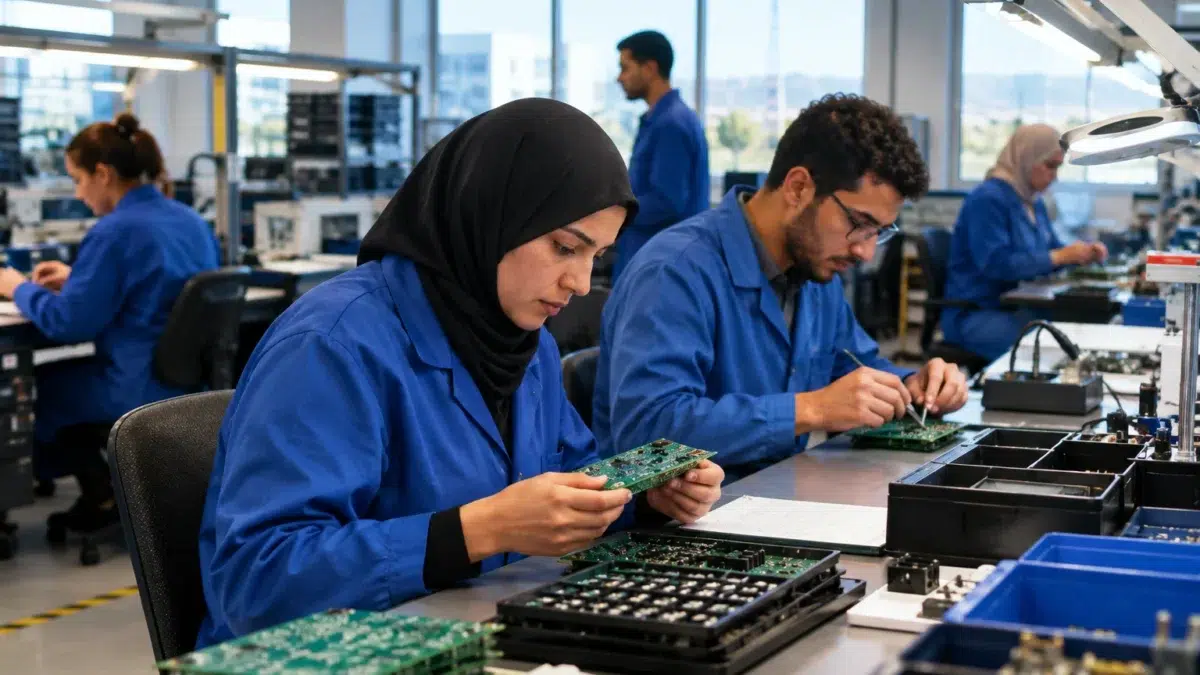
Producing some defence equipment locally, training specialists and selling abroad: Morocco wants to make the security industry a new pillar of its industrial base. The ambition is high. Its success will depend less on announcements than on skills, partnerships and the businesses that actually come into being.
An industrial strategy as much as a military one
In Rabat, King Mohammed VI chaired a working session on 18 November 2026 devoted to the roadmap known as “Morocco Offer”. The programme covers the entire industrial chain: design, manufacturing, maintenance, testing and storage of defence and security equipment.
The Hassan II Fund for Economic and Social Development is to contribute 4 billion dirhams, or about $400 million. This is a contribution announced for the programme, not the total cost of all the public and private investment that could follow.
The targets set for 2035 are to create nearly 50,000 direct and indirect jobs, meet about 40% of the needs of the Royal Armed Forces and security services, and generate more than 65% of sector revenues from exports. These are official projections, not results already achieved. African news agency APA and Anadolu Agency report the same figures and deadlines.
Industrial zones and training to be established
The roadmap targets drones, autonomous systems, land and naval equipment, electronics, cybersecurity and artificial intelligence. Some so-called “dual-use” technologies can serve both civilian and military applications. This overlap could facilitate skills transfers from sectors where Morocco already has industrial activity, notably aerospace, automotive and electronics.
The plan provides for two new dedicated zones, in Benguerir and Benslimane, in addition to two industrial acceleration zones already launched. It also announces an agency to steer the strategy, an industrial holding company to structure the sectors and an academy to train future employees. Investors are said to have expressed interest, but their identities and the corresponding projects were not made public in the announcements reviewed.
The legal framework, meanwhile, is not starting from scratch. Moroccan Law 10-20 governs defence and security equipment, and its implementing texts organise, in particular, manufacturing, import and export permits. The regulations published by Morocco’s Ministry of Justice also provide for investment support and a commission responsible for overseeing their implementation.
Jobs will depend on skills and local benefits
The 50,000 jobs announced could cover a range of roles: engineers, technicians and specialists in maintenance, cybersecurity and production. But the number of jobs does not yet indicate where they will be created, what proportion will be lasting or what role Moroccan companies will play in supply chains. The planned academy will therefore have to meet concrete industrial needs, rather than simply support the programme’s communications.
The challenge is also to turn public funding into production capacity. Companies will need predictable orders, access to technology, reliable suppliers and clear rules on partnerships. Foreign capital can accelerate the transfer of expertise. On its own, however, it does not guarantee that design, skilled jobs and added value will remain in Morocco.
The target of more than 65% of revenues from exports shows that the domestic market alone would not be enough to support this industry. Exports can strengthen the viability of factories, but require competitive products, contracts and compliance with the rules governing the arms trade. Morocco has already established industrial partnerships with several countries, including Turkey, India, Israel, France and the United States, according to reports by TV5MONDE. The available announcements do not, however, detail the timetables or the division of responsibilities in these projects.
A regional issue, but the plan is not just about tensions
This initiative comes amid strained relations between Morocco and Algeria, which severed diplomatic ties with Rabat in 2021. The timing is therefore prompting strategic interpretations. Moroccan officials, however, also present the project as a choice in favour of industrial sovereignty and economic development. Both dimensions can coexist, without either being sufficient to explain the other.
In North Africa, Morocco’s strategy could reshape industrial partnerships and equipment trade. Across the continent, it raises a broader question: under what conditions can African countries develop local capabilities, train specialists and reduce certain dependencies while regulating exports? The announced targets do not yet make it possible to measure the effect on imports or identify future African markets.
The next stage will therefore be implementation: establishing governance structures, setting up industrial zones, publishing the projects selected and recruiting the first staff. These milestones will test the reach of the “Morocco Offer”: not only in the equipment produced, but also in skilled jobs, the share of value captured locally and the ability to maintain equipment on site.



