
 Egypt
 Libya
 Morocco
 Sudan
 Tunisia
 Benin
 Burkina Faso
 Cabo Verde
 Côte d'Ivoire
 Ghana
 Guinea
 Guinea-Bissau
 Liberia
 Mali
 Mauritania
 Niger
 Nigeria
 Senegal
 Sierra Leone
 The Gambia
 Togo
 Cameroon
 Central African Republic
 Chad
 DR Congo
 Equatorial Guinea
 Gabon
 Republic of the Congo
 São Tomé and Príncipe
 Burundi
 Comoros
 Djibouti
 Eritrea
 Ethiopia
 Kenya
 Madagascar
 Malawi
 Mauritius
 Mozambique
 Rwanda
 Seychelles
 Somalia
 South Sudan
 Tanzania
 Uganda
 Angola
 Botswana
 Eswatini
 Lesotho
 Namibia
 South Africa
 Zambia
 Zimbabwe
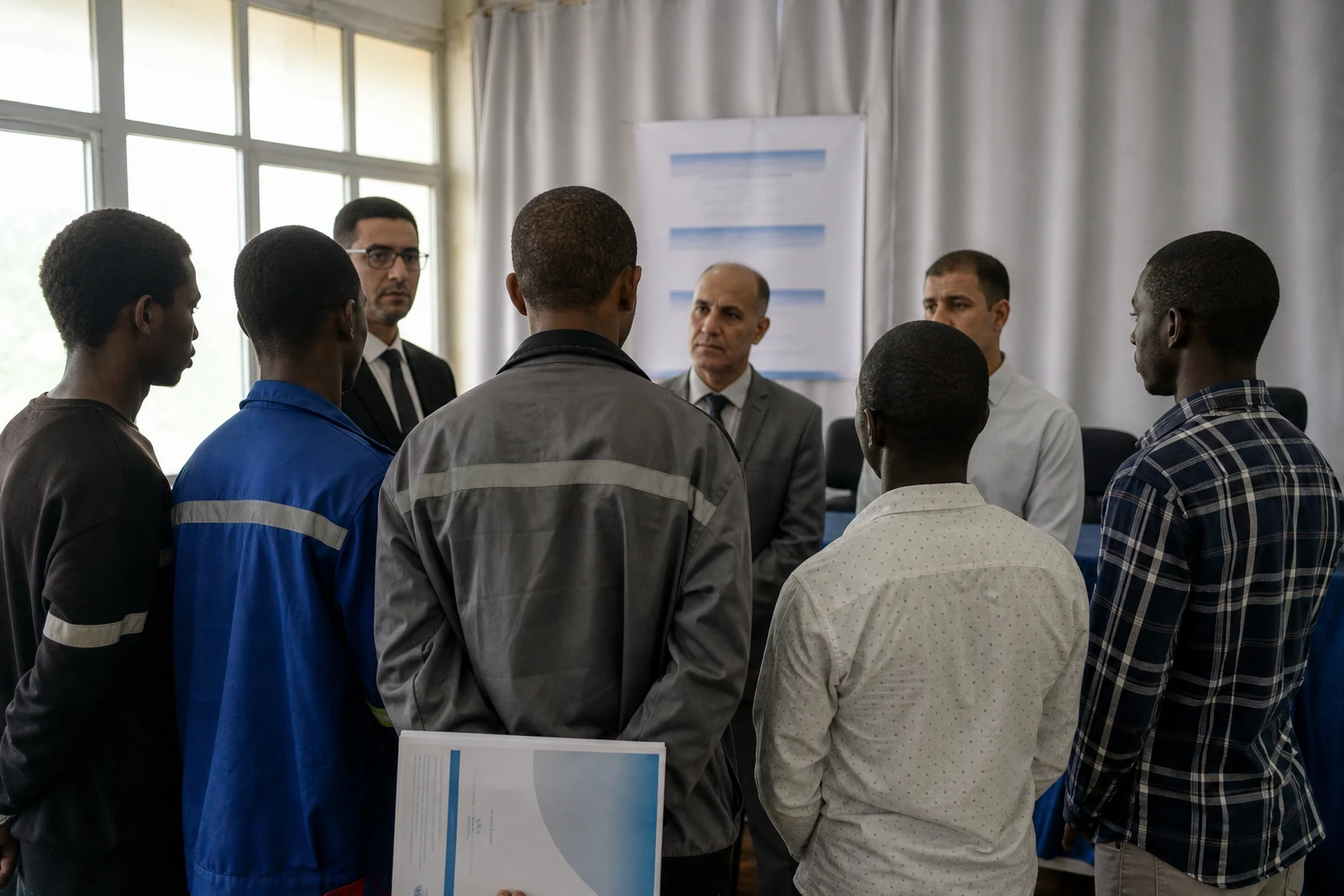
In Niamey, the question is no longer simply how to train more young people. Above all, they need to acquire skills that can be put to direct use in businesses, workshops and services. This is the stated aim of a new cooperation programme between Niger and Algeria.
Training designed around market needs
On 3 October 2026, a programme for 500 Nigerien trainees was launched in Boumerdès, Algeria. Participants are to be trained in 19 technical and vocational fields across several Algerian institutions.
The programme targets, in particular, building electrics, plumbing and welding. Other fields are to complement this initial group. According to the Nigerien authorities, the trades were selected on the basis of a study by the National Employment Observatory.
This approach seeks to avoid a common difficulty in West Africa: training that leads to certificates but few jobs. Niger’s ministry responsible for labour therefore plans to provide support after the trainees return. The precise arrangements for this support have not yet been detailed.
The launch ceremony brought together Nigerien and Algerian officials in Boumerdès. Niger’s ambassador to Algeria, Aminou Malam Manzo, praised the welcome given to the Nigerien trainees. The training is thus part of bilateral cooperation that goes beyond diplomatic exchanges and directly addresses young people’s employability.
The programme covers an initial cohort of 500 people. It is therefore not, on its own, a response to the scale of the national challenge. It could nonetheless serve as a test case for better links between training centres, employers’ needs and Niger’s economic projects.
A labour market dominated by informality
The available data explain the urgency of this approach. The bulletin from Niger’s National Institute of Statistics covers young people aged 15 to 35 tracked in the country’s eight regional capitals.
In the second quarter of 2025, the employment rate for this population stood at 34.5%. The unemployment rate calculated according to International Labour Organization standards reached 25.5%.
The most revealing figure, however, concerns the nature of the jobs. According to the same bulletin, 91.3% of employed young people worked in the informal sector. This sector encompasses activities essential to the day-to-day economy, but often offers little social protection, stability or opportunity for advancement.
The situation also differs sharply by gender. The employment rate was 46.9% among men, compared with 22.1% among women over the same period. An effective training policy will therefore need to monitor young women’s access to technical fields, internships and employment-support programmes.
The NIS bulletin also found that 37.4% of young people were not in employment, education or training. This group, often referred to by the English acronym NEET, signals a break with conventional pathways into employment.
Return to Niger will be the decisive step
Training in Algeria will have lasting effects only if the skills acquired are put to use in Niger. This means identifying businesses likely to recruit, projects able to take on trainees, and fields in which self-employment is a realistic option.
For an electrician, plumber or welder, the transition from training to work rarely depends on a qualification alone. It also requires tools, access to credit, clear professional standards and customers with the means to pay. In cities, demand may come from construction, equipment maintenance and networks. In the regions, it may be linked to agriculture, crafts, energy and local services.
Monitoring the participants will make it possible to measure the programme’s real impact. It will be important to establish how many secure jobs, start businesses or join companies after returning. It will also be necessary to check whether the skills taught match the equipment and methods used in Niger.
This is a central issue, since training designed without links to local realities may shift the problem rather than solve it. Conversely, a programme developed with employers and professional organisations can help improve service quality and the productivity of small businesses.
Niger already has a developing training network. The Nigerien Press Agency reported in July 2026 that public technical and vocational training institutions had 96,386 students in the 2025-2026 academic year, including 42,973 girls. Seventeen programmes had been developed, revised or adapted by then.
Cooperation with Algeria can therefore complement the national provision. It should not replace it. Its value will be greater if it also strengthens trainers, curricula and partnerships between Nigerien and Algerian institutions.
Cooperation in a changing regional landscape
The partnership comes as West Africa is being reshaped. Niger, Burkina Faso and Mali officially left the Economic Community of West African States (ECOWAS) on 29 January 2025. The three countries are now developing coordination within the Alliance of Sahel States, while maintaining economic ties with their regional neighbours.
In this context, direct cooperation takes on particular importance. Vocational training is becoming a means of skills mobility, as well as a lever for economic sovereignty. For Niamey, the challenge is to reduce dependence on certain external expertise while making use of available partnerships.
Algeria has considerable experience in organising vocational training and establishing technical fields. Niger’s interest, therefore, lies not only in hosting 500 trainees. It may also lie in transferring methods, training trainers and creating links between the two systems.
The International Labour Organization notes, for its part, that the gap between the skills taught and businesses’ needs remains a major challenge in Niger. A project involving Nigerien trainers is seeking, in particular, to develop programmes based on a competency-based approach, meaning teaching centred on the ability to perform a professional task in practice.
The next step will therefore be less symbolic than practical. It will involve documenting the 500 trainees’ progress, publishing the results of their integration into employment and determining whether the model can be expanded. Only then can cooperation between Niger and Algeria go beyond an exchange of training places and become a genuine tool for transforming the labour market.



