
 Algeria
 Egypt
 Libya
 Morocco
 Sudan
 Tunisia
 Benin
 Burkina Faso
 Cabo Verde
 Côte d'Ivoire
 Ghana
 Guinea
 Guinea-Bissau
 Liberia
 Mali
 Mauritania
 Niger
 Nigeria
 Senegal
 Sierra Leone
 The Gambia
 Togo
 Cameroon
 Central African Republic
 Chad
 Equatorial Guinea
 Gabon
 Republic of the Congo
 São Tomé and Príncipe
 Burundi
 Comoros
 Djibouti
 Eritrea
 Ethiopia
 Kenya
 Madagascar
 Malawi
 Mauritius
 Mozambique
 Rwanda
 Seychelles
 Somalia
 South Sudan
 Tanzania
 Uganda
 Angola
 Botswana
 Eswatini
 Lesotho
 Namibia
 South Africa
 Zambia
 Zimbabwe
In the Great Lakes region, peace is no longer measured by the signing of agreements, but by their implementation on the ground. Yet, fifteen months after the agreement reached in Washington between the Democratic Republic of the Congo and Rwanda, the anticipated military disengagement remains at the heart of the deadlock.
An agreement under pressure in the Great Lakes
On 27 June 2025, Kinshasa and Kigali signed an agreement in Washington aimed at reducing tensions in eastern DR Congo. The text provides, in particular, for the withdrawal of Rwandan forces present on Congolese territory and the neutralisation of the Democratic Forces for the Liberation of Rwanda, the FDLR, an armed group partly formed from networks linked to the 1994 genocide against the Tutsi.
These two commitments are linked. Kigali presents the FDLR as a direct threat to its security. Kinshasa, for its part, considers that this threat cannot justify the continued presence of Rwandan soldiers in the provinces of North Kivu and South Kivu.
The initial timetable did not break this pattern of reciprocity. DR Congo is calling for a verifiable Rwandan withdrawal. Rwanda first wants guarantees that the FDLR will be neutralised. Between these two positions, the peace mechanism is progressing in stages, but has yet to bring decisive change for people in eastern Congo.
A joint security coordination mechanism nevertheless brings the parties together with several partners. The mechanism’s fifth meeting was held on 15 and 16 July 2026, with representatives of DR Congo, Rwanda, the United States, Qatar, Togo and the African Union Commission in attendance. Participants reaffirmed their commitments on military disengagement and the fight against the FDLR, without resolving the underlying dispute.
Évariste Ndayishimiye’s assessment
In an interview with France 24 on the sidelines of the United Nations General Assembly, Burundian President Évariste Ndayishimiye said on 23 September 2026 that the process remained at an impasse. He called on Rwanda to follow through on its commitments regarding the withdrawal of its forces from DR Congo.
“If there really is a desire for peace in Congo, Rwanda should show a positive attitude towards disengagement,” the Burundian head of state said, according to the Congolese Press Agency.
Bujumbura’s position is being closely watched. Burundi shares a long border with DR Congo and remains directly exposed to the security consequences of the conflict in the Kivu provinces. It has also been involved in the regional force deployed alongside Kinshasa against armed groups active in eastern Congo.
Évariste Ndayishimiye is also the current chairperson of the African Union. His stance therefore gives continental significance to criticism that is not coming solely from Kinshasa. It also shows that the disagreement over Rwanda’s withdrawal has now moved beyond a stand-off between the Congolese and Rwandan authorities.
Two opposing views of security
For Kinshasa, the priority is respect for Congolese sovereignty. The authorities say the issue of the FDLR can no longer be used to justify the continued presence of foreign troops, particularly since DR Congo made commitments to locate and disarm the group.
Congolese Prime Minister Judith Suminwa restated this position before the UN General Assembly on 23 September 2026. According to Actualite.cd, Kinshasa believes that progress on the FDLR should now be assessed separately from the Rwandan military presence.
Kigali takes a different view. Rwanda says its security measures are a response to a cross-border threat. In June 2026, its foreign minister, Olivier Nduhungirehe, made the withdrawal of Rwandan forces conditional on Kinshasa neutralising the FDLR, according to Actualite.cd.
This divergence is blocking implementation of the agreement. Each party believes the other should act first. In practice, the security commitments remain interdependent, while verification mechanisms have yet to build sufficient trust.
A direct impact on communities
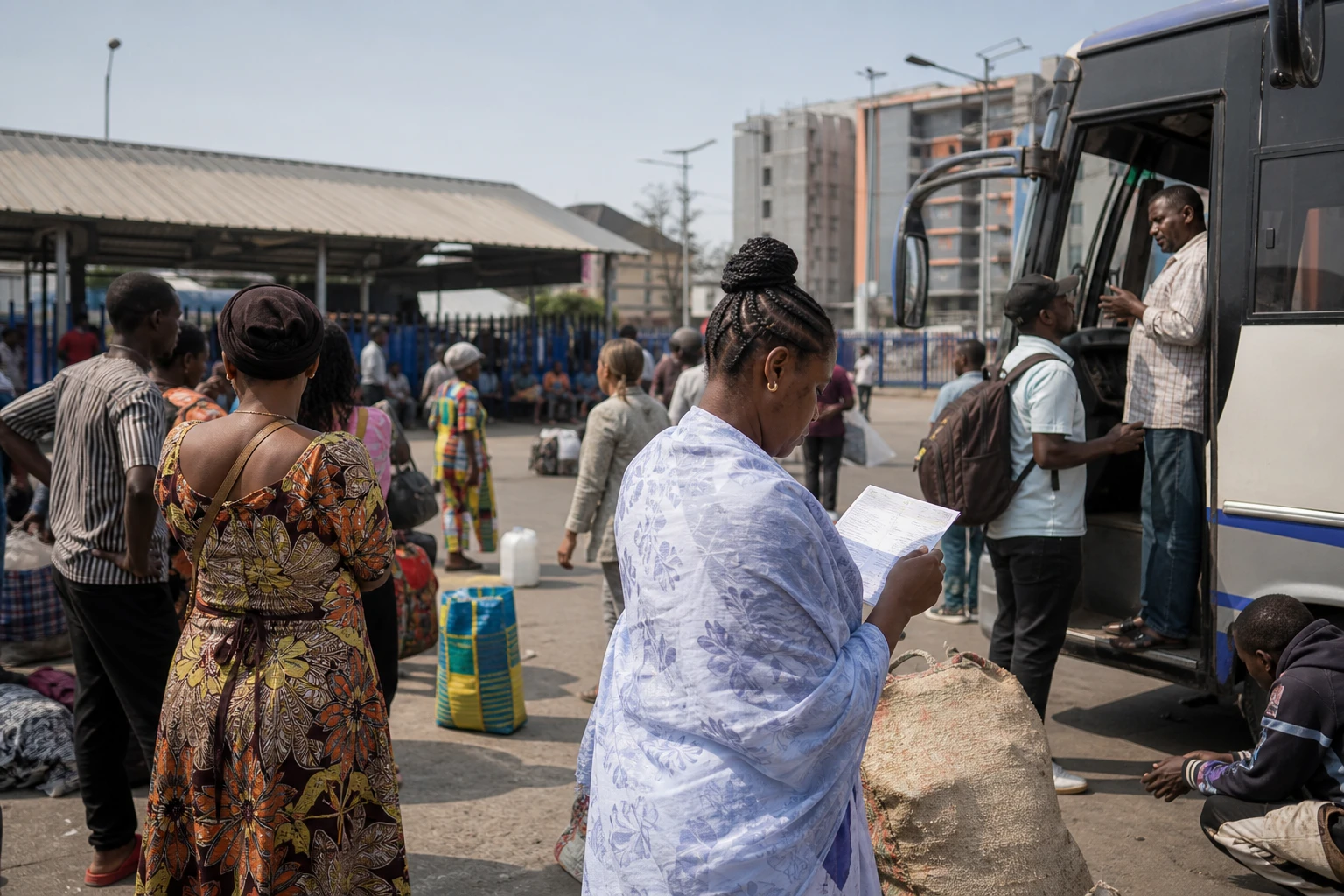
In Goma, Bukavu and the rural areas of North Kivu and South Kivu, the diplomatic debate translates into persistent uncertainty. Residents are waiting first for roads to reopen, economic activity to resume and farming areas to be made safe.
The consequences vary from one area to another. In major cities, instability disrupts transport, markets and public services. In rural areas, it has a greater effect on access to fields, families’ movements and the circulation of goods.
The ongoing crisis is also weighing on regional trade. The borders between DR Congo, Rwanda and Burundi are vital to traders, transport operators and small businesses. When security deteriorates, the informal economy absorbs the shock before established companies do.
The conflict also complicates the work of humanitarian organisations and local authorities. Population movements, restrictions on travel and the presence of armed groups make it harder to deliver aid and enable displaced families to return permanently.
The next test will be implementation
The Washington and Doha talks remain the two main diplomatic frameworks. The first deals directly with relations between Kinshasa and Kigali. The second concerns dialogue between the Congolese government and the Congo River Alliance-M23, whose forces still control several areas in eastern DR Congo.
African mediation also retains a role. Togo is taking part in the security coordination mechanism as an African Union facilitator. For the pan-African organisation, the challenge is to prevent external initiatives from sidelining the regional frameworks already involved in seeking a solution.
The next step will therefore be practical rather than symbolic. Troop movements will have to be verified, the neutralisation of armed groups documented, and a sequence acceptable to both states established. Without measurable progress on these points, the Washington agreement will remain a diplomatic framework with too little impact on the ground.
Burundi occupies a particular position in this equation. Geographically close to the theatre of operations and now at the forefront of the African Union, Bujumbura can help maintain diplomatic pressure. But it will also have to preserve a fragile regional balance, as mistrust between Kinshasa, Kigali and several neighbouring capitals remains high.



