Egypt
 Libya
 Morocco
 Sudan
 Tunisia
 Benin
 Burkina Faso
 Cabo Verde
 Côte d'Ivoire
 Ghana
 Guinea
 Guinea-Bissau
 Liberia
 Mali
 Mauritania
 Niger
 Nigeria
 Senegal
 Sierra Leone
 The Gambia
 Togo
 Cameroon
 Central African Republic
 Chad
 DR Congo
 Equatorial Guinea
 Gabon
 Republic of the Congo
 São Tomé and Príncipe
 Burundi
 Comoros
 Djibouti
 Eritrea
 Ethiopia
 Kenya
 Madagascar
 Malawi
 Mauritius
 Mozambique
 Rwanda
 Seychelles
 Somalia
 South Sudan
 Tanzania
 Uganda
 Angola
 Botswana
 Eswatini
 Lesotho
 Namibia
 South Africa
 Zambia
 Zimbabwe
A discreet presence that is already proving useful
In bank corridors, consultancy offices and business forums, an Algerian movement less visible than migration to Europe is taking shape in West Africa. It does not resemble a mass diaspora. It is growing through small networks of bankers, engineers, traders and SME executives settling in Dakar, Nouakchott and other capitals in the sub-region. This movement is part of a broader shift: Algeria is now seeking to turn its political presence on the continent into a lasting economic one.
This development is taking place in a regional space where trade operates on the scale of ECOWAS, WAEMU and, more broadly, the African Continental Free Trade Area, designed to facilitate flows of goods, services and investment. For Algiers, the challenge is clear: no longer to remain on the sidelines of the African market, but to enter it through concrete footholds. Banks, air transport and trade fairs are thus becoming instruments of economic outreach, not merely diplomatic symbols.
Two banks to lead the way
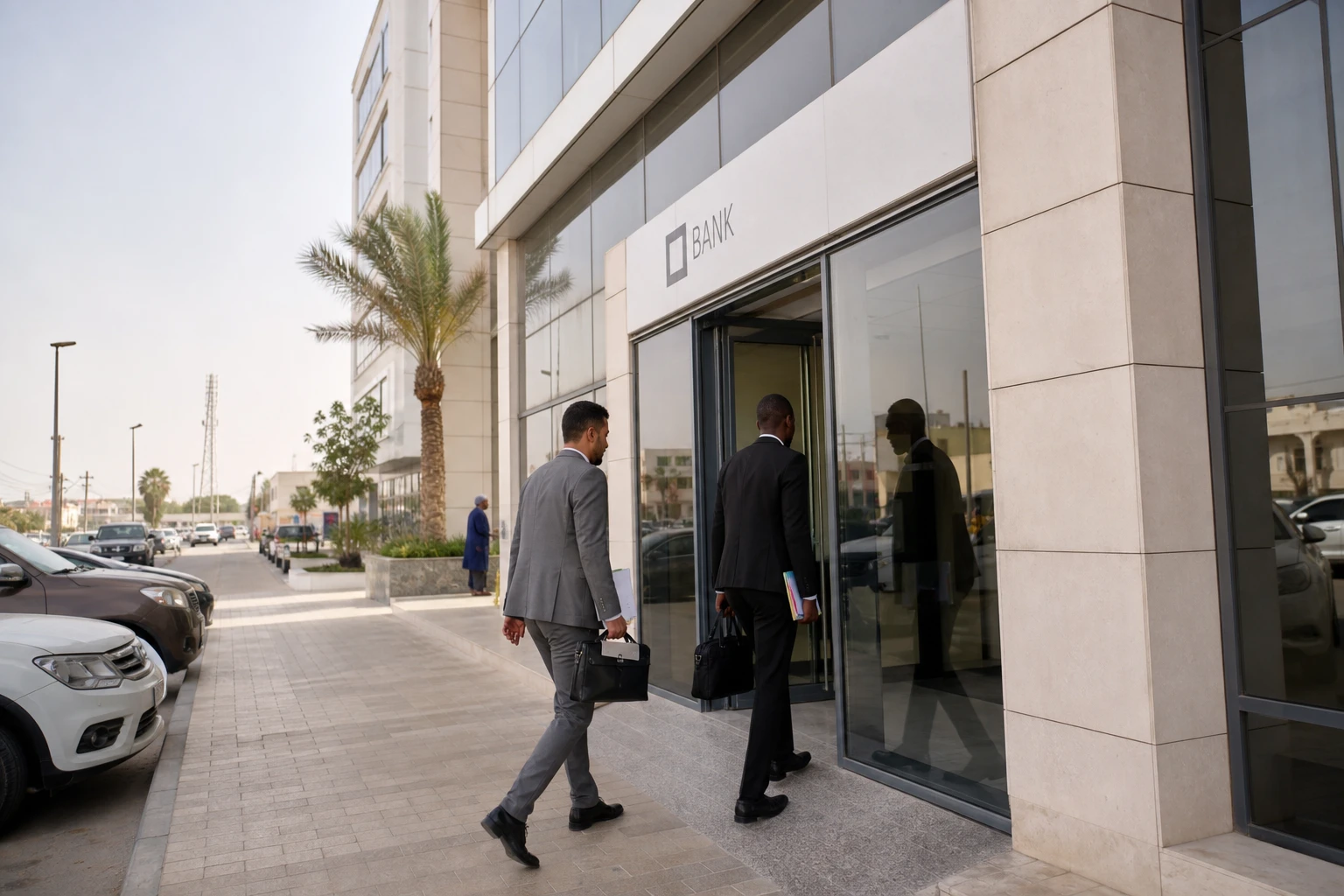
The most visible turning point came in September 2023, with the opening of two Algerian banking outposts in West Africa: the Algerian Bank of Senegal, in Dakar, and the Algerian Union Bank, in Nouakchott. ABS Bank says it has been operating in Senegal since September 2023, and BCEAO documents confirm its authorisation in the WAMU area; the Senegalese bank is presented as an Algerian-owned institution, with stated capital of $100 million. In Nouakchott, its sister bank was launched with capital of $50 million, according to Algerian state media.
This is not just a matter of putting a logo on a façade. These branches create local teams and attract executives from Algeria: finance managers, lawyers, sales staff and engineers. They also provide a bridge for Algerian companies seeking to export, set up a subsidiary or secure a contract. The message is simple: in markets where trust is built over time, a local banking presence matters as much as an agreement signed remotely.
In Dakar, ABS Bank is also intended to make it easier for Algerian businesses to establish themselves. The dates, building materials, services and distribution sectors are already benefiting, because businesses need accounts, guarantees and a precise understanding of local rules. The same logic applies to Mauritania as to Senegal: a company cannot sell in West Africa over the long term with only a catalogue exported from Algiers. It must understand government bodies, commercial practices, payment schedules and customers’ expectations. This is where Algerians based locally become useful intermediaries.
Turning agreements into real activity
The fourth edition of the Intra-African Trade Fair, held in Algiers from 4 to 10 September 2025, gave this strategy a new scale. The event brought together 2,148 exhibitors and 112,476 visitors, according to Afreximbank and Algerian state media. Announced contracts reached $48.3 billion, including about $11.4 billion for Algerian companies. These figures are impressive, but they will matter only if the signatures lead to projects, deliveries and jobs.
This economic showcase has particular significance for Algeria. The country has an industrial base, a still-active public engineering sector and an openly stated desire to diversify its markets beyond traditional partners. West Africa offers a region that is close in business terms, larger in terms of demand and strategically placed on maritime and air routes. For Algerian businesses, the aim is therefore less to export on a one-off basis than to establish a lasting presence, drawing on people already based there.
This logic also explains the interest in companies such as the public holding company SNS, which announced eight memorandums of understanding worth a total of $950 million on the sidelines of IATF 2025. Two of the agreements were concluded with Senegalese partners, confirming Senegal’s growing role as a gateway to West Africa. Here, too, execution remains the challenge. A memorandum is not a factory. A contract is not yet a market. And an announcement is no substitute for an industrial presence.
The skies as an extension of the market
Air transport completes this framework. In February 2026, Air Algérie signed two cooperation agreements in Addis Ababa with the African Business Council and the Africa Prosperity Network. The agreements cover passenger and freight mobility, as well as training programmes and support for economic initiatives. The airline wants to make Algiers a connecting hub between the north and south of the continent, with a stated goal of approaching 10 million passengers in 2026.
This matters to entrepreneurs based between Algeria and West Africa. More frequent air links lower travel costs, speed up prospecting visits and make it easier to follow up on business. In other words, they give greater depth to a presence that is still sometimes temporary. For Algerian executives in Dakar or Nouakchott, the frequency of flights becomes as practical a working tool as a bank account or a local office.
Ultimately, this new mobility points to something beyond a simple professional exodus. It reflects a change in outlook. Some of the Algerians concerned are no longer looking only towards Europe, but towards African economies where growth, urbanisation and demand for services create tangible opportunities. This dynamic is not limited to Algeria. It also says something about a continent increasingly connected through its own networks, banks and air corridors. The next test will be whether announcements from Algiers, Dakar, Nouakchott and Addis Ababa can be turned into stable, measurable and reciprocal economic ties.