
 Algeria
 Egypt
 Libya
 Morocco
 Sudan
 Tunisia
 Benin
 Burkina Faso
 Cabo Verde
 Côte d'Ivoire
 Ghana
 Guinea
 Guinea-Bissau
 Liberia
 Mali
 Mauritania
 Niger
 Nigeria
 Senegal
 Sierra Leone
 The Gambia
 Togo
 Cameroon
 Central African Republic
 Chad
 Equatorial Guinea
 Gabon
 Republic of the Congo
 São Tomé and Príncipe
 Burundi
 Comoros
 Djibouti
 Eritrea
 Ethiopia
 Kenya
 Madagascar
 Malawi
 Mauritius
 Mozambique
 Rwanda
 Seychelles
 Somalia
 South Sudan
 Tanzania
 Uganda
 Angola
 Botswana
 Eswatini
 Lesotho
 Namibia
 South Africa
 Zambia
 Zimbabwe
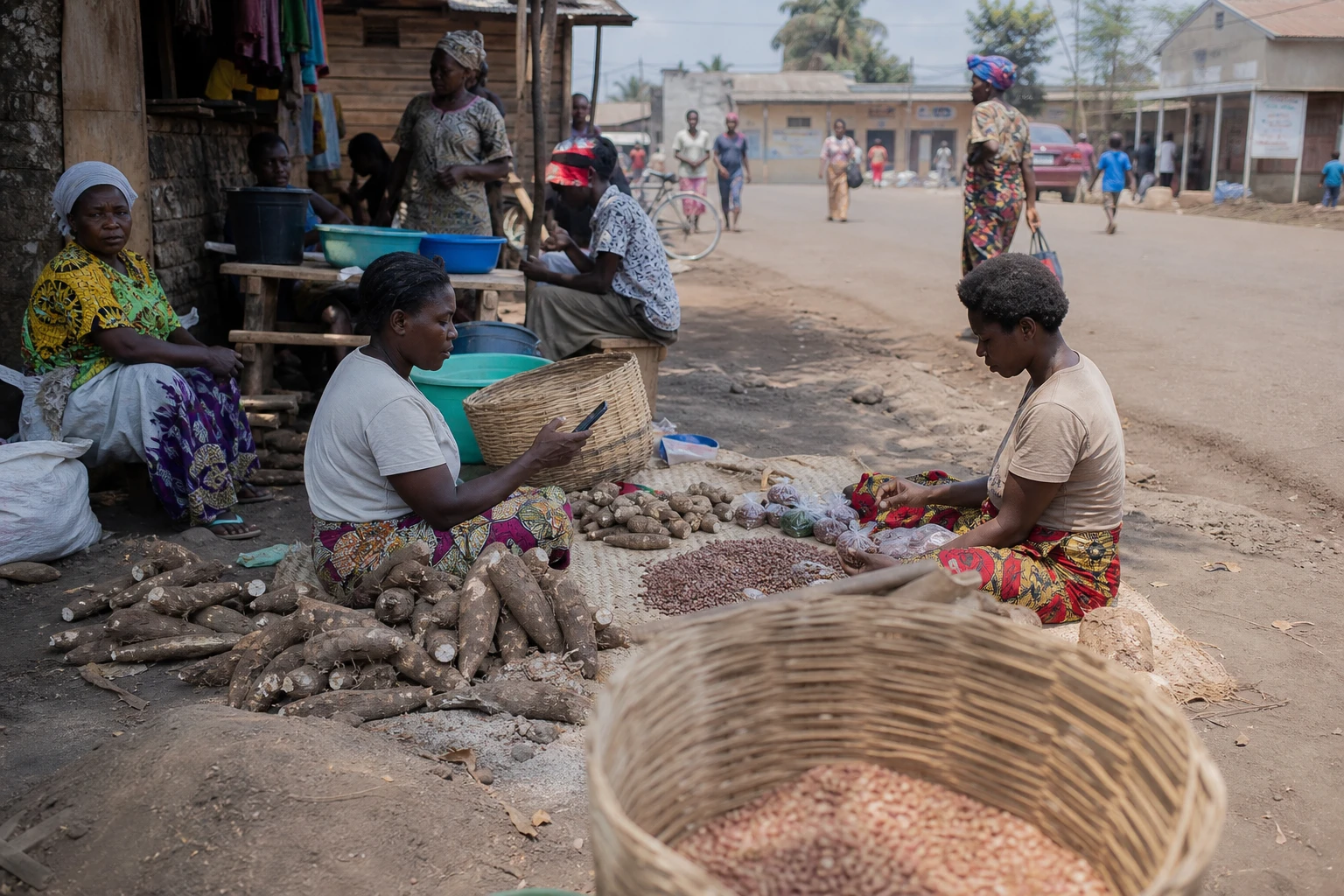
Returning, then trying to live again
In North Kivu, going home does not necessarily mean getting back to a normal life. In Kimoka and Saké, in Masisi territory, families who have returned after months of flight are first trying to bring a field back into cultivation, secure a meal and then rebuild an income. In this part of the east of the Democratic Republic of the Congo, the return of displaced people is already progress. But it remains fragile as long as security, access to land and movement along routes remain uncertain.
A territory still under pressure
Masisi lies in an area where fighting has disrupted displacement patterns, markets and harvests. In late February 2025, the United Nations was already describing a major humanitarian crisis in North Kivu, with millions of people displaced in the province and around Goma after the escalation of clashes. The Security Council, for its part, referred to mass population movements and an underfunded humanitarian response. This gives a sense of the challenge facing returns to Kimoka and Saké.
The presence of the M23 in some areas of North Kivu further complicates the recovery. In practice, the local economy depends mainly on small farms, informal cross-border trade and secondary roads. When insecurity cuts off a route, the whole chain breaks down: seeds, transport of harvests, access to healthcare and children’s schooling. In this context, regional organisations such as the Southern African Development Community, of which DR Congo is a member, are also monitoring the effects of a conflict that extends far beyond the local area.
What the UN mission observed in Kimoka
On Friday, a United Nations team travelled to Kimoka to assess living conditions for residents who had returned. The observers met women working in the fields and examined the crops. According to Damien Mama, the UN’s humanitarian activities co-ordinator in DR Congo, the women stressed one basic need above all: not to depend on a single activity. They also want access to livestock farming, so they can diversify their resources and better withstand shocks linked to the conflict.
The available figures show that returns are already taking place, but have yet to stabilise. As of 4 February 2025, about 30,384 people, or 5,064 households, had returned to Kimoka and Saké, according to a humanitarian alert cited by organisations working on the ground. In several villages in Masisi territory, more than 1,400 people were already receiving support for farming and socio-economic reintegration. These programmes primarily target women who have returned from displacement sites, often the first to restart household activity.
The case of Sifa Asifiwe illustrates this grassroots recovery. With funding from the FAO, she was able to resume farming after being displaced by the violence. In cases like hers, aid is not limited to emergency relief. It also serves as a bridge between assistance and self-reliance. This is central in eastern Congo: without start-up capital, seeds, small livestock and a minimum level of security, return often remains precarious.
Beyond the fields, the challenge of social reconstruction
The value of these programmes goes beyond agricultural production alone. When a household can harvest again, food supplies improve, debts fall and children eat more regularly. People cited by humanitarian organisations directly link the resumption of farming to better family nutrition. In a province marked by repeated displacement, this link between income, health and household stability is decisive. It shows that the response to the crisis cannot be security-focused alone. It must also be economic and social.
This approach is all the more important because DR Congo continues to face multiple crises. The United Nations’ 2025 humanitarian plan said that 11 million people needed life-saving assistance, including 7.8 million internally displaced people. The same document also highlighted severe funding constraints. In short, returns such as those to Kimoka are welcome, but they depend on a support system that remains too fragile to absorb another security shock.
Public health adds another layer of vulnerability. In September 2026, Congolese authorities reported an Ebola outbreak with 7,022 confirmed cases and 3,398 deaths, according to the latest figures reported by the WHO and Congolese media. Even if this outbreak is not affecting Masisi to the same extent as other provinces, it is a reminder of a constant reality in DR Congo: crises overlap, making every return harder to consolidate.
What Kimoka says about the moment in Congo and the region
Kimoka tells a story that goes beyond a simple return to the village. The case shows how, in eastern DR Congo, forced displacement can become cyclical: flight, survival in a displacement site, partial return, then exposure to a new risk. For the authorities in Kinshasa, humanitarian organisations and local communities, the real issue is therefore not just getting families back. It is keeping them at home. That requires security, but also water, roads, markets, health services and the means to produce.
Across the continent, this case highlights a well-known but often underestimated reality: in several African conflict zones, recovery depends on rural women. They are at once guardians of household income, agents of agricultural recovery and those most exposed to repeated displacement. If support in Kimoka and Saké is sustained, it could offer a useful example for other crisis zones in Central Africa and the Great Lakes region. The next test is simple: whether the returns seen in February 2025 lead to lasting resettlement, or whether recovery remains contingent on how the front line shifts.



