
 Algeria
 Egypt
 Libya
 Morocco
 Sudan
 Tunisia
 Benin
 Burkina Faso
 Cabo Verde
 Côte d'Ivoire
 Ghana
 Guinea
 Guinea-Bissau
 Liberia
 Mali
 Mauritania
 Niger
 Nigeria
 Senegal
 Sierra Leone
 The Gambia
 Togo
 Cameroon
 Central African Republic
 Chad
 Equatorial Guinea
 Gabon
 Republic of the Congo
 São Tomé and Príncipe
 Burundi
 Comoros
 Djibouti
 Eritrea
 Ethiopia
 Kenya
 Madagascar
 Malawi
 Mauritius
 Mozambique
 Rwanda
 Seychelles
 Somalia
 South Sudan
 Tanzania
 Uganda
 Angola
 Botswana
 Eswatini
 Lesotho
 Namibia
 South Africa
 Zambia
 Zimbabwe
A small but already strategic market
In Kinshasa, cooking with domestic gas remains the choice of only a minority of households. Yet despite this low level of uptake, the market is now attracting players able to finance terminals, depots and distribution networks. In the Democratic Republic of the Congo, the question is therefore no longer just one of supply. It also concerns roads, ports, technical rules and families’ purchasing power.
This shift is significant. In a city of more than ten million people, charcoal cooking remains widespread, with its health costs, recurring expenses and pressure on forest cover. DR Congo’s National Energy Compact sets a clear goal: to accelerate clean cooking from a still-low baseline and reach 30% access by 2030, or around 40 million people.
What BB Energy is planning in DR Congo
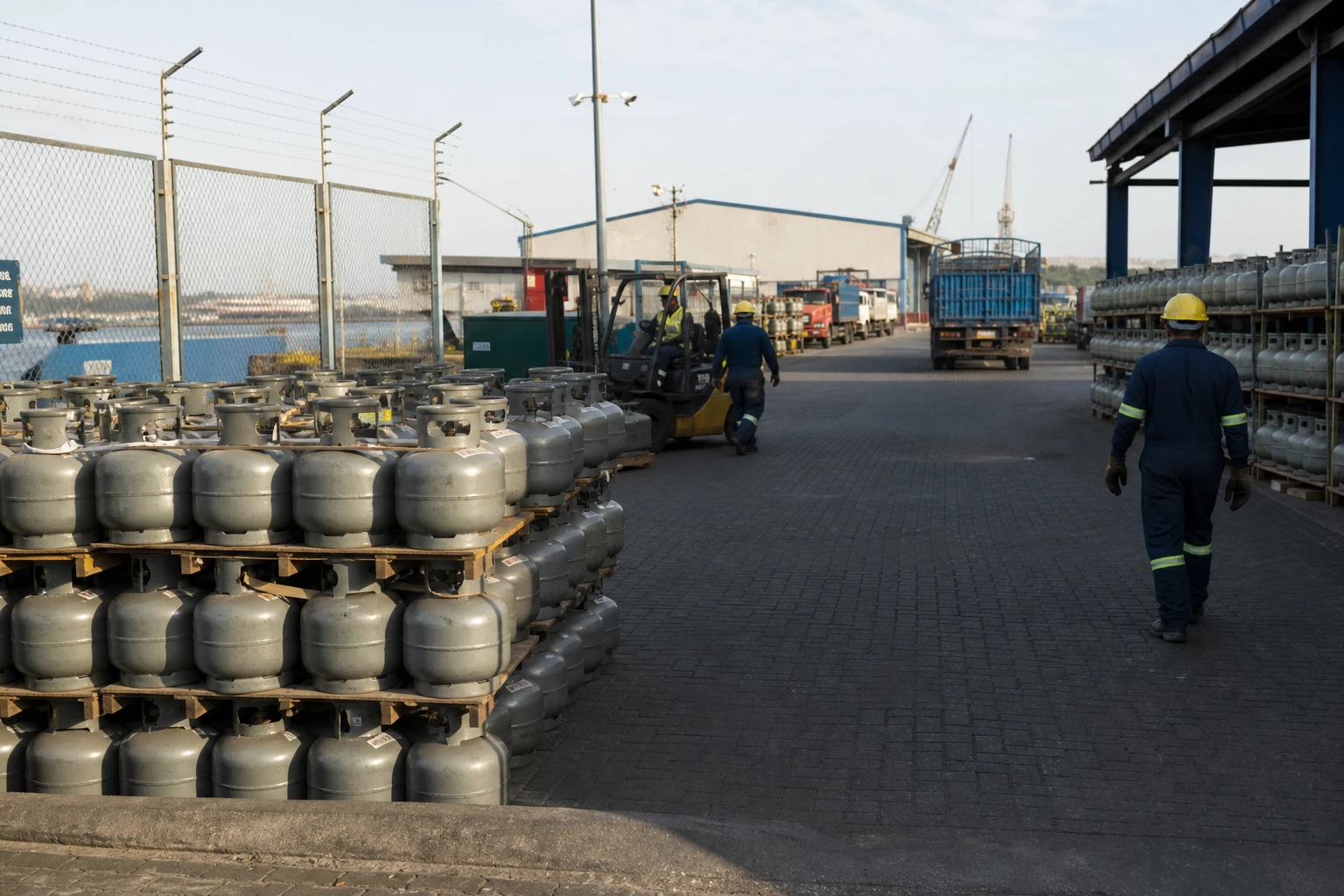
BB Energy is advancing a project centred on the logistics and packaging of liquefied petroleum gas, or LPG, the technical term for domestic gas. Public IFC documentation says the phase-one operation, involving up to $42 million from the IFC, is part of a broader $64 million programme that also covers South Africa and Zambia. The project is currently listed as pending approval.
In DR Congo, the planned set-up has two components. The first is a coastal terminal at Boma, in Kongo Central, for importing, storing and filling LPG on a leased site of about 2.5 hectares. The facility has a capacity of 1,800 tonnes. The second is a bottling and filling plant in Kinshasa, in the Kin-Malebo special economic zone, also covering about 2.5 hectares. The product is then to be transported by road between the two sites.
This structure says much about the Congolese market. The country is not starting with an already extensive industrial network. The value chain must therefore be built almost step by step: bringing in the product, storing it, packaging it, transporting it and then getting it to households. That is where the difference between commercial ambition and actual uptake will be decided.
Why demand exists but remains constrained
Data cited in the Energy Compact give a precise picture of the gap to be bridged. In Kinshasa, LPG penetration is estimated at 14% of households, or about 250,000 homes. The authorities want to raise that number to 1.2 million households by 2030. Other field sources confirm that the market remains shallow but is already active, with operators such as Dap Gaz and other distribution networks present in the capital.
The problem is not just the availability of cylinders. The upfront cost of a kit, the reliability of sales outlets, urban transport, safety standards and regulatory stability all weigh on uptake. Public policy has begun to clarify the framework. A ministerial order in 2025 set technical specifications for LPG placed on the market in DR Congo, signalling that the sector is entering a phase of stricter formalisation.
In this context, new investment can help reduce barriers, but it will not remove them. For households in Kinshasa, the practical challenge is being able to buy, refill and use gas without facing supply disruptions or additional logistics costs. For operators, the industrial challenge is to recoup heavy investment in a market that is still taking shape.
A signal for DR Congo and the region
The BB Energy project is part of a wider trend. In several African countries, clean-cooking supply chains are now attracting private investment because they combine urban demand, the energy transition and public health needs. In DR Congo, the rationale is even more pronounced: the state wants to reduce dependence on biomass, expand access to clean cooking and mobilise the private sector in a country where financing needs remain considerable.
The project’s significance therefore extends beyond Kinshasa. A terminal at Boma linked to the capital shows how energy infrastructure can shape an inland corridor from the coast to the country’s political and economic centre. It is also a test for the Kin-Malebo special economic zone, which is meant to host higher value-added activities rather than simply serving as a transit point.
At continental level, the Congolese case is a reminder of a reality that is often underestimated: Africa’s energy transition is not limited to solar power or hydropower. In major cities, it also depends on cleaner cooking solutions that are better stored and distributed. DR Congo has set its targets. It remains to be seen whether financing, approvals and implementation will keep pace.



