Algeria
 Egypt
 Libya
 Morocco
 Sudan
 Tunisia
 Benin
 Burkina Faso
 Cabo Verde
 Côte d'Ivoire
 Ghana
 Guinea
 Guinea-Bissau
 Liberia
 Mauritania
 Niger
 Nigeria
 Senegal
 Sierra Leone
 The Gambia
 Togo
 Cameroon
 Central African Republic
 Chad
 DR Congo
 Equatorial Guinea
 Gabon
 Republic of the Congo
 São Tomé and Príncipe
 Burundi
 Comoros
 Djibouti
 Eritrea
 Ethiopia
 Kenya
 Madagascar
 Malawi
 Mauritius
 Mozambique
 Rwanda
 Seychelles
 Somalia
 South Sudan
 Tanzania
 Uganda
 Angola
 Botswana
 Eswatini
 Lesotho
 Namibia
 South Africa
 Zambia
 Zimbabwe
When local ownership becomes a financing issue
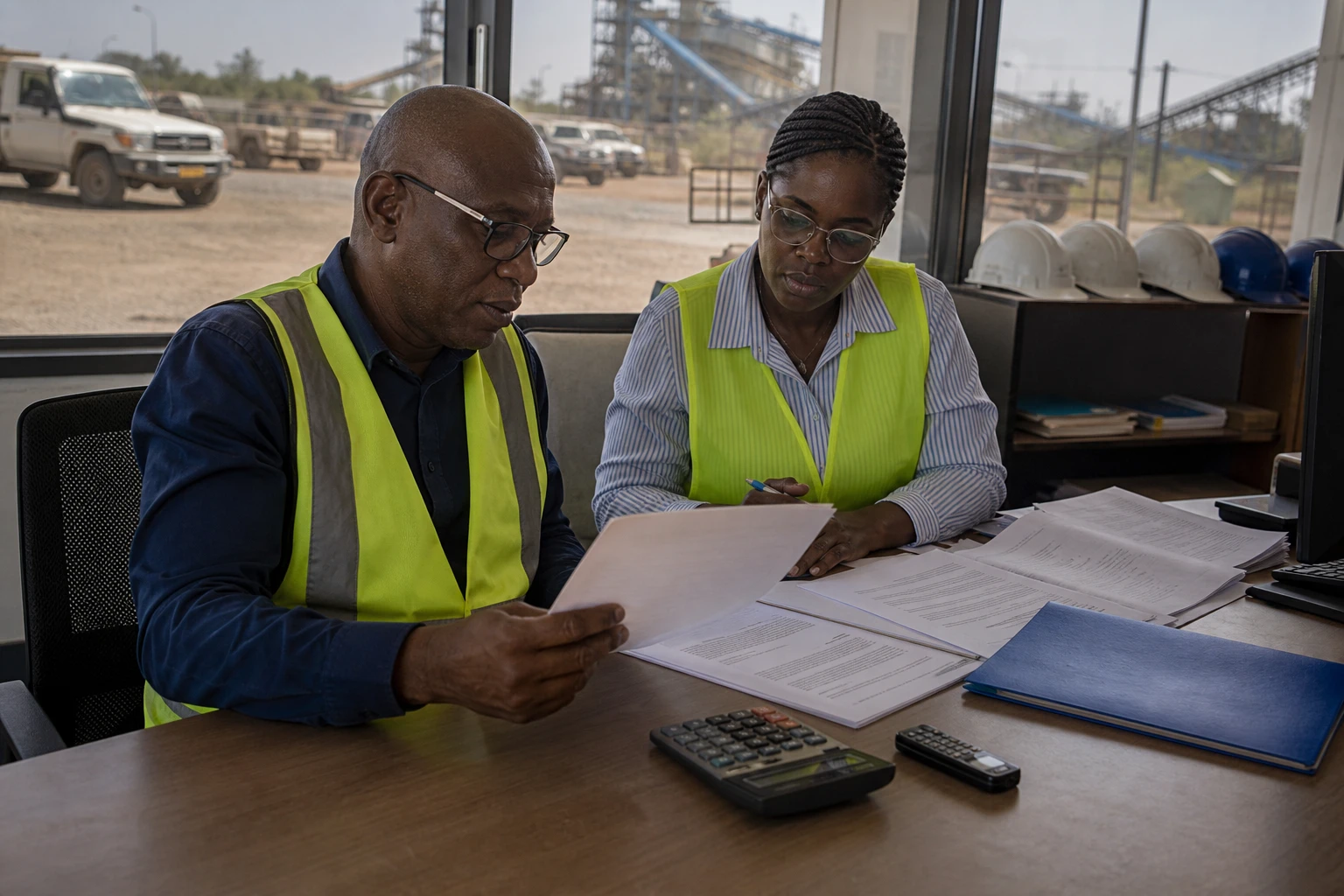
In several mineral-rich African countries, the debate is no longer limited to the share reserved for the state. It now also extends to nationals expected to take a stake in projects. On paper, the goal is clear: to ensure mines are not merely operated locally, without any real stake in the value they create. In practice, one simple question is still holding back many reforms: who pays, and how?
This question has become central in Mali, Burkina Faso, the Democratic Republic of the Congo and, to a lesser extent, Namibia. In each of these countries, legislation aims to broaden ownership in the mining sector. But reserving a share of the capital is not enough. Financing must also be arranged, along with the selection of beneficiaries, the governance of shareholdings and, often, the repayment of shares bought on credit.
Stricter rules, but mechanisms remain unclear
In Mali, the Mining Code adopted in 2023 provides for a 30% stake for the state and 5% for national investors in companies holding mining permits. The Council of Ministers on 28 August 2026 took a further step for the Kobada gold mine, in the Kangaba district of the Koulikoro region, setting out the terms of this participation in the capital of Mines de Kobada-S.A. The announced arrangement divides the stake into 10% free, non-dilutable shares for the state, 20% shares for the state to purchase, and 5% reserved for national investors. Management of this portion has been entrusted to the Société du Patrimoine minier du Mali.
The decisive question, however, remains unresolved: how will national investors finance their entry into the capital? The public statement did not give details of the subscription process or the profile of the shareholders concerned. This is not merely an administrative question. For projects worth hundreds of millions of dollars, a 5% stake can represent sums beyond the reach of savers or local operators without an appropriate financing vehicle.
Burkina Faso is following a similar approach, but with a different framework. The July 2024 law on the mining code and the local content law strengthened the state’s participation. The Ministry of Mines said the state now holds a free 15% stake in the capital of mining companies, with the state and national investors able to subscribe, for a fee, to at least a further 30%. Implementing texts were approved in 2025 to specify local employment, subcontracting and the resources of a local content support fund.
Here too, one link remains fragile: the transfer of shares to private national investors. The principle has been established, but the terms for payment, shareholding on behalf of investors or resale of shares are not always clearly set out in the publicly available documents. Burkina Faso has also shifted its mining sector towards greater state control, amid security tensions and a search for more stable domestic revenues.
In the Democratic Republic of the Congo, the debate goes further still. The mining code, amended in 2018, reserves at least 10% of the share capital of mining companies for Congolese individuals, including 5% for employees. The text has been in place for several years, but implementation remains uneven. A draft decree circulated in 2025 and cited in the specialist press proposed that employees take part through a cooperative, with shares transferred on credit and partly repaid from future dividends.
Local shareholding on credit: practical solution or deferred promise?
The model of interest-free financing appears to offer a pragmatic solution. It allows local stakeholders to take a stake without immediately providing the funds. This is used in some projects in Namibia. In the Etango uranium project, the agreement with One Economy Foundation provides for a 5% “loan-carried” stake, meaning it is initially financed by the company and then repaid from future dividends. Bannerman Energy’s annual reports have confirmed this arrangement since 2017.
The mechanism has an obvious advantage: it lowers the barrier to entry. Without it, the promise of local ownership would remain theoretical in economies where available capital is scarce and expensive. But it also has a limitation. For several years, dividends are used first to repay the acquisition debt. The local shareholder does become an owner, but does not immediately receive the full value of their stake. In practice, access to capital often comes long before access to profits.
The debate does not end there. It also concerns transparency. Who selects local investors? How can ultimate beneficiaries be verified? How can the shares reserved for nationals be prevented from being captured by a few well-connected intermediaries? And, above all, what real power do these shares confer? In most cases, a minority stake gives economic rights, but no veto. It creates potential value without, by itself, changing the balance of power in mining governance.
What these reforms mean for states, companies and communities
For governments, the benefits are twofold. First, they can capture more revenue from a strategic sector. Second, they can demonstrate a restoration of control over resources long seen as too far removed from the local economy. In Mali and Burkina Faso, this approach forms part of a more sovereignty-focused view of mining revenues. In these two Sahelian countries, minerals are no longer seen merely as exportable assets. They are becoming an instrument of national redistribution, at least in public discourse and in recent legislation.
For companies, the issue is more sensitive. Adding public and national shareholders changes projects’ financial structure and can lengthen discussions before industrial operations begin. It can also reduce room for manoeuvre in governance, even if minority stakes are often passive. Companies are more willing to accept these mechanisms when they are governed by clear, transparent and predictable rules. They are wary when they depend on late political decisions or incomplete implementing rules.
For communities, the impact ultimately depends on how the arrangement is designed. A poorly financed local stake can become an abstract promise. A well-organised one can, by contrast, generate income, skills and the beginnings of domestic capital formation in a sector dominated by large international groups. But this requires clear rules, institutions able to enforce them and selection mechanisms that do not equate being “national” with being “excluded from access”.
Across the continent, this trend deserves attention. It shows that several African states are no longer content to demand higher taxes. They are also seeking to bring local stakeholders into ownership itself. The next question will be decisive: will these reforms lead to a genuine expansion of African capital in mining, or merely shift the problem towards more complex financial arrangements? The next implementing decrees, the first concrete financing deals and transparency about the real shareholders will show whether this new phase truly changes the place of Africans in their own resources.