
 Egypt
 Libya
 Morocco
 Sudan
 Tunisia
 Benin
 Burkina Faso
 Cabo Verde
 Côte d'Ivoire
 Ghana
 Guinea
 Guinea-Bissau
 Liberia
 Mali
 Mauritania
 Niger
 Nigeria
 Senegal
 Sierra Leone
 The Gambia
 Togo
 Cameroon
 Central African Republic
 Chad
 DR Congo
 Equatorial Guinea
 Gabon
 Republic of the Congo
 São Tomé and Príncipe
 Burundi
 Comoros
 Djibouti
 Eritrea
 Ethiopia
 Kenya
 Madagascar
 Malawi
 Mauritius
 Mozambique
 Rwanda
 Seychelles
 Somalia
 South Sudan
 Tanzania
 Uganda
 Angola
 Botswana
 Eswatini
 Lesotho
 Namibia
 South Africa
 Zambia
 Zimbabwe
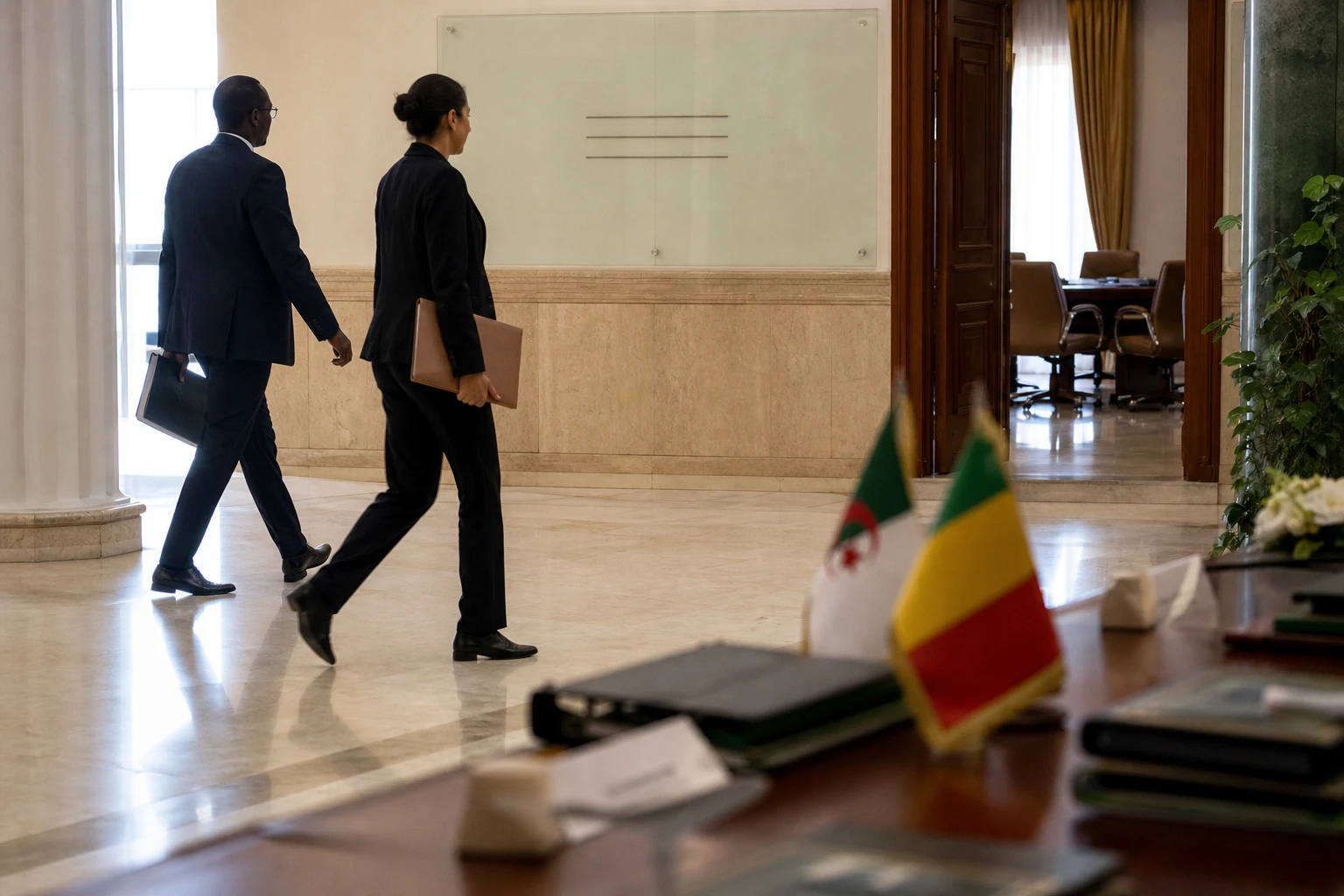
Between Algiers and Bamako, renewed diplomacy goes beyond a photo opportunity
In the Sahel, diplomatic gestures matter as much as statements. A flight route reopened, an ambassador recalled, an audience at the presidential palace: behind these signals lies a very practical question for Mali and Algeria — the movement of people, border security and Bamako’s place in an unstable Sahelian region.
The latest developments took shape at the beginning of the summer, after more than a year of tensions. On 10 July 2026, Algeria reopened its airspace to Malian aircraft. The same day, Bamako announced the return of its ambassador to Algiers and the reopening of its own airspace to flights linked to Algeria. On 24 August 2026, Mali’s Prime Minister Abdoulaye Maïga travelled to Algiers for a working visit, before being received by President Abdelmadjid Tebboune.
An old dispute reignited by the border and an information war
Mali and Algeria share a long Saharan border and have had intersecting interests for decades. The Algiers-Bamako axis long served as a channel for mediation, notably over the Agreement for Peace and Reconciliation resulting from the Algiers process, signed in 2015. However, Mali’s authorities repudiated the agreement in January 2024, after months of disagreements over its implementation.
The sharpest rupture came in the spring of 2025, after a Malian military drone was destroyed near Tinzaouaten, on the border. Algiers said it had shot down the aircraft after it violated Algerian airspace. Bamako disputed this account. The incident led to a rapid deterioration in relations and a series of diplomatic retaliatory measures. The crisis also affected air links, already critical in a region where connections are essential for government, businesses and travel between the capital and northern regions.
The tensions were not confined to a bilateral standoff. They also overlapped with the Sahel’s regional realignment. Mali, Burkina Faso and Niger left ECOWAS, the Economic Community of West African States, and have since 2024 built their Alliance of Sahel States, which became the AES Confederation. In this context, every move between Algiers and Bamako is watched beyond the bilateral framework.
What the 2026 visit signals
Abdoulaye Maïga’s visit to Algiers is part of a thaw that was already under way. On 9 August 2026, the Malian government announced that a telephone conversation between the two prime ministers had paved the way for the trip. On 24 August, Mali’s head of government met his Algerian counterpart, Sifi Ghrieb, and then Abdelmadjid Tebboune. After his audience, he stressed a shared desire to make the region a space for peace and prosperity, rejecting all forms of hegemony and terrorism.
This is more than diplomatic language. It points to highly practical priorities. For Bamako, closer ties with Algiers could reopen channels for security co-operation in northern Mali, where armed groups and the jihadist threat remain strong. For Algiers, easing tensions with Bamako helps preserve its role as a major border actor in the Sahel, without breaking off dialogue with Mali’s transitional authorities or the region’s other capitals.
The return of ambassadors and the reopening of airspace also have economic significance. The trans-Saharan corridor, which links Algeria to Mali as part of a road network designed to connect North Africa with West Africa, remains a strategic asset. It can facilitate the transport of goods, reduce some logistics costs and strengthen opportunities for Malian businesses to reach Algerian ports and, beyond them, the Mediterranean. For formal businesses, this means greater visibility. For informal networks, which play a major role in Saharan trade, it could also change routes, costs and checks.
Different impacts for different groups and regions
The thaw between Algiers and Bamako will not have the same effects everywhere. In Bamako, it could ease diplomatic pressure on the transitional authorities as they seek to show they retain room for manoeuvre in the north and abroad. In Algiers, it offers a chance to demonstrate active diplomacy in a region where Algeria has long claimed the role of a stabilising neighbour. On the ground, however, the impact will depend on whether the two capitals can turn political gestures into lasting mechanisms.
In Mali’s border regions, particularly Kidal and the routes towards Algeria, people are first looking for practical results: safer journeys, reliable supplies, freedom of movement and the resumption of some commercial exchanges. In major cities, the thaw is felt mainly in ministerial corridors and embassies. In the north, it will be measured by fuel availability, road conditions and whether security incidents decline.
The 24 August visit therefore opens a period of testing. It resolves neither the question of the Algiers agreement, nor border issues, nor incidents involving aircraft. But it restores direct dialogue between two capitals that had drifted apart during the 2025 escalation. In a Sahel where ECOWAS is still seeking new points of balance with AES countries, and the African Union is trying to maintain a political presence, Algiers and Bamako are sending a simple message: despite recent ruptures, geography often reasserts itself over strained rhetoric.



