Algeria
 Egypt
 Libya
 Morocco
 Sudan
 Tunisia
 Benin
 Burkina Faso
 Cabo Verde
 Côte d'Ivoire
 Ghana
 Guinea
 Guinea-Bissau
 Liberia
 Mali
 Mauritania
 Niger
 Nigeria
 Senegal
 Sierra Leone
 The Gambia
 Togo
 Cameroon
 Central African Republic
 Chad
 Equatorial Guinea
 Gabon
 Republic of the Congo
 São Tomé and Príncipe
 Burundi
 Comoros
 Djibouti
 Eritrea
 Ethiopia
 Kenya
 Madagascar
 Malawi
 Mauritius
 Mozambique
 Rwanda
 Seychelles
 Somalia
 South Sudan
 Tanzania
 Uganda
 Angola
 Botswana
 Eswatini
 Lesotho
 Namibia
 South Africa
 Zambia
 Zimbabwe
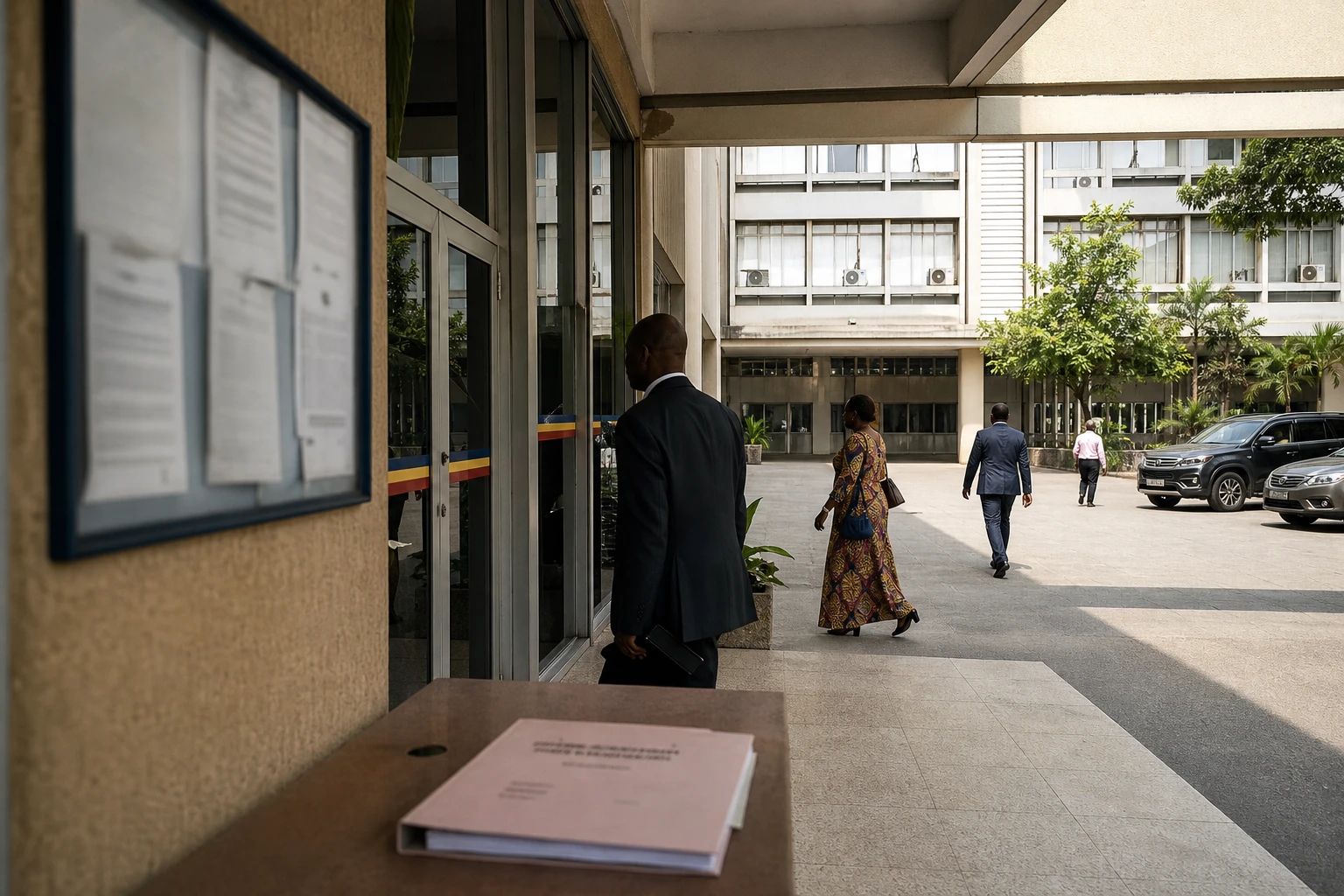
In Kinshasa, the battle is not merely legal. It touches on the political timetable, the war in the east and already fragile trust between the government and its opponents.
In the Democratic Republic of the Congo, every institutional debate quickly runs up against a broader question: who decides, within what framework, and in the interests of what kind of stability? Today, the controversy over constitutional reform is unfolding in a country where security remains poor in the east, where the presidency has announced a national dialogue, and where the opposition is trying to regain the initiative after its defeat in 2023.
The regional context matters as much as the domestic stand-off. The DRC remains involved in several peace or de-escalation frameworks linked to the Great Lakes region, with support from the United Nations, the African Union, Qatar, the United States and Switzerland, while discussions on the east of the country continue to be linked to the AFC/M23 issue. In that area, national institutions, the SADC and African verification mechanisms remain directly concerned by developments on the ground.
Reform at the heart of a twofold concern: the presidential term and the state of the country
Delly Sesanga, president of ENVOL and a leading figure in the C64 coalition, has called on President Félix Tshisekedi to abandon plans to amend the Constitution. In his view, a nation at war should not make the Constitution a priority. His camp sees the referendum-based reform as a major political risk because, in time, it could offer a way to secure a third term.
The government, for its part, is proceeding in stages. In late July 2026, the Constitutional Court ruled that the law setting out the arrangements for organising the referendum was admissible and consistent with the Constitution, while expressing reservations about several articles. In early August, the president referred the text back to the National Assembly for further deliberation, so that the requested corrections could be incorporated. The September 2026 session is therefore set to become a key moment in the process.
Opponents see something else at stake. In a country where the head of state has been in office since 2019 and his current term is due to end in late 2028, any change to the electoral framework is immediately seen as a test of institutional good faith. Debate over a possible third term is not new, but it is now taking a more concrete form, with parliamentary steps, constitutional review and a possible public vote.
Political developments: mobilisation postponed, dialogue announced, divisions remain
The C64 postponed its march, initially scheduled for mid-August, and then set 15 September 2026 as a new date for mobilisation if national dialogue has not been officially convened by then. The strategy shows an opposition that remains active but is also seeking to influence the timetable rather than confront head-on a numerically and institutionally dominant state apparatus.
The presidency, for its part, has announced an inclusive national dialogue following a meeting with representatives of religious denominations, including CENCO and ECC. Several actors have welcomed the signal, but it remains surrounded by a crucial grey area: the arrangements, participants, agenda and precise link with the constitutional question have not yet been clearly settled.
Delly Sesanga has described the move as insufficient. He is calling for the reform plan to be abandoned once and for all and refuses to confine the debate to a dispute between political parties. In his words, the real adversaries are poverty, insecurity and the lack of jobs for young Congolese. This framing matters: it shifts the debate beyond the institutional arena alone and towards everyday social concerns, where most people first judge the performance of the state.
The east weighs on everything: security, voting and legitimacy
The most sensitive issue lies in the east. In recent reports, the United Nations has confirmed that Goma and Bukavu came under AFC/M23 control in January and February 2025, amid heavy fighting and alleged Rwandan involvement denounced by several UN bodies. The Security Council has also condemned the M23 offensive and demanded its withdrawal from Goma, Bukavu and other occupied areas.
The war has very tangible effects on political life. If millions of voters in North Kivu and South Kivu remain deprived for a prolonged period of administrative services, normal movement and a stable electoral framework, the 2028 presidential election would raise a major problem of representation. In that case, the debate over the Constitution would not merely be a clash between Kinshasa’s elites: it would become a question of citizenship for entire provinces.
President Tshisekedi himself linked the holding of the next elections to resolving the conflict in the east in May 2026, arguing that an election under these conditions would be impossible without a return to stability. This position fuels opposition suspicions, but it also reflects a material reality: organising a national vote in a continent-sized country requires roads, polling stations, an administrative presence and a minimum level of security.
What this means for the DRC and the Great Lakes region
For the government, the challenge is twofold. It must retain the political initiative without appearing to be closing down debate in an authoritarian manner. It must also keep control of an agenda on which peace, institutional reform and electoral deadlines overlap. If Kinshasa moves too quickly on the constitutional question, it risks deepening mistrust. If it retreats too far, it may appear weakened in the face of an opposition still seeking cohesion.
For the opposition, the challenge is tougher. After the 2023 presidential election, it remains weakened and fragmented, even as it tries to speak with one voice on the Constitution and dialogue. Its task is not only to denounce, but to show that it can still mobilise beyond Kinshasa, in a country where political fatigue is widespread and urgent social needs often take precedence over procedural battles.
At regional level, the Congolese issue resonates across the Great Lakes region. The DRC’s stability weighs on relations with Rwanda, African mediation mechanisms, the SADC and negotiations that are still seeking to silence the guns in the east. That is why the next phase to watch will not be confined to parliament in Kinshasa. It will also play out in peace talks, in the implementation of ceasefire verification mechanisms and in the ability of Congolese actors to accept a genuinely inclusive framework for discussion.
In the Democratic Republic of the Congo, the constitutional debate never unfolds in isolation. It travels alongside war, the memory of past crises and the demand for a state capable of protecting its citizens, including in outlying areas. It is this equation, more than the text of the law alone, that will determine whether the process under way in Kinshasa leads to genuine calm or renewed tensions.