
 Egypt
 Libya
 Morocco
 Sudan
 Tunisia
 Benin
 Burkina Faso
 Cabo Verde
 Côte d'Ivoire
 Ghana
 Guinea
 Guinea-Bissau
 Liberia
 Mali
 Mauritania
 Niger
 Nigeria
 Senegal
 Sierra Leone
 The Gambia
 Togo
 Cameroon
 Central African Republic
 Chad
 DR Congo
 Equatorial Guinea
 Gabon
 Republic of the Congo
 São Tomé and Príncipe
 Burundi
 Comoros
 Djibouti
 Eritrea
 Ethiopia
 Kenya
 Madagascar
 Malawi
 Mauritius
 Mozambique
 Rwanda
 Seychelles
 Somalia
 South Sudan
 Tanzania
 Uganda
 Angola
 Botswana
 Eswatini
 Lesotho
 Namibia
 South Africa
 Zambia
 Zimbabwe
When the daily journey becomes a road risk
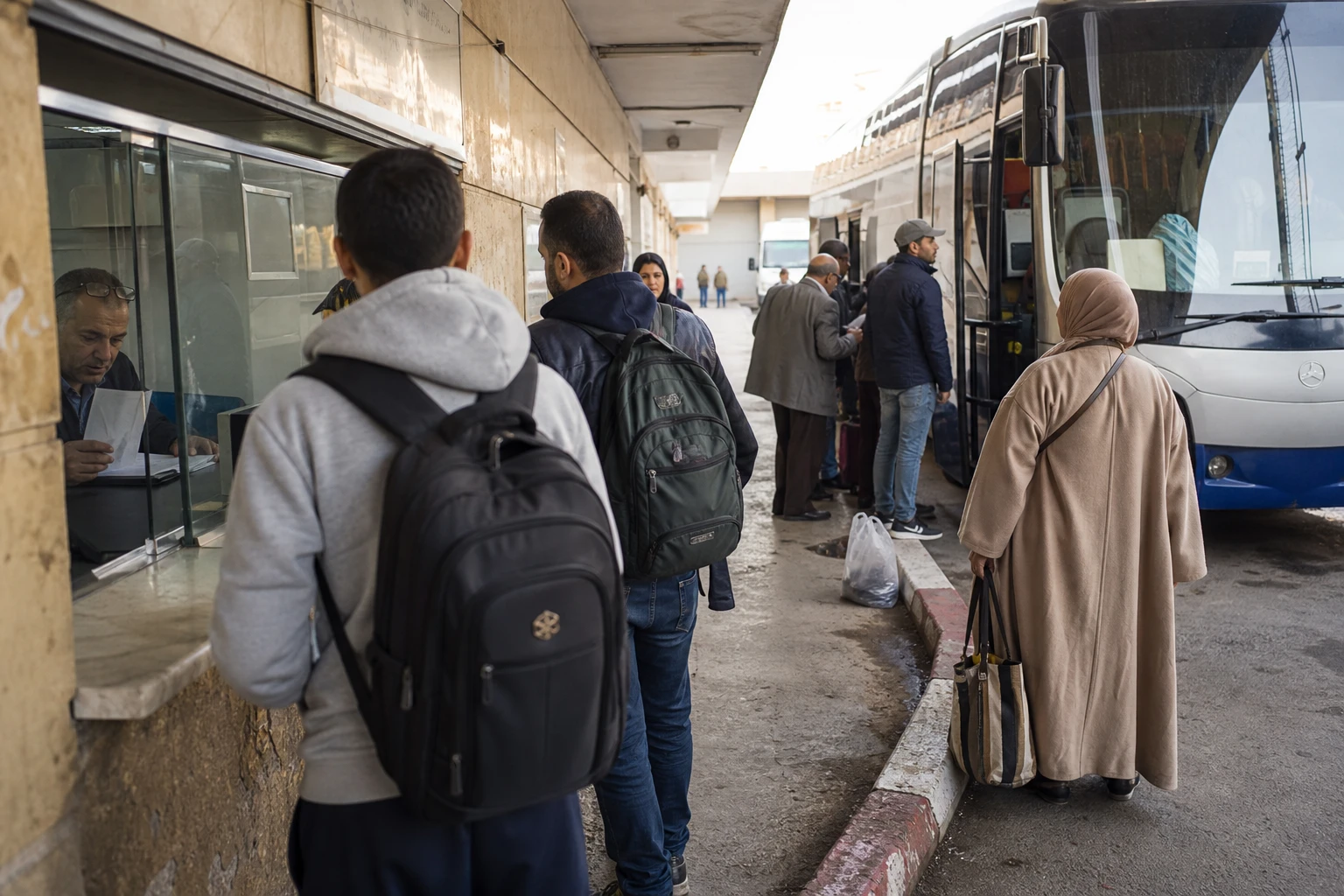
On Algeria’s roads, buses remain a vital link. They connect wilayas, carry workers, students and families, and often serve as a de facto public service. But within just a few days, this mode of transport has once again shown its vulnerability: a crash in Boumerdès, another in Timimoun, then a new tragedy near Constantine.
This cluster of crashes does more than reveal the scale of the emergency response required. It also raises questions about the chain of responsibility, from the condition of the vehicle fleet and technical inspections to driving conditions, overloading and road maintenance. In Algeria, road safety is no abstract issue: it directly affects everyday mobility and the safety of passengers.
Three tragedies in one week
The latest crash took place on Thursday 6 August on the RN79, near the municipality of Ben Ziad, between Constantine and Mila. A bus left the road and ended up at the bottom of a ravine. The provisional toll announced by Civil Protection was three dead and 13 injured. The response involved two fire engines and 10 ambulances.
A few days earlier, on Friday 31 July, another coach carrying passengers skidded at Brarhmoun El Kerma, in Boumerdès province. The initial estimate was 11 dead and 38 injured. The following day, Saturday 1 August, a bus collided with a lorry in Timimoun. Civil Protection put the toll at four dead and 43 injured.
In total, the three crashes have killed at least 18 people and injured 94, according to provisional figures released by Civil Protection. The figures for Boumerdès may still have changed, as the authorities continued to provide updates in the hours that followed.
The Boumerdès crash also brought serious facts to light. The investigation found that the vehicle was overloaded, with 64 people on board despite a legal capacity of 51, and travelling at more than 121 km/h in an area where the limit was 60 km/h, according to information reported by the authorities. The driver, who died in the crash, was reported to have tested positive for several narcotic substances.
Known failings that remain all too common
Taken together, these crashes point to recurring problems. First, overloading. Then, the monitoring of actual speeds on secondary roads and national highways. Finally, the physical and mental fitness of professional drivers, an issue that has become central to official statements as road tragedies have multiplied.
The government has already announced measures on road safety and the prevention of drug and psychotropic substance use. In October 2025, a cabinet meeting was devoted to both issues, a sign that they are being monitored at the highest level of the state. In November 2025, President Abdelmadjid Tebboune also ordered stricter requirements for owners of public and private transport vehicles.
At the same time, control measures are being strengthened on paper. On 18 July 2026, the Ministry of Public Works and Basic Infrastructure and the National Gendarmerie signed an agreement to deploy mobile weighing stations to combat heavy goods vehicle overloading. The measure primarily concerns lorries, but reflects the same approach: the state wants to address the technical causes of crashes, not just their consequences.
The issue of narcotics adds to this picture. In 2025, the National Security Directorate announced the seizure of more than 20 million psychotropic pills, while Customs reported seizing more than 16.5 million units that same year. These figures alone do not show that large numbers of drivers are driving under the influence. They do, however, illustrate the scale of a market that also fuels social and road risks.
What these crashes mean for Algeria and the region
For passengers, the immediate consequence is a loss of confidence in intercity transport. Yet in several wilayas, the bus remains the most accessible option, including for journeys where rail alternatives are limited or non-existent. When a crash occurs, it is first and foremost lower-income households, commuters and people living in remote areas who pay the price.
For the authorities, the challenge is also institutional. Civil Protection responds quickly, and its operational effectiveness is beyond question. But the focus must be upstream: vehicle inspections, operator discipline, monitoring of high-risk roads, effective penalties and judicial follow-up to crashes. Emergency response alone cannot reduce road deaths driven by recurring causes.
The issue extends beyond Algeria. Across North Africa, road safety remains a shared challenge, amid a growing vehicle fleet, heavily used roads and pressure on public transport. For Algiers, the challenge is also to show that public policy can be sustained over time, beyond announcements prompted by public outrage. This is what will be watched in the coming days: the investigation into the Ben Ziad crash, developments in the condition of the injured, and, above all, the practical implementation of the checks announced after the crashes in Boumerdès and Timimoun.



