Algeria
 Egypt
 Libya
 Morocco
 Sudan
 Tunisia
 Benin
 Burkina Faso
 Cabo Verde
 Ghana
 Guinea
 Guinea-Bissau
 Liberia
 Mali
 Mauritania
 Niger
 Nigeria
 Senegal
 Sierra Leone
 The Gambia
 Togo
 Cameroon
 Central African Republic
 Chad
 DR Congo
 Equatorial Guinea
 Gabon
 Republic of the Congo
 São Tomé and Príncipe
 Burundi
 Comoros
 Djibouti
 Eritrea
 Ethiopia
 Kenya
 Madagascar
 Malawi
 Mauritius
 Mozambique
 Rwanda
 Seychelles
 Somalia
 South Sudan
 Tanzania
 Uganda
 Angola
 Botswana
 Eswatini
 Lesotho
 Namibia
 South Africa
 Zambia
 Zimbabwe
An Ivorian memory returns to the spotlight
In Arles, an exhibition devoted to Paul Kodjo is bringing back into circulation images that tell the story of a Côte d’Ivoire in motion, confident, inventive and urban. This return matters for Abidjan and for African creativity as a whole: it reminds us that the continent’s archives are not relics, but tools for re-examining the present.
The choice is no accident. The Rencontres d’Arles, France’s major summer photography festival, has placed Africa at the heart of part of its programme this year, with a series devoted to independence and the images that shaped national imaginaries. Within this programme, Paul Kodjo holds a distinctive place: that of an Ivorian photographer who captured the gestures, clothing, celebrations and aspirations of a capital undergoing profound change.
Paul Kodjo, chronicler of an urban, popular Côte d’Ivoire
Paul Kodjo, born in 1939 and died in 2021, is often described as a founding figure of Ivorian photography. His work developed mainly in Abidjan in the 1970s, when the city was a hub of economic modernisation, the assertion of an urban culture and the emergence of a youth eager for new styles. His images show fashions, street scenes, living rooms, parties and stories staged for the popular press.
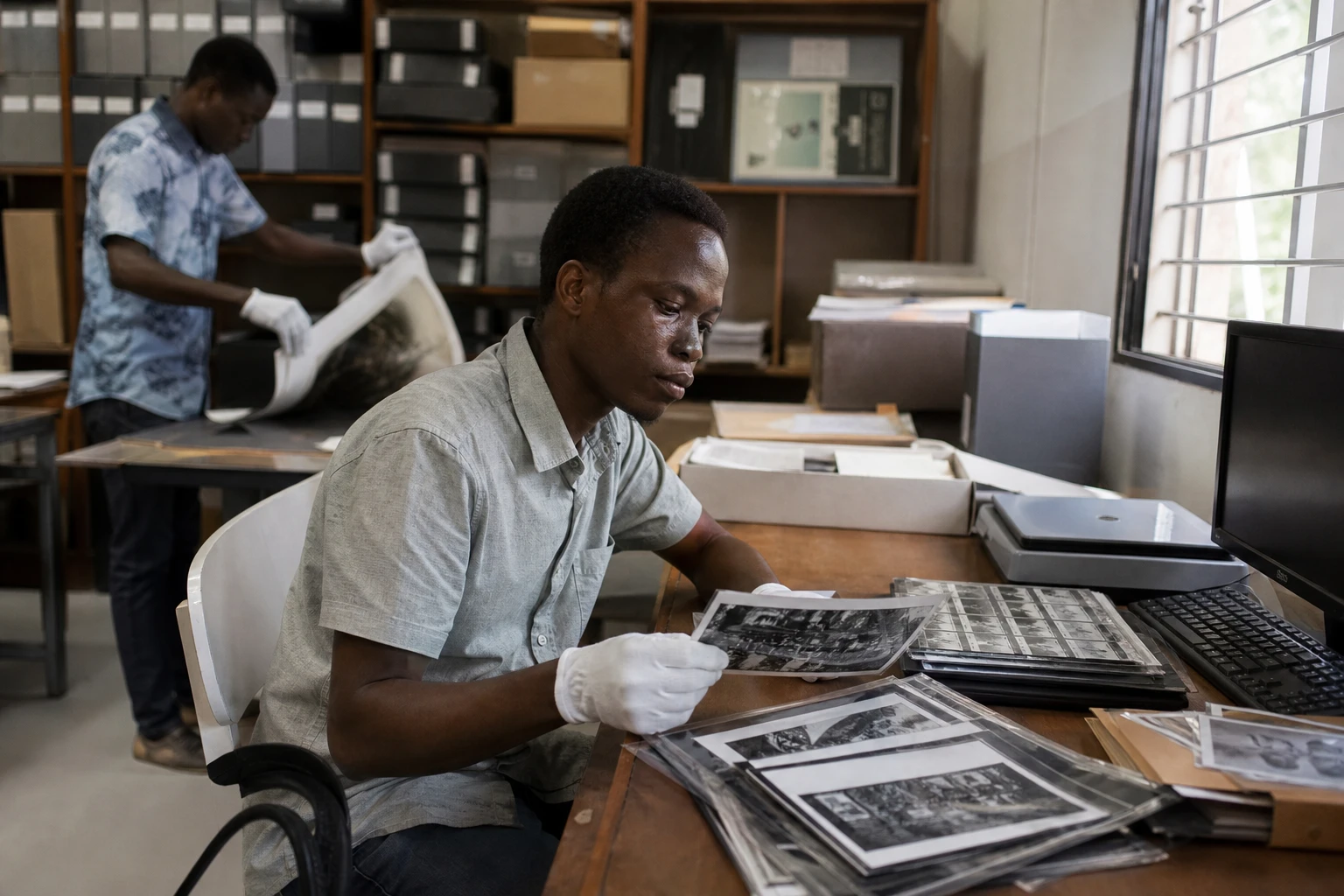
This Paris exhibition does more than display beautiful photographs. It brings back to the fore a chapter of Ivorian visual history that has for too long remained in private collections or been difficult to access. Several sources indicate that a significant portion of Paul Kodjo’s negatives was kept in fragile conditions before being better identified and made accessible. This point is essential: without archival work, a national memory can disappear as quickly as a poorly stored roll of film.
His work also speaks to a medium long considered minor: the photo-novel. In 1970s Côte d’Ivoire, this format brought together photography, storytelling and mass culture. It circulated in the press, reached a broad audience and created an African way of telling stories about love, the city, everyday life and social tensions. Paul Kodjo made the format his own, with a personal style close to cinema, precise framing and a sense of setting that gives his images real social significance.
What this exhibition says about Côte d’Ivoire today
For Côte d’Ivoire, the issue goes beyond recognition of its heritage. In Abidjan as in Yamoussoukro, cultural archives remain bound up with available resources, preservation and transmission. The country produces artists, film-makers, photographers and researchers, but the promotion of their work still too often depends on scattered initiatives, collectors’ networks or international partnerships. The Arles exhibition shows what becomes of an Ivorian body of work when it is finally given a solid interpretative framework.
The national context lends this visibility particular significance. Côte d’Ivoire remains a major cultural hub in West Africa, with an image market, an active art scene and an economic capital that continues to attract creatives, journalists and institutions. In this landscape, Paul Kodjo’s images serve as a long-term record. They remind us that Abidjan was not merely a commercial or administrative centre. It was also a laboratory for aesthetics, social life and African stories created by Africans.
There is a question of cultural sovereignty here. When African archives remain invisible in their own region, they risk being interpreted elsewhere before they are studied at home. The reverse approach is healthier: document, catalogue, exhibit and teach from the continent first, then engage with foreign institutions. In Paul Kodjo’s case, recognition from Arles can therefore be useful, provided it opens up greater access for Ivorian schools, museums, researchers and photographers.
West African resonance beyond Côte d’Ivoire
The significance extends beyond Côte d’Ivoire. In several West African countries, the years following independence produced images of modernity, social change and urban pride that remain little known. By bringing Paul Kodjo back into the spotlight, Arles reminds us that African photography is not limited to crisis reporting. It also documents elegance, leisure, aspirations and the making of a national imaginary. This is a fairer and more complete reading of the continent.
This latest development is also part of a broader circulation of African works between Abidjan, Dakar, Accra, Paris and Brussels. Artists from the continent are gaining international visibility, but the fundamental questions remain the same: who preserves the archives, who studies them, who displays them, and under what conditions? The exhibition devoted to Paul Kodjo, on view until 4 October as part of the Rencontres d’Arles, poses precisely this question. It celebrates not only a photographer who has died. It examines how a nation and a region write their own visual memory.