Algeria
 Egypt
 Libya
 Morocco
 Sudan
 Tunisia
 Benin
 Burkina Faso
 Cabo Verde
 Ghana
 Guinea
 Guinea-Bissau
 Liberia
 Mali
 Mauritania
 Niger
 Nigeria
 Senegal
 Sierra Leone
 The Gambia
 Togo
 Cameroon
 Central African Republic
 Chad
 DR Congo
 Equatorial Guinea
 Gabon
 Republic of the Congo
 São Tomé and Príncipe
 Burundi
 Comoros
 Djibouti
 Eritrea
 Ethiopia
 Kenya
 Madagascar
 Malawi
 Mauritius
 Mozambique
 Rwanda
 Seychelles
 Somalia
 South Sudan
 Tanzania
 Uganda
 Angola
 Botswana
 Eswatini
 Lesotho
 Namibia
 South Africa
 Zambia
 Zimbabwe
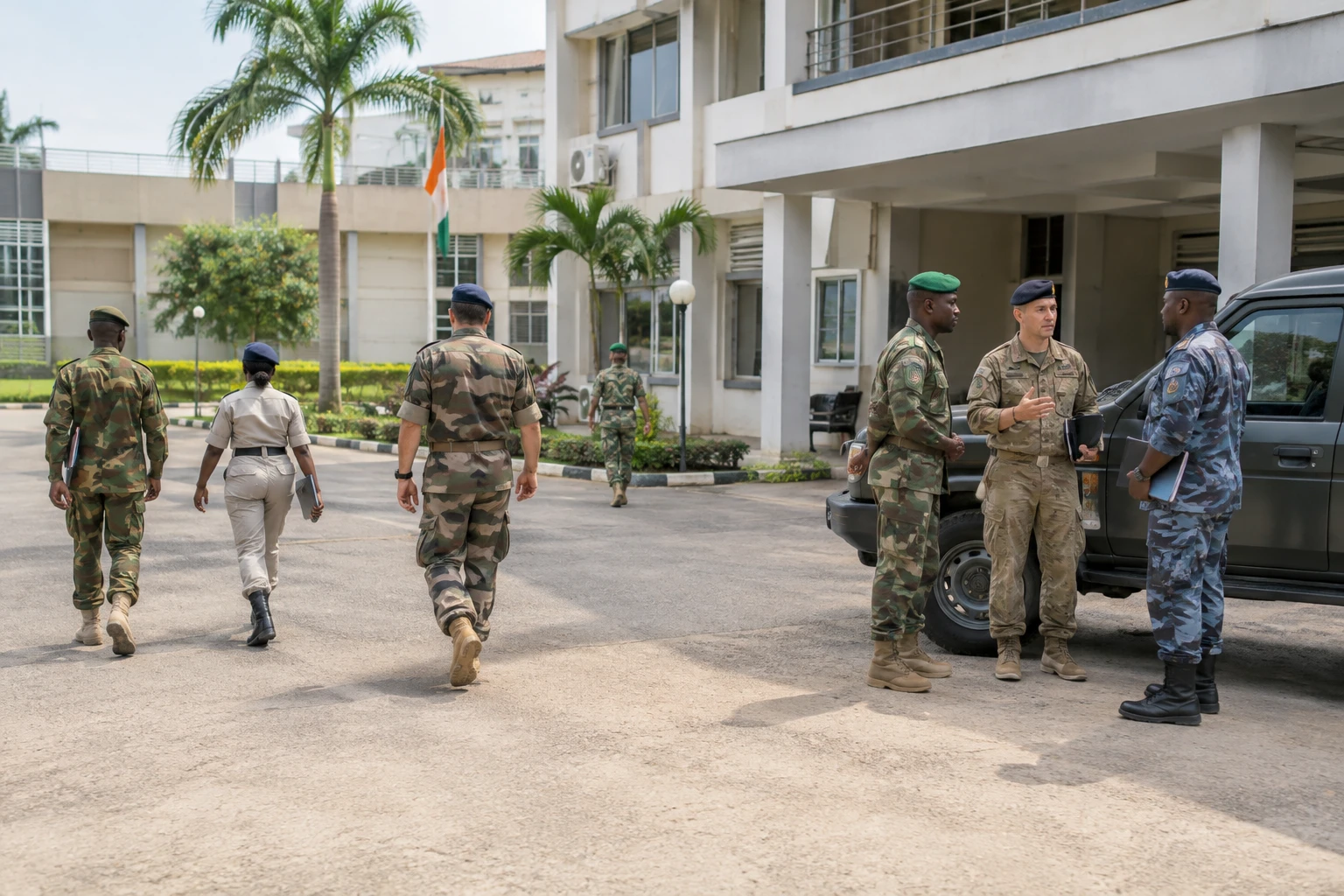
This week, residents of Jacqueville, Yamoussoukro and Bouaké may hear more engines, see aircraft movements and witness military activity. Behind these manoeuvres, three armies are testing their ability to operate together, as West African countries seek to strengthen their own responses to security risks.
A two-phase exercise between Côte d’Ivoire and Gabon
The Grand Multinational Joint Exercise, or GEX 26, brings together the forces of Côte d’Ivoire, Gabon and France. Its Ivorian phase, named FANGHA, takes place from 7 to 14 November 2026 in three locations: Jacqueville, Yamoussoukro and Bouaké. A second phase is scheduled in Gabon from 24 to 29 November. The Ivorian news agency AIP reported as early as March that the three countries were preparing these manoeuvres for November.
The schedule warrants clarification: the field exercise began on Saturday 7 November, not 30 October. On 10 November, the African Press Agency (APA) reported its official launch in Abidjan. It said the Ivorian phase was due to end on 14 November, before the Gabonese component, named WAIYA. These dates are consistent with the Ivorian military’s announcement, carried by several local media outlets.
Participation figures published by APA give a total of 2,131 military personnel: 1,181 Ivorians, 850 French and 100 Gabonese. They differ from the lower initial estimates cited in some presentations of the exercise. The figures are attributed to the agency; the official statements reviewed confirm the participating countries and dates, but do not all publish the same level of detail on troop numbers.
Announced activities include the movement of troops, vehicles, ships and aircraft. The Ivorian military warned that some operations could cause noise around the sites involved, while saying residents could continue their usual activities. The manoeuvres are also intended to test coordination procedures and operations in difficult environments.
Local needs in a regional security landscape
Côte d’Ivoire is a member of ECOWAS, the Economic Community of West African States, which brings together countries facing cross-border security challenges. In the north of the country, its proximity to Burkina Faso and Mali makes information-sharing, force mobility and unit preparedness particularly important. This does not mean the exercise is aimed at a named adversary: the authorities present it as coordination training.
The choice of several sites brings different conditions into play. Jacqueville provides a coastal setting, while Yamoussoukro, Côte d’Ivoire’s political capital, and Bouaké allow exercises in the country’s centre. Training across these locations can test communications and movement between units. For local residents, the most immediate effects may be the unusual presence of vehicles or aircraft and the associated noise.
Gabon brings its own experience and priorities to this cooperation. The programme is therefore not limited to a bilateral relationship between Abidjan and Paris: it brings together two African armies, which can compare procedures and share methods. The FANGHA exercise is part of a broader framework, with the Gabonese component set to extend the manoeuvres later this month.
Cooperation with Paris faces a multi-partner test
For France, GEX 26 illustrates military cooperation presented as temporary and organised at the request of its partners. This approach comes as defence relations between Paris and several African states evolve, amid growing opposition to older forms of permanent military presence. France’s rhetoric about a renewed partnership is not, by itself, enough to establish the real balance of the cooperation: that also depends on how objectives, command and the transfer of expertise are defined.
For the Ivorian and Gabonese armies, the practical challenge is to verify their ability to plan and conduct joint operations. For the authorities, such exercises make defence cooperation visible and can strengthen institutional ties. For people in the training areas, the immediate consequences are more practical: the movement of equipment, noise and safety instructions. Available statements do not detail any economic impact or general restrictions on civilian activities.
France’s presence also comes in an environment where African states are diversifying their security partners. Several governments across the continent have asserted this diversification as a political choice; it can broaden access to training and equipment, while raising questions about coordination between partners. GEX 26 alone cannot measure the operational autonomy gained by the participating forces.
What the regional phase will assess
The significance of GEX will depend less on its format alone than on what remains after the manoeuvres: common procedures, lasting exchanges between military headquarters and the ability to adapt training to the needs identified by participating countries. The second phase in Gabon, announced for 24 to 29 November, will be the next observable step. Detailed operational results have not yet been made public.
Across West Africa, the exercise is a reminder that security is not determined solely at borders. It also depends on cooperation between armed forces, coordination with civilian institutions and the trust of the communities concerned. For Côte d’Ivoire, an ECOWAS member, the focus will therefore be as much on regional cooperation as on the ability of the armed forces to turn a multinational exercise into useful skills, without conflating external partnership with an African response to national priorities.
The dates and locations of the Ivorian phase were announced by the Ivorian News Agency, then specified by the African Press Agency. Gabon’s military headquarters has also published information on preparations for the regional component of GEX 26.